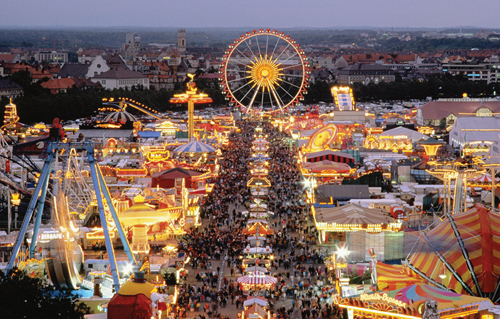
With more than six million visitors, over five
million litres of beer, 200,000 pairs of pork sausages, and 100
spit-roasted oxen – Munich’s Oktoberfest is the largest folk fair in the
world. At the foot of the Bavaria statue, a huge field, the
Theresienwiese (Wiesn for short), is transformed into a fairground with
beer tents operated by traditional breweries, rides, and a variety of
vendors selling gingerbread hearts, roast chicken, and fresh pretzels.
For 16 days, visitors and locals, some in traditional costume, indulge
in Bavarian revelry.
Theresienwiese U3/U6 Goetheplatz, U1Theresienwiese 16
days mid-Sep–early Oct Hours: 10am–11:30pm Mon–Fri, 9am–11:30pm Sat,
Sun & hols (some beer tents even longer). Last orders are at 10:30pm
daily. free For large groups, reserve tables well in advance of the fair’s start
www.oktoberfest.de
|
The marriage of Crown
Prince Ludwig and Therese von Sachsen-Hildburghausen on 12 October 1810
was celebrated with a five-day festival on Theresienwiese, named in
honour of the bride. A horse race capping the festivities was slated to
be repeated the following October. It became an annual event, quickly
growing into a major fair with rides and beer stalls. The first “beer
palaces” appeared in 1896. Today, the fair attracts millions of tourists
and is famous worldwide. |

For those who prefer alcohol-free beverages, the Wiesn features coffee kiosks. |
|
Discounts are available on certain dates for some attractions. |
|
In addition to beer, wine is available at tents such as the Weinwirt or Käfer’s wine bar. |
|
Top 10 Features
Grand Entry
Since
1925, the Wiesn opening is signalled by the Saturday morning Grand
Entry of the Oktoberfest landlords. Draught horses decked in festive
harnesses pull flower-decorated brewery wagons through the city. They
are accompanied by brass bands and brewery owners, families, and workers
in traditional costume.
O’zapft is!
The
Grand Entry is followed by the opening ceremony in the oldest Wiesn
beer tent, Schottenhamel. At noon, Munich’s mayor taps the first beer
barrel and says “O’zapft is!” – the barrel is tapped.
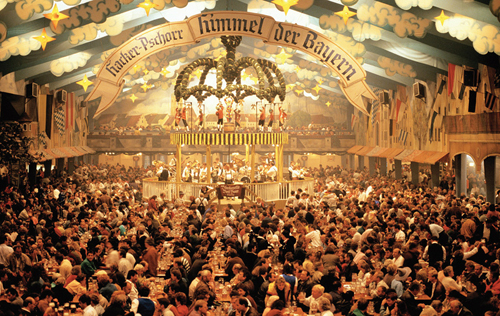
Beer Tents
Beer
is king in the large tents, where patrons link arms and sway to the
music of brass bands, and challenge each other to drink yet another Maß
or litre. The motto is: “Everyone has a right to his or her own beer
heaven.” For a less beery ambience, visit one of the smaller tents, such
as Fischer Vroni

Oxen Roast
Entire
oxen are roasted on a spit right before your eyes. A portion of roast
oxen or a pork hock with crackling are just two of the traditional and
hearty Bavarian treats served up at the Oktoberfest. Some 100 oxen are
slaughtered for the Wiesn every year.
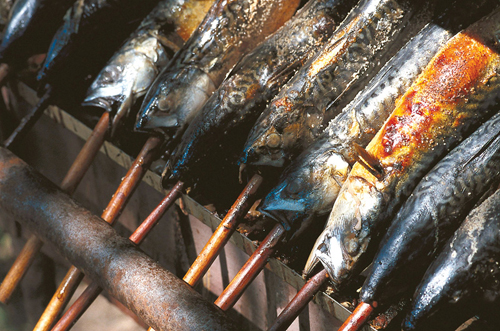
Steckerlfisch
The
air is not only filled with the smell of beer but also with the
tantalizing aroma of grilled fish – Steckerlfisch (fish on a stick) –
prepared on a charcoal grill.

Beim Schichtl
Welcome
one and all to this cabaret – a Wiesn fixture since 1871. Today you can
still watch acts such as the “beheading” of a living person on the
guillotine.
Flea Circus
Another
old-time tradition: the tiny trained creatures and their lord and
master have entertained spectators for over half a century. The flea
circus is an absolute must for all fans of yesteryear.
Rides
With
traditional amusement rides such as the merry-go-round, clay-pigeon
shooting, and the sedate Crinoline, or the latest thrilling attractions
such as Euro-Star, Freefall, and several roller-coasters – there’s
something for everyone, from children to adrenaline addicts. The slowly
rotating giant Ferris wheel offers a spectacular view of the scenery.
Memorial
On
26 September 1980 at about 10:30pm, a bomb exploded near a Wiesn exit.
Thirteen people were killed and more than 200 were injured. A stele
stands as a reminder of the attack carried out by a neo-Nazi.
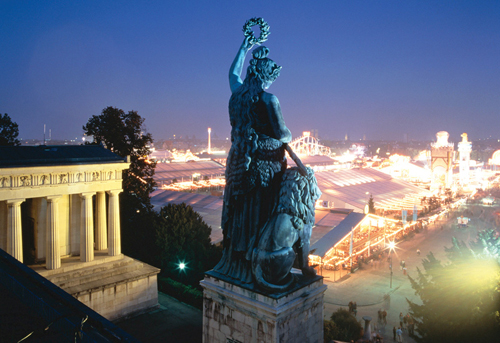
Statue of Bavaria
In
1843, Ludwig I commissioned Leo von Klenze to build the Ruhmeshalle
(Hall of Fame) on the Theresienhöhe; today, it houses the busts of
famous Bavarians. The colossal statue of Bavaria by Ludwig Schwanthaler
(cast in ore by Ferdinand von Miller) rises in front of the hall. A
platform inside the statue’s head offers a spectacular view of the Wiesn
.