Milestones in Immigration History
1624
First
Dutch arrived in New Amsterdam, which thrived as a trading center,
attracting settlers from many other nations. By 1643, the 500-strong
population spoke 18 different languages.

Arrivals to the island
1664
The
dislike of Dutch governor Peter Stuyvesant and unpopular tax demands by
the Dutch West India Company meant little resistance to the ousting of
the Dutch by the British, who renamed the city New York.
1790
For
the first U.S. Census, New York’s population of 33,131 was the second
largest in the Colonies. The make-up was mostly British and Dutch.
Mid-1800s
Ireland’s
1845–8 Great Famine and economic hardship in Germany led many to seek
new lives in New York, where rapid growth as a seaport and manufacturing
center opened many jobs.
1880–1910
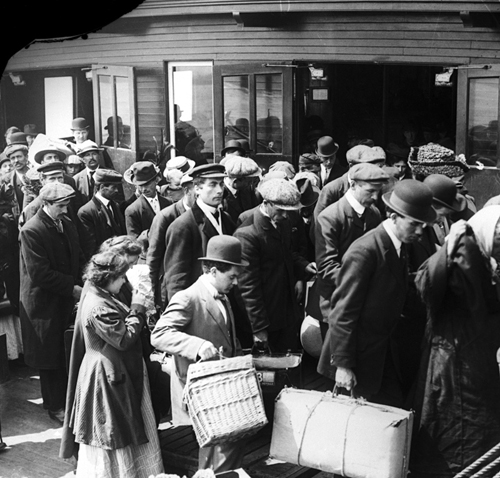
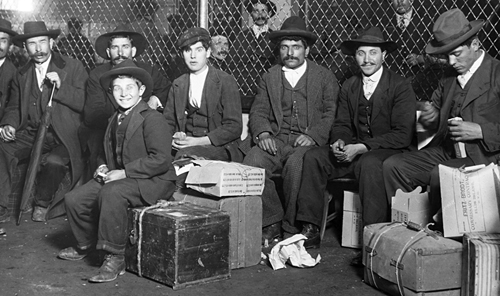
Thousands of Russian and Polish Jews and Italians arrived, fleeing persecution or hard economic times.

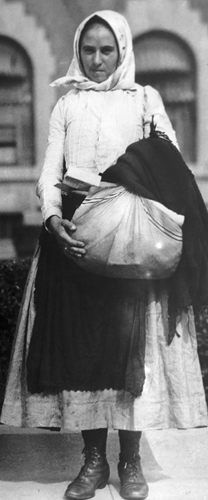
Polish woman at Ellis Island c.1910

Italian immigrants
1892
When
Castle Island, an immigrant depot set up in 1855, could no longer
handle the inflow, Ellis Island took over. “Settlement Houses” were set
up in the city to help those living in squalid tenements, and
“Americanization” programs encouraged assimilation.
1924
Nearly
40 percent of New York’s population was foreign-born. U.S. laws set
national quotas on immigration; Great Britain’s Caribbean colonies
benefited from the British quota and arrived in large numbers.
1965
The Hart-Cellar Act ended discrimination based on national origin; a new wave of immigration began.
1980s
One
million mainly Asian and Latin American newcomers arrived. The Chinese
population topped 300,000, Koreans became visible elements in the city,
and Dominican numbers grew.

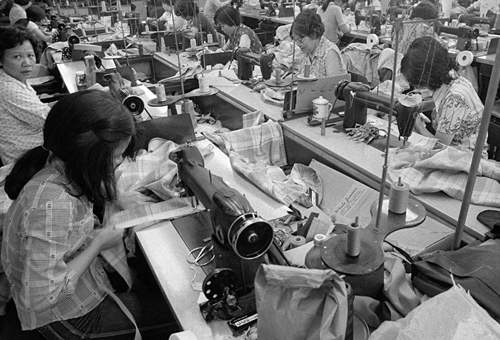
Asian women in a garment factory in Chinatown
1990–present
Over
1.2 million newcomers entered, swelling the foreign-born population to
over 40 percent of the total population – the highest since 1910. Queens
is classified as the most ethnically diverse county in the U.S.
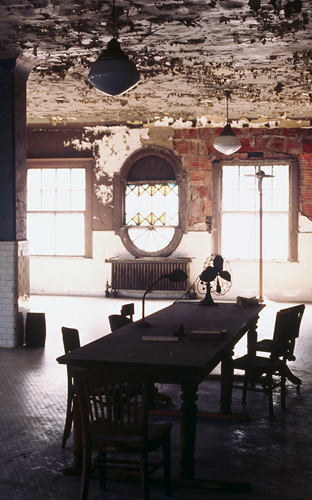
The Restoration of Ellis Island
Laws defining
immigration quotas enacted in 1924 drastically curtailed the numbers of
foreigners coming into the U.S., and Ellis Island was no longer needed
as an immigration depot. It became a detention and deportation center
for undesirable aliens, a training center for the U.S. Coast Guard, and a
hospital for wounded servicemen during World War II. In 1954 the U.S.
government closed the island. It remained abandoned until 1984, when a
$156 million renewal project replaced the copper roof domes, cleaned the
mosaic tiles, and restored the interior, preserving any surviving
original fixtures in the largest historic restoration in U.S. history.
The restoration included the establishment of the Ellis Island Immigration Museum,
telling the immigrant story through displays and more than 2,000
artifacts. The museum also has an oral history archive of taped
interviews and an interactive children’s gallery, both available to
visit by appointment. Reopened to the public in 1990, Ellis Island
receives almost 2 million visitors every year.
Restoration
Preservation of Ellis Island began in 1965 with the rebuilding of
the seawall, but the biggest task was the restoration of the main
building, which had deteriorated severely. The period of 1918–24 was
chosen for reconstruction because this coincided with a peak time for
immigration.


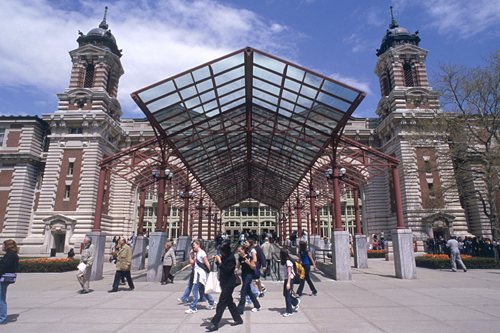
Glass canopy marking the restored main entrance to Ellis Island
Top 10 Nationalities Entering Ellis Island
Austria and Hungary: 2,275,852
Ottoman Empire: 212, 825 (Between 1892–7, 1901–31)