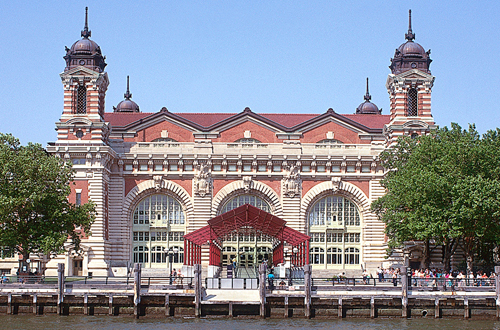
Ellis Island is the symbol of America’s immigrant
heritage. From 1892 to 1954, it was the arrival point for over 12
million people fleeing religious persecution, poverty, or unrest in
their homelands. Their descendants, more than 100 million people,
comprise almost 40 percent of today’s population. First and second class
passengers were processed for immigration on board ship, but the poor
traveling in steerage class were ferried to the crowded island for
medical and legal examinations. It was a frightening prospect after an
exhausting journey to a land where few newcomers could speak the
language. As many as 5,000 passed through in a day. The museum not only
retraces their experience here, but is a picture of the total immigrant
experience in America.
For a map of Ellis Island see Lower Manhattan to Midtown 212 363 3200
www.nps.gov/elis
Ferries from Battery Park: 866 STATUE4 Ferry rides to Statue of Liberty and Ellis Island: adults $12, seniors $10, children (4–12) $5, children under 4 free Open Jun–Aug: 9am–6pm daily; Sep–May: 9am–5:15pm daily Free
|
Although federal
property, a long-fought battle over territorial jurisdiction of Ellis
Island was settled in 1998. Originally a 3-acre site, Ellis Island’s
landmass was increased in the 1900s with landfill to more than nine
times its original size, to over 27 acres. A US Supreme Court ruling in
1998 decided the added landfill to be in the territory of New Jersey,
and the original portion to be in New York. New Jersey officials
launched a restoration program that included saving the derelict
hospital buildings. |


The island’s cafeteria and picnic areas are great for lunch or snacks. |
|
Catch an early ferry from Battery Park to avoid crowds on the island. |
|
Stop at the museum information desk for tickets to the free 30-minute film “Island of Hope, Island of Tears.” |
|
Top 10 Features
Arrival Area
Crowds
of steerage passengers entered through the original gateway here after
being ferried from arrival vessels. Instructions were given by
interpreters in a babel of languages.
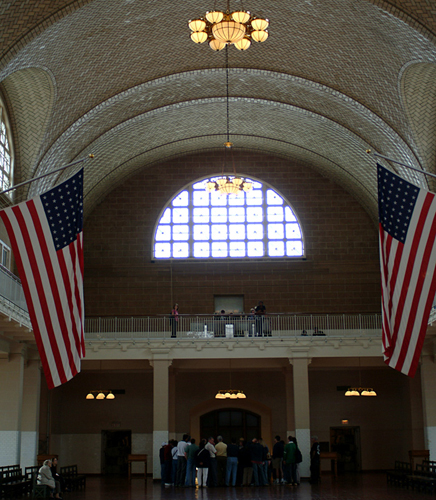
Great Hall
Huddled
on benches, immigrants awaited examinations that would determine
whether they would be granted entry. A doctor watched as they ascended
the stairs and marked letters in chalk on those who showed signs of
conditions needing special inspection.

The vast interior of the Great Hall
Medical Examining Line
Interpreters
guided immigrants through their medical examinations. The most dreaded
were the “eye men,” looking for symptoms of trachoma, a disease that
caused blindness. It was the reason for more than half the medical
detentions and meant sure deportation.
Dormitory
Immigrants
who were detained for further examinations slept here in separate
quarters for men and women. Although the process was nerve-wracking,
only two percent of those seeking refuge were sent back.
Railroad Ticket Office
Those
traveling beyond New York were ferried to railroad terminals in New
Jersey to continue their journeys. Agents could sell as many as 25
tickets per minute.
Baggage Room
Here
newcomers checked the boxes, trunks, and baskets that held the meager
belongings they carried, now all their worldly possessions.
The Peopling of America
400 years of immigration history are displayed in more than 30 galleries. Exhibits such as The Peopling of America have artifacts, heirlooms, posters, maps, and photos donated by immigrants’ families.
American Family Immigration History Center
Using
computer and multimedia technology, visitors can access passenger
arrival records of more than 22 million people entering New York between
1892 and 1924.
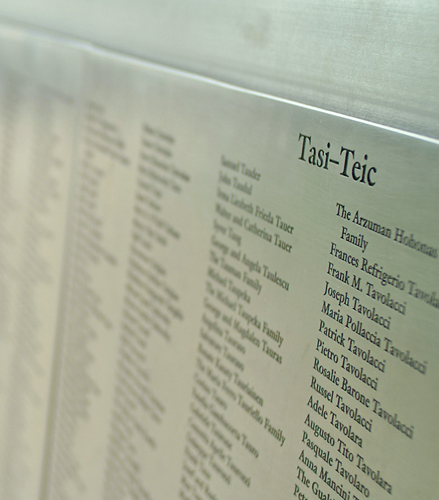
American Immigration Wall of Honor
To
honor their forebears, Americans pay to have their names inscribed on
this list. Including the families of John F. Kennedy and Barbra
Streisand, this is the world’s largest wall of names; over 600,000.

Immigrants’ Living Theater
Daily
theatrical productions that are based on actual immigrant accounts are
given by actors who recreate the experiences of Ellis Island. The museum
has two movie theaters, a Library and an Oral History Studio with taped
reminiscences.