The heart of the country, both geographically and
spiritually, the Cathedral of Notre-Dame (Our Lady) stands majestic on
the Ile de la Cité. After Pope Alexander III laid the foundation stone
in 1163, an army of craftsmen toiled for 170 years to realize Bishop
Maurice de Sully’s magnificent design. Almost destroyed during the
Revolution, the Gothic masterpiece was restored in 1841–64 by architect
Viollet-le-Duc. Some 130 m (430 ft) in length with a high-vaulted nave
and double side aisles, it also contains France’s largest organ.
6 Parvis Notre-Dame-Place Jean-Paul II, 75004 01 53 10 07 00 (towers) 01 42 34 56 10 (cathedral) Open:
cathedral 8am–6:45pm daily (to 7:15pm Sat–Sun); towers Apr–Sep:
10am–6:30pm daily (to 11pm Sat–Sun Jun–Aug); Oct–Mar: 10am–5:30pm daily Adm: €7.50, (€4.80 18–25s, under-18s free, free 1st Sun of month)
|
Enter through the West
Front. The stairs to the towers are outside to your left. Ahead, the
central nave soars to a height of 35 m (115 ft), while 37 side chapels
line the walls. These contain the “May” paintings by Charles le Brun,
donated by the goldsmiths’ guild each May in the 17th–18th centuries.
The fine transept across the nave is the best place to admire the three
rose windows. Remnants of the 14th-century stone screen can be seen on
the north and south bays of the chancel. Nicolas Coustou’s Pietà stands behind the high altar, flanked by statues of Louis XIII by Coustou and Louis XIV by Antoine Coysevox. |

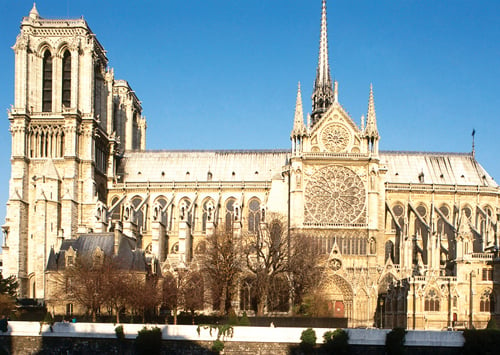
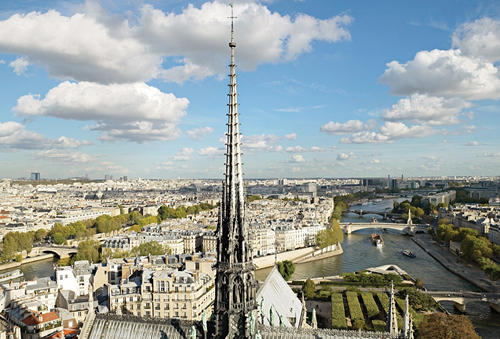
Notre-Dame seen from the River Seine
There are cafés opposite the Square Jean XXIII. |
|
Free
organ recitals on Sunday afternoons.
|
|
Top 10 Features
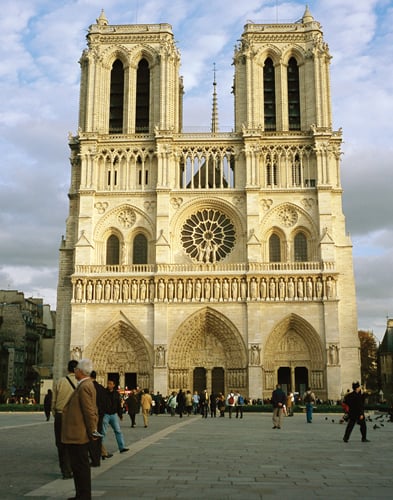
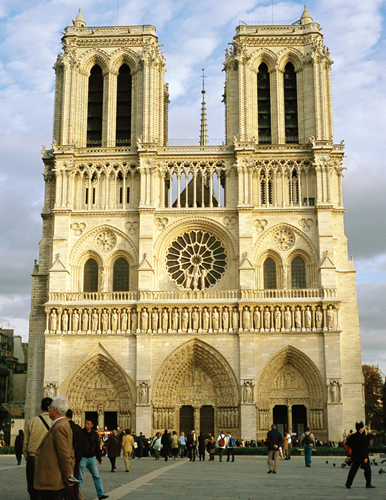
West Front
The
glorious entrance to the cathedral is through three elaborately carved
portals. Biblical scenes, painted in the Middle Ages, represent the life
of the Virgin, the Last Judgment and the Life of St Anne. Above is the
Gallery of Kings of Judaea and Israel.

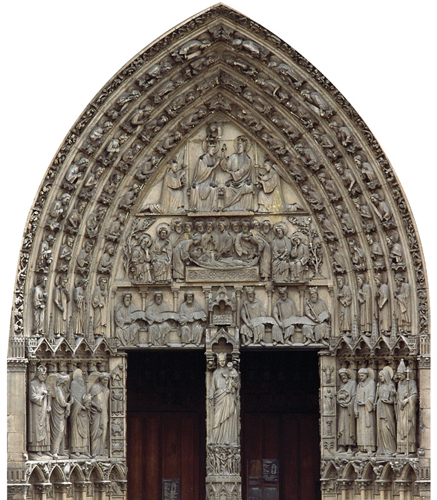
Portal of the Virgin
The
splendid stone tympanum was carved in the 13th century and shows the
Virgin Mary’s death and glorious coronation in heaven. However, the
Virgin and Child carving seen between the doors is a modern work of art.

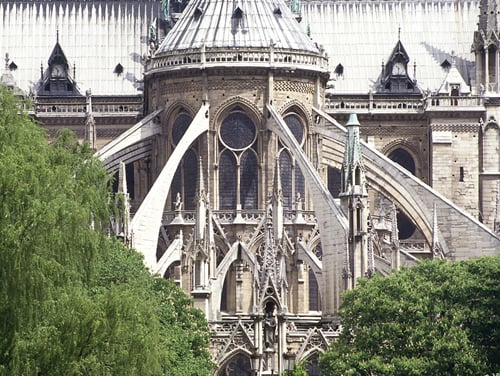
Flying Buttresses
The
striking buttresses supporting the cathedral’s east façade are by Jean
Ravy and have a span of 15 m (50 ft). The best view is from Square Jean
XXIII.

The Towers
The
twin towers are 69 m (226 ft) high: visitors can climb the 387 steps of
the north tower for splendid vistas over Paris. The south tower houses
the Emmanuel Bell, weighing 13 tonnes.

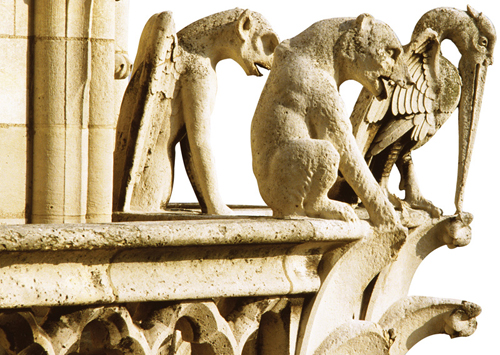
Galerie des Chimères
Lurking between the towers are the famous gargoyles (chimères), placed here by Viollet-le-Duc to ward off evil.
The Spire
The
90-m (295-ft) spire was added by Viollet-le-Duc. Next to the Apostles
statues on the roof is one of the architect, admiring his work.

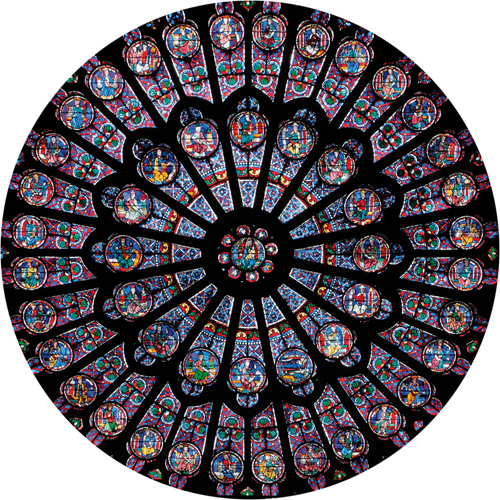
Rose Windows
Three
great rose windows adorn the north, south and west façades, but only
the north window retains its 13th-century stained glass, depicting the
Virgin surrounded by figures from the Old Testament. The south window
shows Christ encircled by the Apostles.

Statue of the Virgin and Child
Also
known as Notre-Dame de Paris (Our Lady of Paris), this beautiful
14th-century statue was brought to the cathedral from the chapel of St
Aignan. It stands against the southeast pillar of the transept, at the
entrance to the chancel.
Choir Stalls
More
than half of the original stalls commissioned by Louis XIV survive.
Among the beautifully carved work on the 78 stalls are scenes from the
Life of the Virgin.
Treasury
Ancient
manuscripts, reliquaries and religious garments are housed in the
sacristy. The Crown of Thorns and a piece of the True Cross are on
public view every Good Friday.