National Gallery of Art Collections

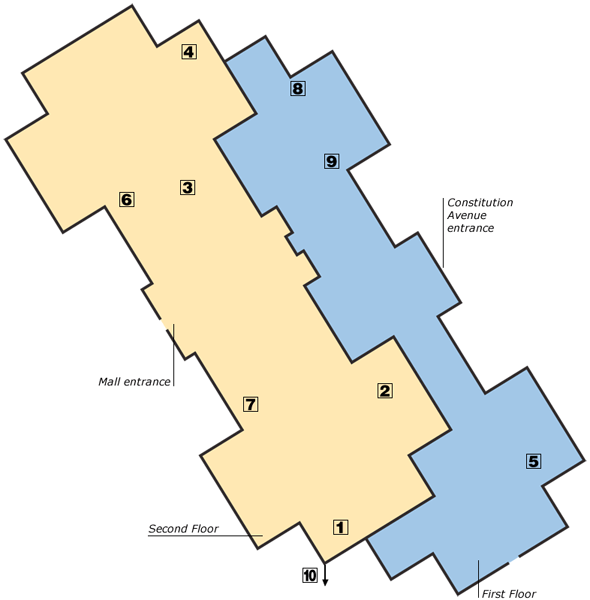
Collections Floorplan
American Paintings
The
breadth of this collection reveals many themes: portraiture, a desire
for accuracy in depicting American life and landscape, and a social
conscience.
French 19th-century Paintings
Especially
rich in works of the Impressionists, this collection includes some of
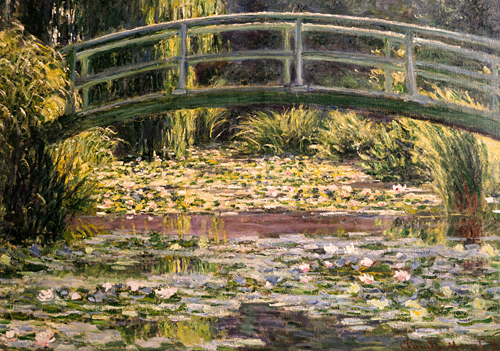
the world’s most beloved works of art, such as Monet’s Japanese Footbridge. Manet and Degas also feature.

Japanese Footbridge, Monet
Italian 15th-century Paintings
Best
known for the increasing mastery of the naturalistic portrayal of the
human figure and of interior and exterior settings, the works in this
collection still have appealing variety: decorative, mystical, simple,
and elegant.
Italian 16th-century Painting
The
mature flowering of the Renaissance bursts forth in this deep and broad
collection of works by Raphael, Giorgione, Titian, and many others.
Works on Paper
The
National Gallery is especially strong in this area. Repeat visitors see
an almost unbelievable quantity and variety of exquisite drawings,
prints, illustrated books, and photographs. The permanent collection
contains more than 65,000 items, dating as far back as the 11th century.
Dutch and Flemish Paintings
Again,
visitors will find an overwhelmingly rich array of Old Master works by
artists such as Rembrandt, Frans Hals, Van Dyck, Rubens, Vermeer, and
their contemporaries.
Spanish Paintings
El Greco, Zurbarán, Murillo, and Velázquez are just some of the Spanish highlights in this vibrant collection.
Decorative Arts
Sumptuous
tapestries, full of imagery, outstanding pieces of furniture, and
everyday items such as plates and bowls, give a wonderful glimpse of the
passing centuries in Europe.
European Sculpture
Portrait
busts and portrait medals have always been important products of the
sculptor’s studio, and many fine examples are displayed here. There is
also an especially absorbing look at Rodin and some experimental
sculptural pieces by Degas.
Painting and Sculpture of the 20th Century
The
frantic rate of change in 20th-century art is laid out here. From
Matisse’s Fauvist works, the Cubists Picasso and Braque, the abstraction
of Mondrian, Surrealists such as Magritte and Miró, high Modernists
David Smith, and Mark Rothko, right up to minimalism and Pop Art.
The East Building and Sculpture Garden
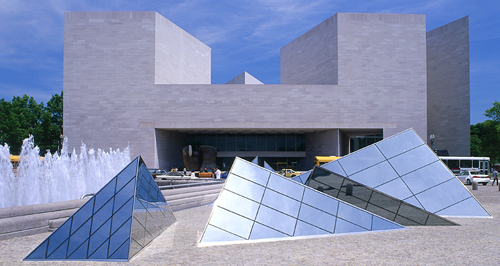
The East Building is an
angular construction designed to house permanent and touring exhibitions
of contemporary art. Its entrance is from 4th Street or from the
underground concourse leading from the West Building. The huge
orange-and-black mobile by Alexander Calder that dominates the lobby was
reconditioned recently to restore its slow motion. Provocative
exhibition halls line the outer walls of the upper halls, connected by
spectacular hanging crosswalks. The Sculpture Garden is a wonderful,
lively public space integrated with the display of contemporary art,
beautifully landscaped around its fountain and reflecting pool. There
are free jazz concerts in the summer on Fridays and the pool is turned
into an ice skating rink in winter.

The East Building
Top 10 Works in the Sculpture Garden
Puellae (Girls), Magdalena Abakanowicz (1992)
House I, Roy Lichtenstein (1996–8)
Four-Sided Pyramid, Sol LeWitt (1997)
Cheval Rouge, Alexander Calder (1974)
Personnage Gothique, Oiseau-ÉclairJoan Miró (1974)
Six-Part Seating, Scott Burton (1985–98)
Spider, Louise Bourgeois (1996)
Thinker on a Rock, Barry Flanagan (1997)
Chair Transformation Number 20B, Lucas Samaras (1996)
Moondog, Tony Smith (1964–99)