Italian Paintings in the Prado

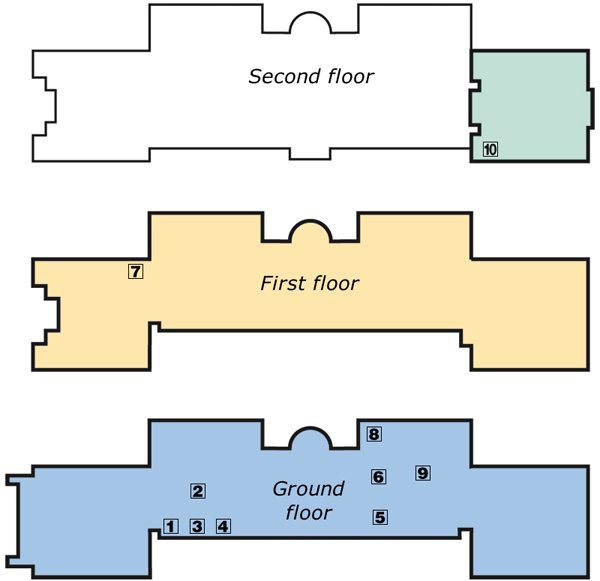
Italian Paintings Floorplan
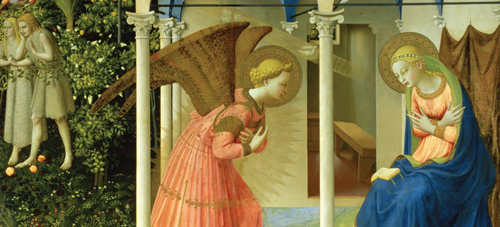
Annunciation
This superb panel (c.1430) by Fra Angelico (c.1400–55) was presented to the Monasterio de las Descalzas Reales.

Annunciation, Fra Angelico
Death of the Virgin
Andrea Mantegna (c.1431–1506) shows the Virgin Mary being carried into heaven in this work (c.1462).
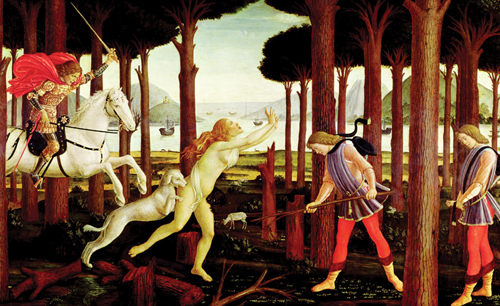
The Story of Nastagio degli Onesti
These panels (1483) by Botticelli (c.1444–1510) were commissioned by two rich Florentine families.

The Story of Nastagio degli Onesti, Botticelli
Fall on the Road to Calvary
In 1661 this painting (c.1513– 16) by Raphael (1483–1520) was considered the world’s finest.
The Washing of the Feet
This early work (1547) by Jacopo Tintoretto (c.1518– 94) reveals his brilliant handling of perspective.
Danäe and the Shower of Gold
Paintings by Titian (1477–1576) were prized by Carlos I. This 1554 work depicts a mythological story by the Latin poet, Ovid.
David with the Head of Goliath
Caravaggio (1573–1610) had a major impact on Spanish artists, who admired the dark and light contrasts as seen here (c.1600).
The Virgin and Child between two Saints
Founder
of the Venetian School, Giovanni Bellini (c.1431–1516) shows an assured
use of colour in this devotional painting (c.1490).
Venus and Adonis
This beautiful work (c.1580) by Paolo Veronese (1528–88) is a masterpiece of light and colour.
The Immaculate Conception
This work (1767–9) by Giovanni Battista Tiepolo (1696–1770) is one of a series intended for a church in Aranjuez.
Goya’s “Black Paintings”
Technically
brilliant, irreverent, ironic, satirical, sarcastic and bitter, Goya’s
“black paintings” are some of the most extraordinary works in the
history of art. They originally decorated the rooms of his house, the Quinta del Sordo
(“Deaf Man’s Residence”), near the River Manzanares and were produced
while he was recovering from a serious illness. In 1873 the then owner
of the quinta,
Baron D’Erlanger, had the paintings transferred to canvas and donated
them to the Prado Museum. What these 14 paintings have in common, apart
from the uniformly sombre colour scheme, is a preoccupation with
corruption, human misery, sickness and death. The key to the series is
the terrifying Saturn devouring his Son, based on a painting by Rubens, but in which the god is transformed from Baroque hero to the incarnation of evil. Even San Isidro Fair, which features the artist, is almost a travesty of his earlier depiction of the fiesta (see The Meadow of St Isidore) and reveals how far he had travelled as man and artist over the years.
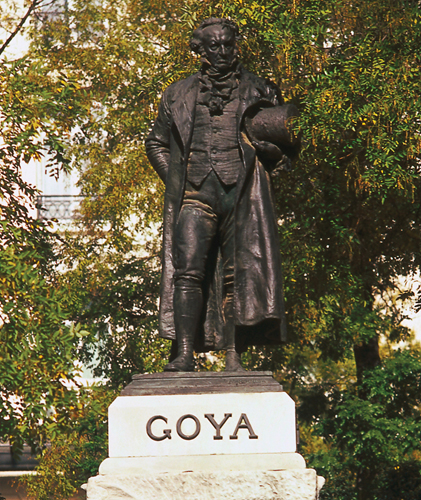
Francisco de Goya
Spain loves to honour its famous sons and daughters with
statuary, as with this figure of Goya outside the Museo del Prado.

Top 10 Events in the Life of Francisco de Goya
Born in Fuendetodos, near Zaragoza (1746)
Joins workshop of local artist, José Luzán (1760)
Moves to Madrid and works at Royal Tapestry Factory (1774)
Admitted to San Fernando Academy (1780)
Appointed court painter (1786)
Begins an affair with Duchess of Alba (c.1796)
Witnesses failed uprising against the French (1808)
Goes into exile in France (1824)