Tian’an Men Guangchang (the Square of the Gate of
Heavenly Peace) is not one of the world’s most attractive public plazas.
It also has unfortunate associations with death, in the physical form
of Mao’s Mausoleum and in the memories of the bloody climax of 1989’s
pro-democracy demonstrations. But it has witnessed triumphant events
too, including the founding of the People’s Republic of China, and it
remains central to modern life in Beijing, surrounded by important
national institutions and filled daily with visitors and kite flyers.
Tian’an Men SquareChina National MuseumMao’s Mausoleum.
6513 2277 Open 8am–noon Tue–Sun. Free with valid ID Handbags, backpacks, cameras, food, and drinks are strictly prohibited
Qian Men6522 9384 Open 8:30am–4pm daily. Admission: ¥20
Tian’an Men (Gate of Heavenly Peace): |
There were earlier defenses
but it was during the Ming era (1368–1644) that the walls took on their
recognizable shape of an outer wall with seven gates, and an inner wall
with nine gates. Tragically, almost all was demolished in the 1950s and
1960s to make way for roads. The gates are remembered only in the names
of the subway stations on the Second Ring Road. |

Cafés and restaurants ring the square, but there are better places a short walk south of Qian Men. |
|
Tian’an Men Square is a heavily symbolic place, so your bags may be inspected. |
|
Come to Tian’an Men Square at sunrise or sunset to watch the flag-raising ceremony |
|
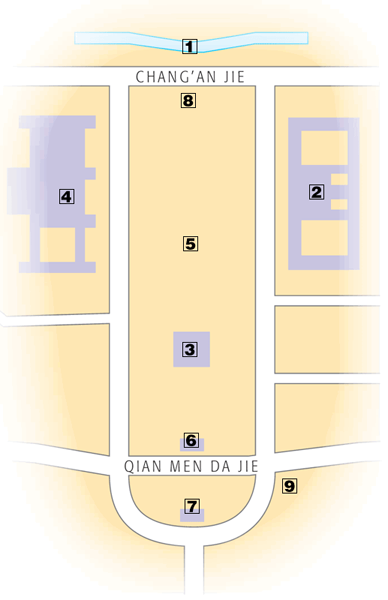
Top 10 Features
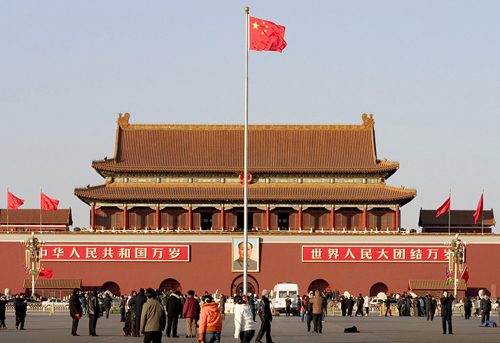
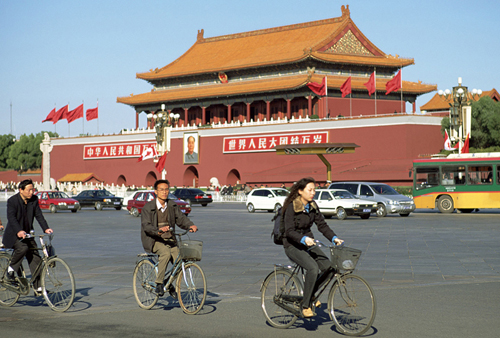
Tian’an Men
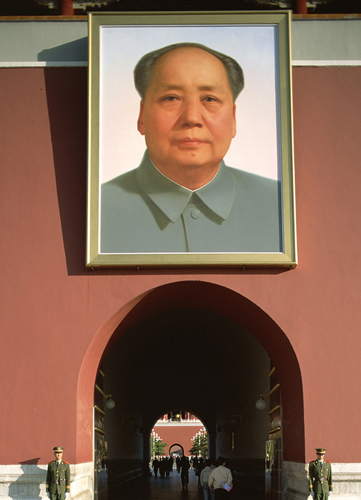
Mao
proclaimed the founding of the People’s Republic of China on October 1,
1949 from this massive Ming-dynasty gate, where his huge portrait still
hangs. The way to the Forbidden City is through here.

Mao’s portrait still hangs from Tian’an Men

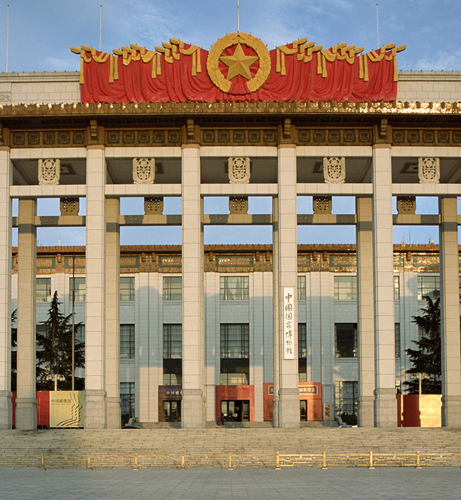
China National Museum
This
brutal 1959 building on the eastern side of the square combines the
Museum of Chinese History and the Museum of the Revolution. The
China National Museum is currently closed for renovation and expansion;
it is due to reopen in 2010.

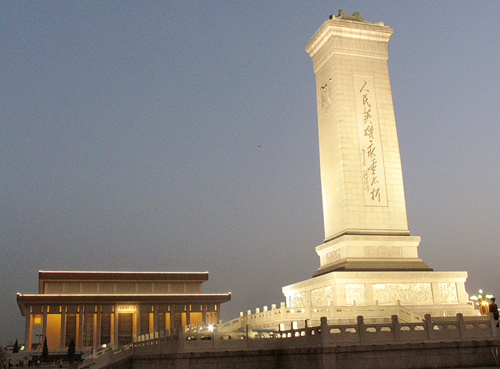
Mao’s Mausoleum
In
an imposing hall at the center of the square lies the embalmed body of
Mao, who died in 1976. Encased in a crystal casket and draped in a red
flag, he is raised from his refrigerated chamber for daily public
viewings.

Great Hall of the People
A
monolithic structure dominating the western side of the square, the
Great Hall is the seat of the Chinese legislature. The vast auditorium
and banqueting halls are open for part of every day except when the
People’s Congress is in session.
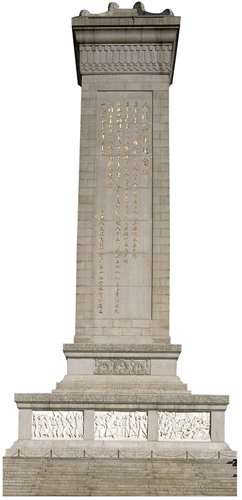
Monument to the Heroes
Erected
in 1958, the granite monument is decorated with bas-reliefs of episodes
from the nation’s revolutionary history and calligraphy from Communist
veterans Mao Zedong and Zhou Enlai.

Qian Men
The
“Front Gate”, also known as Zhengyang Men (“Sun-facing Gate”), was
constructed during the Ming dynasty and was the largest of the nine
gates of the inner city wall. It now houses a city history museum.
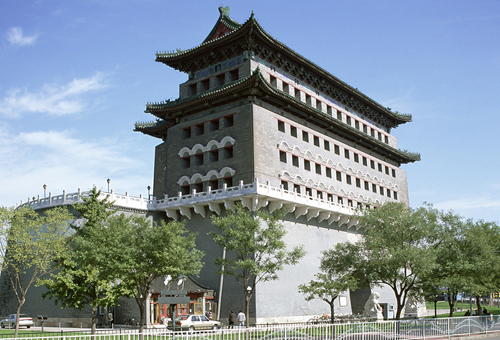
Arrow Tower
With
the Qian Men, the Arrow Gate formed part of a great double gate. The
walls that once flanked the gate were demolished in the 20th century.

National Flag
At
the northern end of the square is a towering pole, from which flies the
Chinese flag; a troop of People’s Liberation Army (PLA) soldiers raises
the flag each day at dawn and lowers it again at sunset.
Qian Men Old Railway Station
The
stripy building on the square’s southeast corner is a British-built
railway station. It now houses shops, an internet café, a branch of
McDonald’s, and a theater where performances of Beijing Opera take
place.
Bicycles
The
bicycle remains the quintessentially Chinese way of getting around.
While 10 million bikes are registered in Beijing, every day as many as
1,300 new cars are added to the city’s congested roads. Smog is a
serious problem.