It was here that the emperor would make sacrifices
and pray to heaven and his ancestors at the winter solstice. As the Son
of Heaven, the emperor could intercede with the gods on behalf of his
people and pray for a good harvest. Off-limits to the common people
during the Ming and Qing dynasties, the temple complex is now fully open
to the public and attracts thousands of visitors daily, including many
local Chinese who come to enjoy the large and pleasant park in which the
monuments are set.
Tian Tan Dong Lu (East Gate), Chongwen 6702 8866 Subway: Tian Tan Dong Men Park open: 6am–9pm daily. Temple open: 8am–5:30pm Admission to temple: ¥35. Admission to park: ¥15. Audio guides are available for ¥40
www.tiantampark.com
|
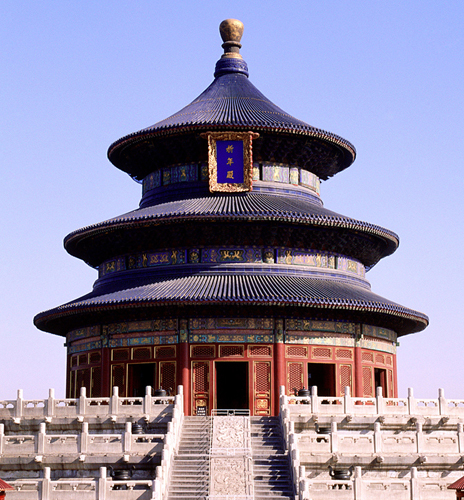
The Hall of Prayer for
Good Harvests, or Qinian Dian, which is the iconic structure at the
heart of the complex, is often incorrectly called the Temple of Heaven.
There is, in fact, no single temple building and the name, which in
Chinese is Tian Tan – a more literal translation of which is Altar of
Heaven – refers to the whole complex. |


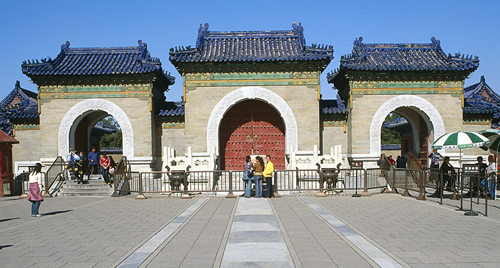
Triple gate for emperor, officials, and gods
There are several small snack kiosks in the park grounds. |
|
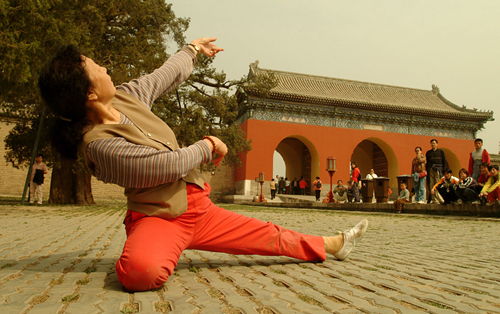
Just as fascinating as
exploring the temple is observing the great numbers of Chinese who come
to the park to dance, exercise, sing opera, play games of cards and
mahjong, and fly kites. |
|
Top 10 Features
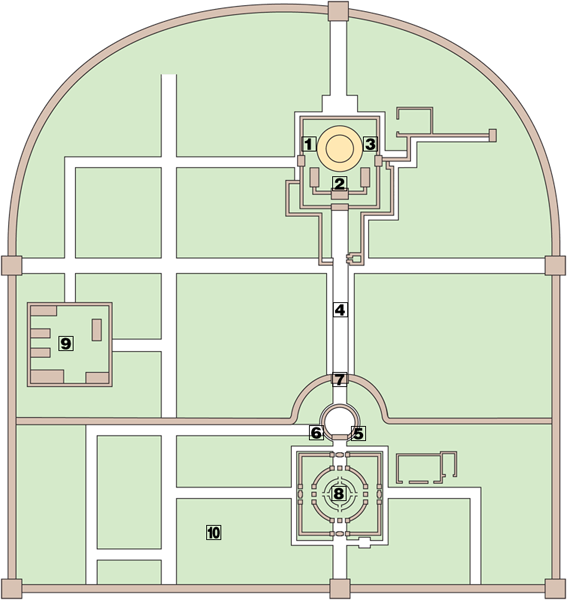
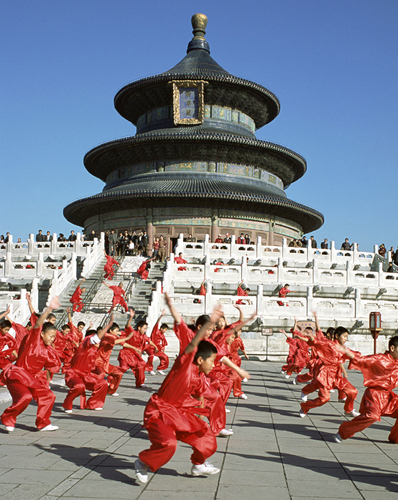
Hall of Prayer for Good Harvests
Built
in 1420, then rebuilt in 1889, this circular tower, with a conical roof
of blue tiles and a gold finial, is the most beautiful building in
Beijing. One of the most striking facts about it is that it was
constructed without the use of a single nail.

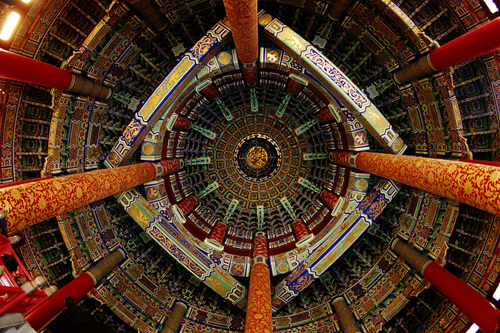
Painted Caisson Ceiling
The
circular ceiling of the Hall of Prayer for Good Harvests has a gilded
dragon and phoenix at its center. The wood for the four central columns
was imported from Oregon, as at the time China had no trees tall enough.

Marble Platform
The
Hall of Prayer for Good Harvests sits atop three tiers of marble that
form a circle 300 ft (90 m) in diameter and 20 ft (6 m) high. The
balusters on the upper tier are decorated with intricate dragon carvings
that serve to signify the imperial nature of the structure.

Red Step Bridge
A
raised walkway of marble and stone that runs exactly along the
north-south axis of the temple complex, the Red Step Bridge connects the
Hall of Prayer for Good Harvests with the Round Altar.
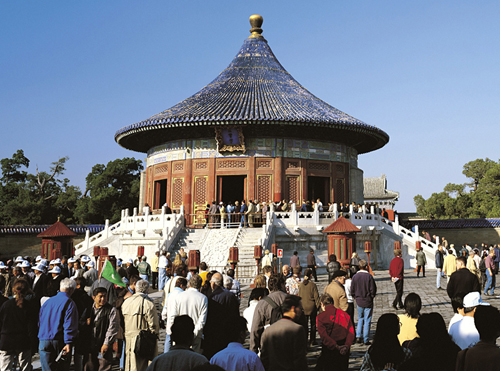
Imperial Vault of Heaven
A
circular hall made of wood and capped by a conical roof, the Imperial
Vault once held the wooden spirit tablets that were used in the
ceremonies that took place on the nearby Round Altar.

Echo Wall
The
Imperial Vault is enclosed by the circular Echo Wall, which has the
same sonic effects found in some European cathedrals, where even a
whisper travels round to a listener on the other side.
Echo Stones
There
are three rectangular stones at the foot of the staircase leading up to
the Imperial Vault: stand on the first and clap to hear one echo; stand
on the second stone and clap once for two echoes; clap once on the
third for three echoes.
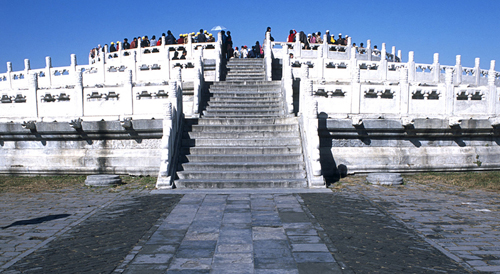
Round Altar
The
altar is formed of marble slabs laid in nine concentric circles with
each circle containing a multiple of nine pieces. The center of the
altar represents the center of the world and it is where the emperor
carried out sacrifices.

Hall of Abstinence
A
red-walled, compound surrounded by a moat spanned by decorative
bridges, the Hall of Abstinence resembles a mini Forbidden City. This is
where the emperor would spend the last 24 hours of his three-day fast
prior to partaking in the Temple of Heaven ceremonies.
Temple of Heaven Park
Today,
locals, inured both to the splendor of the buildings and to the crowds
of tourists, use the extensive grounds to practice tai ji quan, and other martial arts, and to exercise.