Though hard to imagine today, there was a time when
Barcelona was just a small Roman village (named Barcino) encircled by
protective stone walls. Over the centuries, the village grew,
culminating in a building boom in the 14th and 15th centuries. The Barri
Gòtic (Gothic Quarter), a beautifully preserved neighbourhood of Gothic
buildings, medieval places
(squares) and atmospheric alleys, exists today as a splendid reminder
of Barcelona’s medieval heyday. The web of ancient, treasure-filled
streets in this compact area is best explored by aimless wandering. The
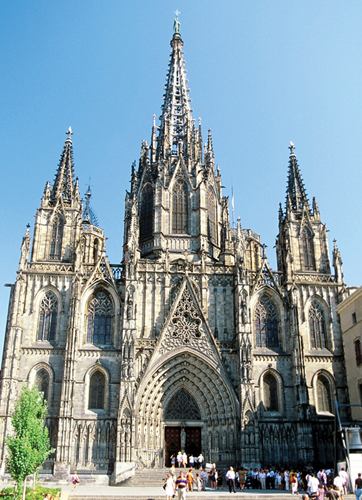
barrio’s centrepiece – and its religious and social heart – is the
13th–century Cathedral and surrounding complex of period buildings.
Nearby, the stately Plaça del Rei
is ringed by some of the best preserved medieval buildings in the area.
Extending east of the Barri Gòtic is the ancient barri of La Ribera,
which includes El Born. Here, the lovely Carrer Montcada is lined with medieval palaces – five of which house the must-see Museu Picasso.
Roman Arch, Carrer Paradis
Sights
Plaça de Sant Jaume
The site of the Plaça de Sant Jaume
was once the nucleus of Roman Barcino. With these roots, it seems
fitting that the square has become home to Barcelona’s two most
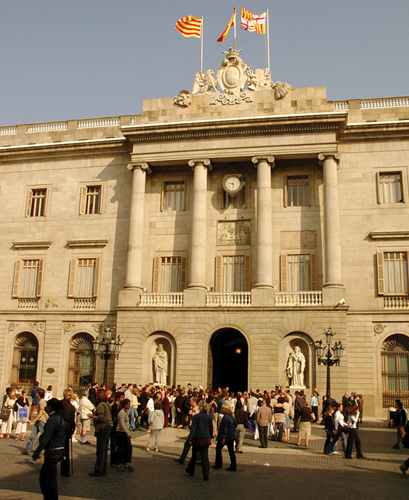
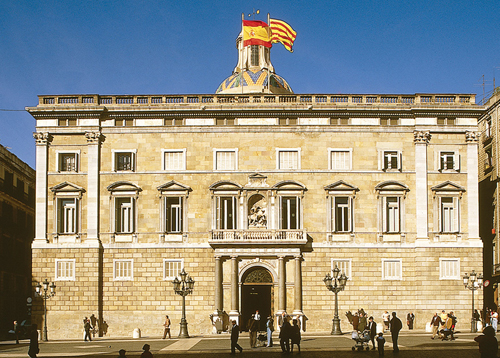
important government buildings: the Palau de la Generalitat (seat of the
Catalan government) and the Ajuntament (city hall). Look for the
detailed carved relief of Sant Jordi, Catalonia’s patron saint, on the
15th-century Generalitat façade. Within is the lovely 15th-century Capella de Sant Jordi,
designed by architect Marc Safont. A highlight of the Gothic Ajuntament
is the lavish red-and-gold Saló de Cent, where the Council of One
Hundred ruled the city from 1372 to 1714. Also of note is the Pati dels
Tarongers, a graceful patio with orange trees.Palau de la Generalitat
Ajuntament


Italianate façade, Palau de la Generalitat
Conjunt Monumental de la Plaça del Rei
In the heart of the Barri Gòtic is the beautifully preserved, medieval Plaça del Rei,
presided over by the 13th- to 14th-century Palau Reial (royal palace).
The impressive palace complex includes the Saló del Tinell, a massive
hall crowned by Gothic arches, where Ferdinand and Isabel welcomed
Columbus after his 1492 voyage to the Americas. The medieval Capella de
Santa Àgata has a beautiful 15th-century altarpiece by Jaume Huguet. A
visit to the Museu d`Història de la Ciutat gives access to the Palau
Reial and to one of the largest underground excavations of Roman ruins
on display in Europe.Pl del Rei
Open 10am–8pm Tue–Sat, 10am–3pm Sun (Oct–May: closes 2–4pm, 7pm)
Adm
DA
Plaça Reial
Late
19th-century elegance meets sangria-swilling café society in the
arcaded Plaça Reial, one of Barcelona’s most emblematic and entertaining
squares. The plaça is planted with towering palm trees and encircled by stately, 19th-century buildings. The Modernista
lampposts were designed by a young Gaudí in 1879. At the square’s
centre is a wrought-iron fountain representing the Three Graces. The
square is the best place to start a big night out, with a cluster of
restaurants, bars and cafés that draw the hoi polloi – including all
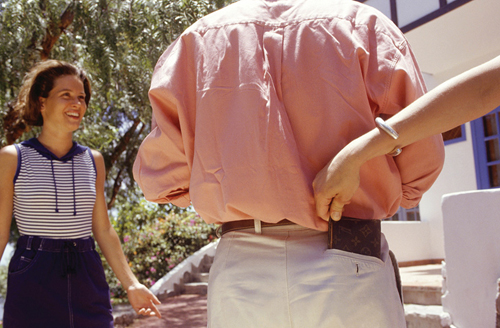
sorts of shady pickpockets.


Museu Frederic Marès
This fascinating museum houses the life collection of wealthy
Catalan sculptor Frederic Marès. No mere hobby collector, the astute
(and obsessive) Marès amassed holdings that a modern museum curator
would die for. Among them, an impressive array of religious icons and
statues – dating from Roman times to the present – and the curious
“Museu Sentimental”, which displays anything from ancient watches to
fans and dolls. Also worth a visit during the summer months is the
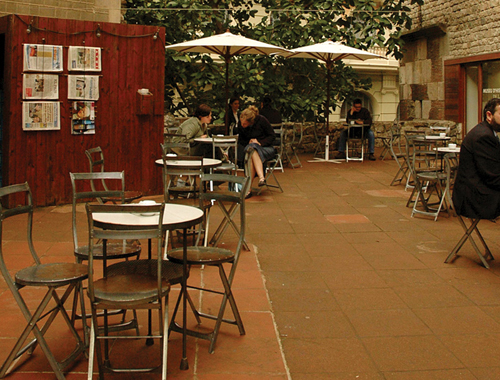
inviting Cafè d’Estiu on the museum’s sun-dappled patio.Open 10am–7pm Tue–Sat, 10am–3pm Sun
Adm
Free Wed eve & 1st Sun of month, free guided visits on request, call 93 256 35 00

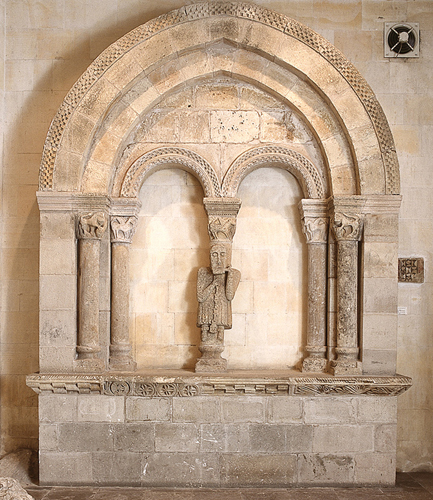
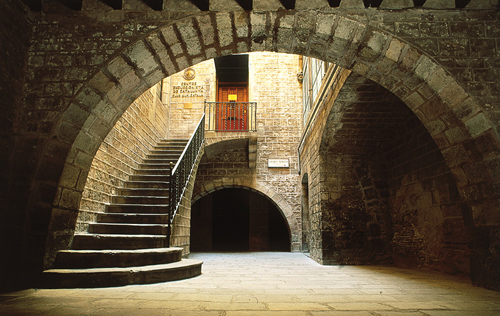
Medieval arch, Museu Frederic Marès

Església de Santa Maria del Mar
The
spacious, breathtaking interior of this 14th–century church, designed
by architect Berenguer de Montagut, is the city’s premier example of the
austere Catalan Gothic style. The church is dedicated to Saint Mary of
the Sea, the patron saint of sailors, and an ancient model ship hangs
near one of the statues of the Virgin. Dubbed “the people’s church”,
this is the city’s most popular spot for exchanging wedding vows.Pl de Santa Maria 1
Open 9am–1:30pm & 4:30–8pm
Disseny Hub
Housed
in a pair of adjoining medieval palaces, the gallery features temporary
exhibitions showcasing aspects of architecture, graphic and
communications design, product design and fashion design. The small but
ultra-cool museum shop sells funky clothes, accessories and design
collectables, while the café beckons with outdoor tables in a shady
courtyard. In 2011 the collection will be moved to a new museum
currently under construction in Plaça de les Glories.C/Montcada 12–14
Open 10am–6pm Tue–Sat, 10am–3pm Sun
Adm
DA
Museu Barbier-Mueller d’Art Precolombí
Pre-Columbian
art and artifacts, spanning 3,000 years, are exhibited in the
16th-century Palau Nadal. Sculpture, ceramics and detailed gold and
silver pieces represent the rich artistic traditions of the Aztecs,
Mayans and Incas. Temporary exhibits explore the diversity of these
civilizations.C/Montcada 12–14
Open 11am–5pm daily
Adm; free 1st Sun of month
DA