Roman Barcelona
Morning
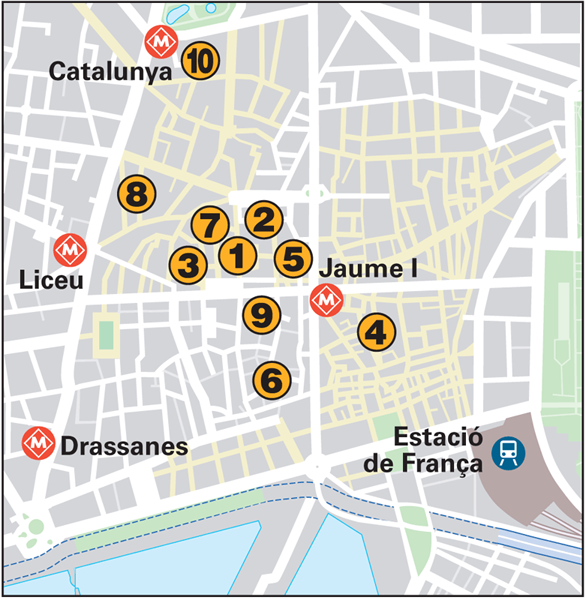
Starting at the Jaume I
metro, enter the ancient walled city of Barcino on C/Llibreteria, once
the main road to and from Rome. Head right up C/Veguer to
Plaça del Rei
and descend into a fascinating underground web of Roman walls and waterways via the Museu d’Història de la Ciutat
(see Conjunt Monumental de la Plaça del Rei).
Also visible here are the remains of a 2nd-century workshop and an
ancient bodega, a source of much Roman merrymaking. Back above ground,
pause for a cafè sol at the terrace of
Café–Bar L’Antiquari
and bask in Barcelona’s Gothic glory
days. Stroll towards the Cathedral’s spires along C/de la Pietat. Turn
right onto C/Bisbe, once a Roman thoroughfare, then right again on Av de
la Catedral to visit the
Pia Almoina
, where you can view a section of the Roman
aqueduct and ride a glass elevator past Roman wall remains. Backtrack to
Plaça Nova, once the Roman gateway to Barcino, cross the plaça and continue along C/Arcs.
Afternoon
Stop for lunch at the
Reial Cercle Artistic,
a late 19th-century artists’ society. Ignore the “members only” sign;
the restaurant is open to the public, and its tranquil balcony terrace
provides a welcome breather from the crowds far below. After lunch, head
up Av del Portal de l’Àngel and turn left onto C/Canuda to
Plaça de la Vila de Madrid
. The square is a fitting end to your Roman ramble, for here are the necropolis remains, where Romans were laid to rest.
Best of the Rest

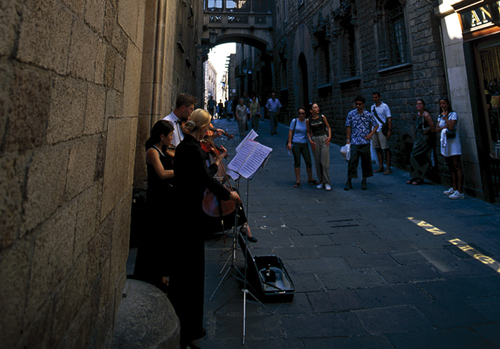
Carrer del Bisbe
Medieval Carrer del Bisbe is flanked by the Gothic Cases dels Canonges (House of Canons) and the Palau de la Generalitat . Connecting the two is an eye-catching Neo-Gothic arched stone bridge (1928).

Carrer del Bisbe
Carrer de Santa Llúcia
At weekends, amateur opera singers perform on this medieval street, home to the Casa de l’Ardiaca, which has a ravishing little patio.
El Call
El
Call was home to one of Spain’s largest Jewish communities until their
expulsion in the 15th century. The dark streets of this ghetto are so
narrow it is said you can tie a handkerchief across their width.
Carrer Montcada
The “palace row” of La Ribera is lined with Gothic architectural gems, including the 15th- century Palau Aguilar, home to the Museu Picasso, and the 17th-century Palau Dalmases with its Gothic chapel.
Plaça de Ramon Berenguer el Gran
This square boasts one of the largest intact sections of Barcelona’s Roman walls.
Carrer Regomir & Carrer del Correu Vell
You’ll
find splendid Roman remains on Carrer Regomir, most notably within the
medieval Pati Llimona. Two Roman towers are revealed on nearby Carrer
del Correu Vell, and there are Roman walls on the leafy Plaça Traginers.
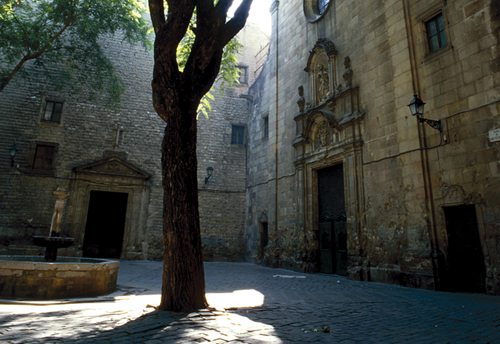
Plaça de Sant Felip Neri
Sunlight filters through tall trees in this hidden oasis of calm. The plaça is home to the Museu del Calçat.

Plaça de Sant Felip Neri
Carrer Petritxol
This well-maintained medieval street is lined with traditional granges and xocolateries
(cafés and chocolate shops). Also here is the famous Sala Parés art
gallery, founded in 1877, which once exhibited Picasso, Casas and other
Catalan contemporaries.
Església de Sant Just i Sant Pastor
This picturesque Gothic church (1342) has sculptures inside that date back to the 9th century.
Església de Santa Anna
Mere paces from La Rambla is the unexpected tranquillity of this Romanesque church, with a leafy, 15th-century, Gothic cloister.