This superb tribute to a man whose legacy as an
artist and as a Catalan is visible city-wide was founded in 1975 by Joan
Miró himself, who wanted it to be a contemporary arts centre. The
museum holds more than 11,000 examples of the artist’s colourful
paintings, sketches and sculptures. The 400 or so on display trace
Miró’s development from an innovative Surrealist phase in the 1920s to
his place as one of the world’s most challenging masters in the 1960s.
Av Miramar, Parc de Montjuïc 93 443 94 70
www.bcn.fjmiro.es
Metro to Parallel, then funicular; or metro to Pl. Espanya, then bus 61; or buses 50 or 55 from the city centre Open 10am–7pm Tue, Wed, Fri & Sat (until 8pm Jul–Sep) 10am–9:30pm Thu, 10am–2:30pm Sun Adm: €8 (complete collection), con €6; €4 (temporary exhibitions) DA
|
The Fundació celebrated
its 25th anniversary in 2001 by opening a new extension (known as Sala
K) to house 25 Miró paintings on long-term loan from a private
collection. |

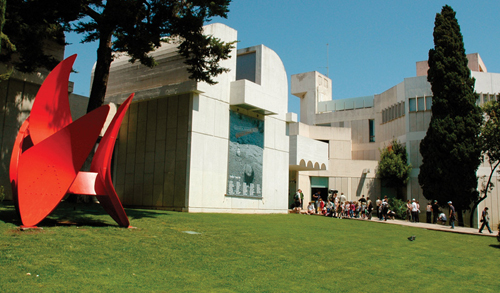
Façade, Fundació Joan Miró
The restaurant-café here is one of the best dining options in the area . |
|
In summer, live experimental music is showcased in the Fundació auditorium, usually on Thursday nights. |
|
The gift shop has an original range of Miróesque curiosities, from tablecloths to champagne glasses. |
|
The Fundació’s collection is vast; only a portion of it is on show at any one time. |
|
Top 10 Works of Art
Tapis de la Fundació
This immense, richly-coloured tapestry represents the culmination of Miró’s work with textiles, which began in the 1970s.
L’Estel Matinal
This is the only one of 23 paintings on paper known as the Constellation Series held by the Fundació. The Morning Star’s
introspective quality reflects Miró’s state of mind at the outbreak of
World War II, when he was living in hiding in Normandy. Spindly shapes
of birds, women and heavenly bodies are suspended in front of an empty
space.
Pagès Català al Cla de Lluna
The figurative painting Catalan Peasant by Moonlight
dates from the late 1960s and depicts two of Miró’s favourite themes:
earth and night. The figure of the peasant, a simple collage of colour,
is barely decipherable, as the crescent moon merges with his sickle and
the night sky takes on the rich green tones of earth.
Home i Dona Davant un Munt d’Excrement
Tortured, misshapened and lurid semi-abstract figures attempt to embrace against a black sky. Miró’s pessimism at the time of Man and Woman in Front of a Pile of Excrement would soon be confirmed by the outbreak of Spain’s Civil War.
Sèrie Barcelona
The
Fundació holds the only complete set of prints of this series of more
than 50 black-and-white lithographs. This important collection is only
occasionally on display.
Font de Mercuri
Alexander Calder donated the Mercury Fountain
to the Fundació as a mark of his friendship with Miró. The work was an
anti-fascist tribute, conceived in memory of the attack on the town of
Almadén.
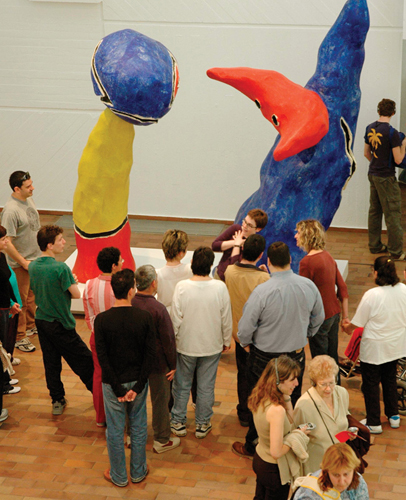
Sculpture Room
This
room focuses on Miró’s sculptures from the mid-1940s to the late-1950s
when he experimented first with ceramic, then bronze and finally with
painted media and found objects. Outstanding works include Sun Bird (1946–9) and Moon Bird (1946–9).

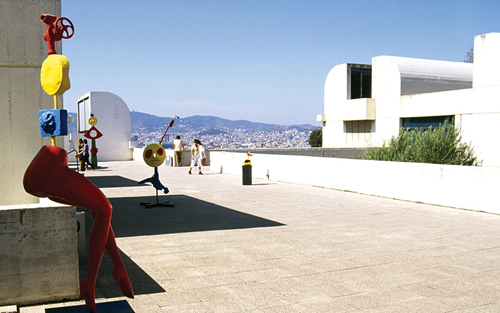
Terrace Garden
More
of Miró’s vibrantly colourful and playful sculptures are randomly
scattered on a spacious terrace from which you can appreciate city views
and the rationalist architecture of Josep Lluis Sert’s geometric
building. The 3-m (10-ft) tall Caress of a Bird (1967) dominates the terrace.

Visiting Exhibitions
Over
the years, these temporary exhibitions (usually held in the west wing)
have included retrospectives of high-profile artists such as Rothko,
Warhol and Magritte.
Espai 13
This
space showcases the experimental work of new artists from around the
world. The exhibitions, which are based on a single theme each year, are
usually radical and often make full use of new technologies.