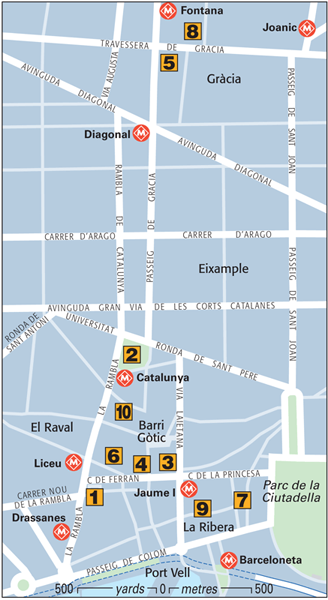
Plaça Reial
The
arcaded Plaça Reial, in the heart of the Barri Gòtic, is unique among
Barcelona’s squares, with its old-world charm, gritty urbanization and
Neo-Classical flair. It is home to majestic, mid-19th-century buildings,
Gaudí lampposts, a slew of happening bars and clubs, and an
entertaining and colourful crowd of inner-city denizens. .Plaça de Catalunya
Barcelona’s
nerve centre is the huge Plaça de Catalunya, a lively hub from which
all the city’s activity seems to radiate. This square is most visitors
first real glimpse of Barcelona. The airport bus stops here, as do RENFE
trains and countless metro and bus lines. The square’s commercial
swagger is evident all around, headed by Spain’s omnipresent department
store, El Corte Inglés .
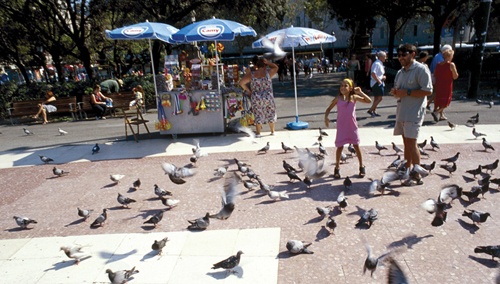
Pigeons flutter chaotically in the square’s centre, lively Peruvian
bands play to booming sound systems and hordes of travellers – from
backpackers to tour groups – meander about. To add to the melting pot,
the square is allegedly home to 25 people (mostly homeless immigrants).

Plaça de Catalunya
Plaça de Rius i Taulet
The
progressive, bohemian area of Gràcia, a former village annexed by
Barcelona in 1897, still exudes a small-town ambience, where socializing
with the neighbours means heading for the nearest plaça.
Topping the list is this atmospheric square, with an impressive clock
tower rising out of its centre. Bustling outdoor cafés draw buskers and a
sociable crowd.Plaça de Sant Josep Oriol & Plaça del Pi
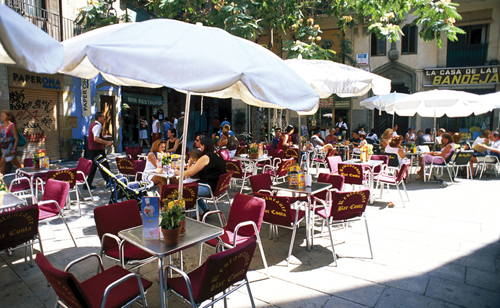
Old-world
charm meets café culture in the Barri Gòtic’s leafy Plaça de Sant Josep
Oriol and Plaça del Pi, named after the pine trees (pi, in Catalan) that shade its nooks and crannies. The lovely Gothic church of Santa Maria del Pi rises between the two squares.

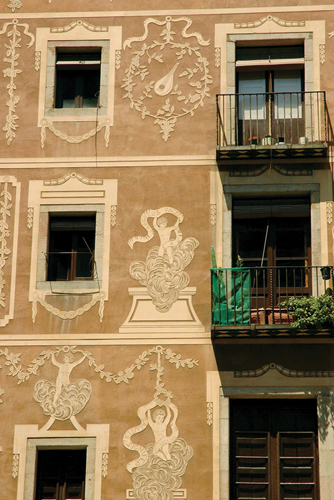
Façade, Plaça del Pi

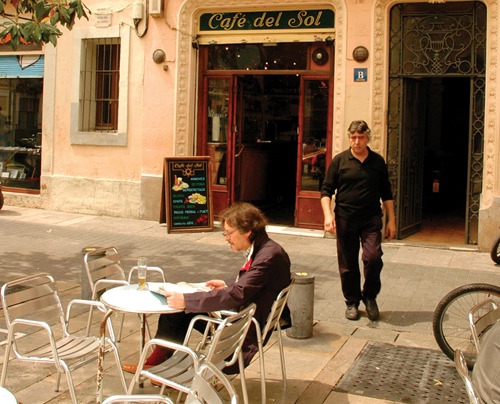
Café, Plaça Sant Josep Oriol, Barri Gòtic
Plaça de la Vila de Madrid
Mere steps from La Rambla is this spacious plaça,
graced with the remains of a Roman necropolis. A remnant of Roman
Barcino, the square sat just beyond the boundaries of the walled Roman
city. A row of unadorned 2nd–4th-century AD tombs were discovered here
in 1957. The complete remains are open to the public.