Beijing is vast. Although you
could spend all your time without ever straying too far from the area
around central Tian’an Men Square, you would be missing out on a lot.
Way out in the northwest of the city is a cluster of sights that
includes the unmissable Summer Palace, with the almost equally
intoxicating hillside Xiang Shan Park and the haunting ruins of the
Yuanming Yuan, or Old Summer Palace, close by. It might be a squeeze to
get all three into one day’s sightseeing but it’s worth a try. For fans
of contemporary urban culture, the 798 Art District in the northeast of
the city is an absolute must, and you can drop in on the markets and
bars around Sanlitun on the way back into town.
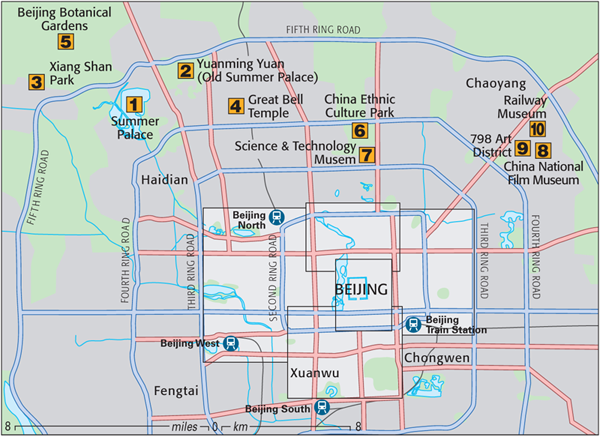
Top 10 Sights
Summer Palace
It’s
only a short bus or taxi ride from Bagou subway station to the
unmissable Summer Palace. The grounds are arranged as a microcosm of
nature, with hills and water complemented by bridges, temples and
walkways. It manages to be both fanciful and harmonious at the same time.

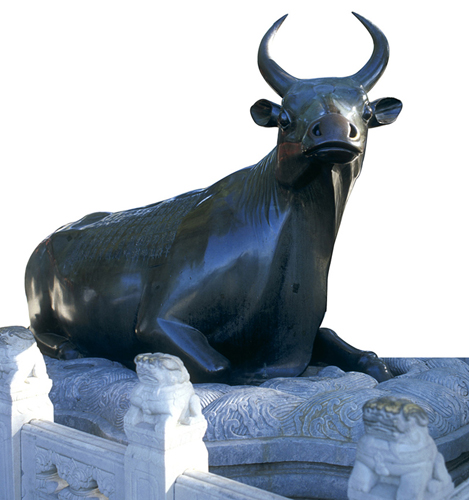
Bronze ox, Summer Palace

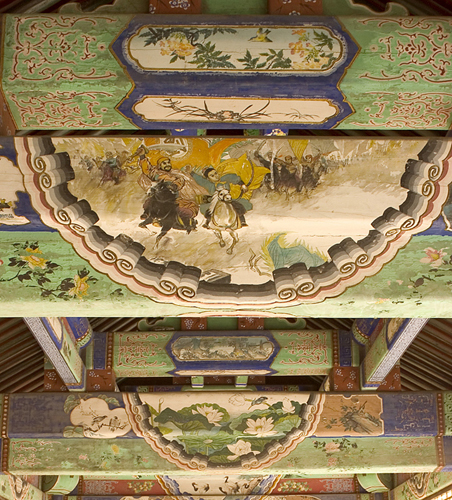
Long Corridor ceiling, Summer Palace

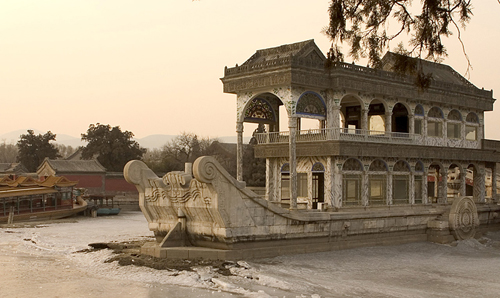
Marble Boat, Summer Palace
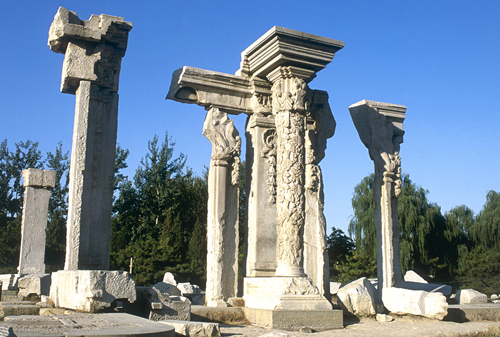
Yuanming Yuan (Old Summer Palace)
The
name Yuanming Yuan derives from a Buddhist term and can be translated
as “Garden of Perfect Brightness”. This was the largest and most
elaborate of all the summer palaces of the Qing era. It once contained
private imperial residences, pleasure pavilions, Buddhist temples, a
vast imperial ancestral shrine, pools for goldfish, and canals and lakes
for pleasure boating. The Qianlong emperor even added a group of
European-style palaces designed by Jesuit missionary-artists serving in
the Qing court. Today, all that’s left are graceful, fragmentary ruins
after the complex was razed to the ground during the Second Opium War
(1856–60). A small museum displays images and models of the place as it
was.28 Qinghua Xi Lu
6262 8501
Subway: Xizhi Men, then bus 375 or 438, or taxi from Wudaokou
Open 7am–7pm daily
¥10

Yuanming Yuan (Summer Palace)
Xiang Shan Park
The
wooded parkland area, also known as Fragrant Hills Park, is 2 miles (3
km) west of the Summer Palace. It boasts fine views from Incense Burner
Peak, which is accessible by a chair lift (¥30). Close to the park’s
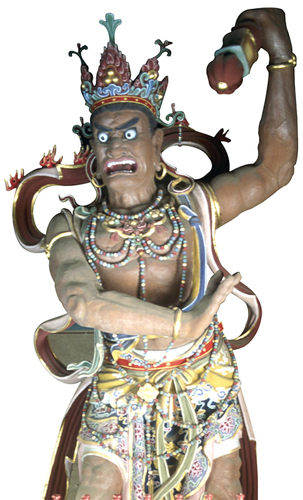
main gate is the Azure Clouds Temple (Biyun Si), guarded by the menacing
deities Heng and Ha in the Mountain Gate Hall. A series of farther
halls leads to the Sun Yat Sen Memorial Hall, where the revolutionary
leader’s coffin was stored in 1925, before being taken to his final
resting place in Nanjing.Wofosi Lu
6259 1155
Bus: 331 from Summer Palace or 634 from Xizhi Men
Open 6am–6:30pm
¥10; Azure Clouds Temple ¥10

Guardian deity, Heng
Great Bell Temple (Dazhangoi)
The
18th-century Da Zhong Si follows a typical Buddhist plan, with a
Heavenly Kings Hall, Main Hall, and a Guanyin Bodhisattva Hall. What
distinguishes it, though, is the 46.5 ton (47, 250 kg) bell – one of the
world’s largest – that is housed in the rear tower. The bell was cast
between 1403 and 1424 and Buddhist sutras in Chinese and Sanskrit cover its surface. Hundreds more bells can be seen in another hall on the west side of the complex.31A Beisanhuan Xi Lu
6254 1971
Subway: Dazhangsi
Open 8:30am–9:30pm daily
¥10
Beijing Botanical Gardens
About
a mile (2 km) northeast of Xiang Shan Park lie these pretty gardens,
containing some 3,000 plant species and some pleasant walks. The
garden’s Sleeping Buddha Temple (Wofo Si) is renowned for its
magnificent 15-ft (5-m) bronze statue of a reclining Buddha. China’s
last emperor, Pu Yi , ended his days here as a gardener.6259 1283
Bus: 331 from Summer Palace or 634 from Xizhi Men
Open 7am–7pm daily
¥5
China Ethnic Culture Park
A theme park devoted to all of China’s ethnic minorities (see China’s Peoples),
the complex is crammed with a weird and wonderful array of buildings
such as the distinctive circular dwellings of the southern Hakka people,
some of which are full-size replicas, while others are scale models.
There is also a Chinese Song and Dance Theatre featuring daily
performances by ethnic representatives in full costume. If you aren’t
going to be traveling around the country, this is a fine way to get an
idea of the diversity of China.1 Minzu Yuan Lu
6206 3640
Subway: Olympic Sports Center
Open 9am–7pm daily
¥60

China Ethnic Culture Park
Science and Technology Museum
Exhibits
begin with ancient science, highlighting China’s “technological
pre-eminence in history.” The technology comes up to date with Chinese
space capsules, robots, and an Astro-vision Theater incorporating
state-of-the-art cinematography. The museum provides good educational
fun for both young and old.1 Beisanhuan Zhong Lu
6237 1177
Subway: Beitucheng
Open 9am–4:30pm Tue–Sat
¥30
China National Film Museum
Reportedly
the world’s largest, this film museum is housed in a modern
glass-and-steel structure and features 20 exhibition halls, an IMAX
theater, a digital projection theater, and several 35mm theaters. One
hundred years of Chinese cinema are represented by 1,500 films and 4,300
stills from the works of 450 film-makers.9 Nanying Road, Chaoyang
6434 6100
Bus: 418 from Dong Zhi Men
Open 9am–4:30pm Tue–Sun (last adm 3:30pm)
¥20
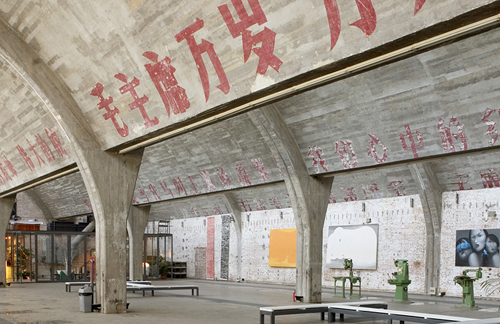
798 Art District
Although
it’s called the 798 Art District, Factory number 798 is only one of
several former industrial units that have been taken over by artists and
galleries. Although increasingly gentrified, the 798 still features
some of Beijing’s best galleries, including UCCA .

798 Art District
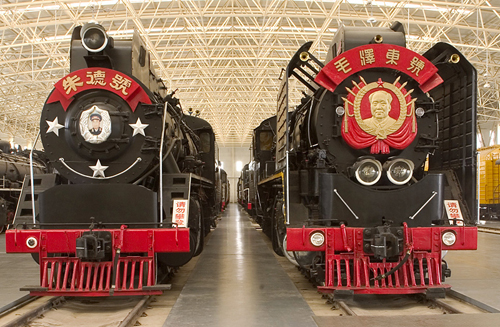
China Railway Museum
The
last passenger steam services in China came to an end in 2006, but a
short taxi ride northeast of the 798 Art District is this new museum
with a sizeable collection of old locomotives. Some of the cabs can be
boarded. An exhibition on the history of China’s railways is promised,
and some of the machines will occasionally be in steam. In the meantime,
the engines are a must for boys of all ages.1 Jiuxian Qiao Bei Lu
6438 1317
Open 9am–4pm Tue–Sun
¥20

China Railway Museum
Green Beijing
Morning
Be at the East Gate (Dong Men) of the Summer Palace
for 8:30am to beat both the heat (if you are visiting in summer) and
the crowds. Make your way along the north shore of Kunming Lake via the Long Corridor and ascend Longevity Hill. Descend again to the Marble Boat and take a pleasure cruiser across the lake to South Lake Island. Cross back to the mainland via the supremely elegant Seventeen-arch BridgeXiang Shan Gongyuan, otherwise known as Fragrant Hills Park. Before you enter, Sculpting In Time is a café near the East Gate that does good salads, pastas, and pizza.
Afternoon
From the park’s East Gate turn right for the Temple of Brilliance, built in 1780 and ransacked by Western troops in 1860 and 1900. Close by is the Liuli Pagoda,
with bells hanging from its eaves that chime in the breeze. Continue
north to pass between two small round lakes linked by a small
hump-backed bridge – the whole known as the Spectacles Lakes. Beyond is a chair lift that takes you up to the top of the “Fragrant Hill”. Zigzag back down past many more pavilions to arrive at the Fragrant Hills Hotel, designed by Chinese-American architect I.M. Pei, otherwise best known for his glass pyramid at the Louvre in Paris.