By far the most rewarding area to explore on foot,
north of the Forbidden City stretches an almost contiguous run of lakes,
either set in parkland or surrounded by swathes of charming historic
hutongs. It’s an area rich in temple architecture and dotted with grand
old courtyard residences. Its appeal to visitors has resulted in
restaurants, bars, and shops flooding in to take advantage of the
picturesque settings, but thankfully much of the growth has so far been
sympathetic.
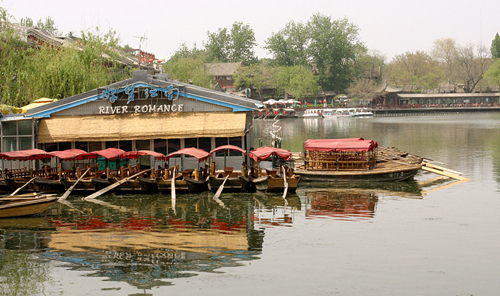
Qian Hai
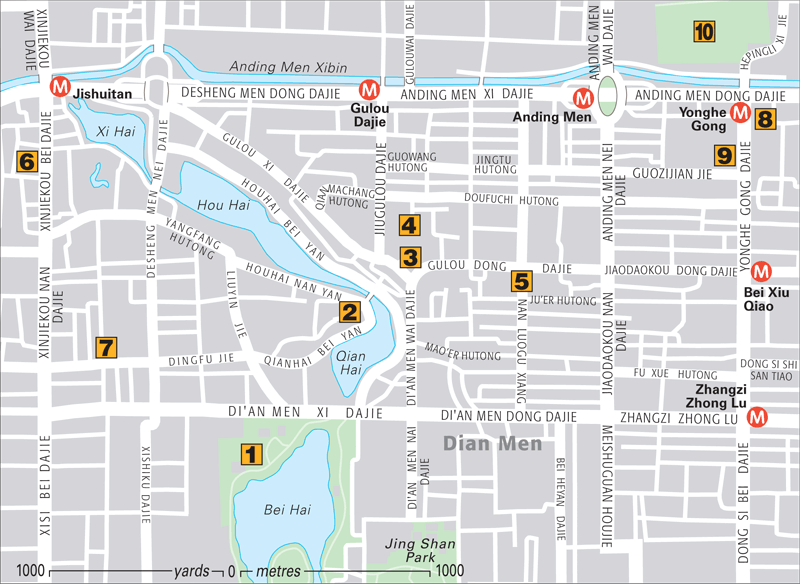
Top 10 Sights
Bei Hai Park
A
beautiful example of a classic imperial garden, Bei Hai was a summer
playground for successive dynasties that ruled from the neighboring
Forbidden City. Today, it is well and truly open to the public, and
thronged daily by locals who come here to socialize. There are a couple
of small temples, a fine, small ornamental garden, and a noted
restaurant. This is arguably the most lovely of Beijing’s many fine city
parks .Hou Hai
The
most visitor-friendly neighborhood of Beijing, Hou Hai consists of
three joined lakes surrounded by an expansive and labyrinthine sprawl of
age-old hutongs
(alleys). Visit for a handful of well-preserved mansions, as well as the
opportunity to see a more humble form of Beijing life as it has been
lived for centuries .

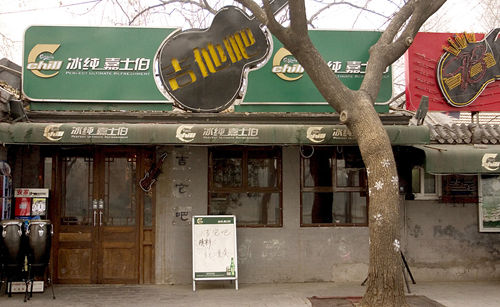
Hou Hai bars

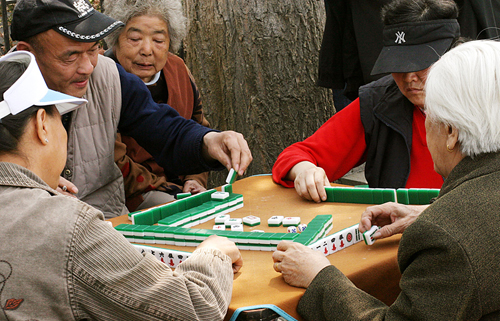
Mahjong players at Hou Hai

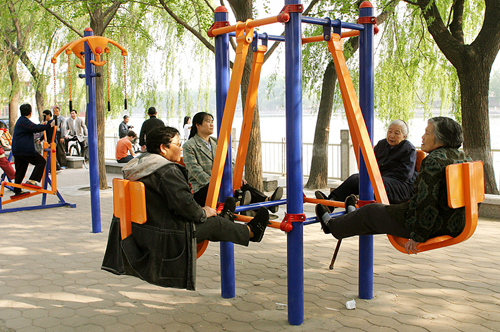
An exercise park beside Hou Hai
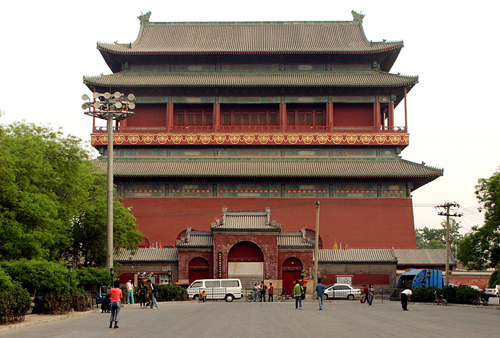
Drum Tower
Drum towers (gu lou)
were once found in all major Chinese towns. They housed large drums
that were beaten to mark the hour, keeping the city’s civil servants on
time for work. There has been such a tower on this site since 1272,
although the current structure dates to 1420. Visitors can clamber up
the torturously steep steps to inspect some 25 drums and be entertained
by a troop of drummers that delivers skin-thumping performances on the
hour.Gulou Dong Dajie
6401 2674
Subway: Gulou Dajie
Open 9am–4:30pm daily
¥20
Bell Tower
This
dates from 1745 and replaces an earlier tower that burnt down. The
great 42-ton (42,674-kg) bell it contains used to be rung to mark the
closing of the city gates in the evening. During Spring Festival
visitors are allowed to ring the bell for a donation of ¥100. The views
from both the Drum and Bell Towers over the neighboring hutongs are well worth the exhausting climb.Gulou Dong Dajie
6401 2674
Subway: Gulou Dajie
Open 9am–4:30pm daily
¥15

Bell Tower
Nan Luogu Xiang
Less
than 10 minutes’ walk east of the Drum Tower, Nan Luogu Xiang is a
arguably Beijing’s hippest hutong. Still traditional in feel, the alley
is home to quite a few small hotels, as well as several interesting
clothing and craft boutiques, and an ever-increasing number of cafés and
bars, including the excellent Pass By Bar.Set
back from the road with a sign on top in green characters, and opposite
a branch of KFC, this museum is dedicated to the man regarded as the
founder of modern Chinese painting. It exhibits a collection of the
lively watercolors of horses that made Xu Beihong (1885–1953)
internationally famous.53 Xinjiekou Bei Dajie
6225 2187
Subway: Jishuitan
Open 9am–4pm Tue–Sun
¥10 (audio guide ¥10, plus ¥100 deposit)
Former Residence of Mei Lanfang
This
was the home of Beijing Opera’s greatest ever performer (1894–1961).
The rear rooms have been left with their traditional furniture as it was
when he died. Others contain a hagiographic account of his life, as
well as diagrams of the stylized movements required by the form and a
video of Mei, already 61, but still playing the young girl roles for
which he was famous.9 Huguosi Jie
6618 0351
Subway: Jishuitan
Open 9am–4pm Tue–Sun
¥10
Confucius Temple (Kong Miao)
Just
west of the Lama Temple, the Confucius Temple was built in 1302 during
the Mongol Yuan dynasty, and expanded in 1906. Around 200 ancient stelae
stand in the courtyard in front of the main hall, inscribed with the
names of those who success-fully passed the imperial civil service
exams. On a marble terrace inside the hall are statues of Confucius and
some of his disciples.13 Guozijian Jie
8402 7224
Subway: Yonghe Gong
Open 8:30am–4:30pm daily
¥20
Di Tan Park
The
park was named after the Temple of Earth (Di Tan), which was a venue
for imperial sacrifices. The altar’s square shape represents the earth.
These days, the park is always full of pensioners strolling, chatting,
and exercising. A lively temple fair is held here at Chinese New Year.

Di Tan Park
North of Lama Temple
6421 4657
Subway: Yonghe Gong
Open 6am–9:30pm daily
Park ¥2; Altar ¥5