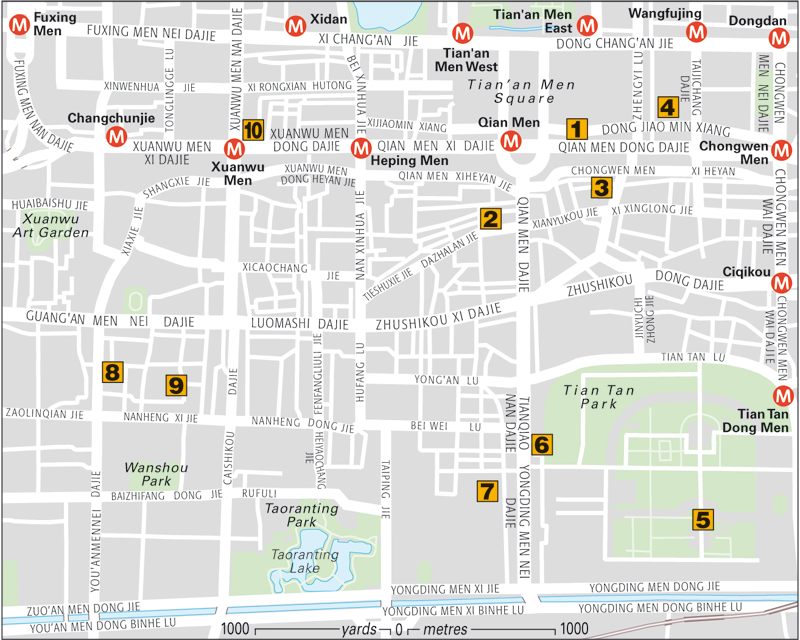
The Qian Men (front gate) at the southern end of
Tian’an Men Square was once part of the inner city walls. These divided
the imperial quarters of the Manchu emperors from the “Chinese city,”
where the massed populace lived apart from their overlords. Walking
south from the gate you are immediately plunged into a network of narrow
and lively hutongs
(alleys), the remnants of the old quarter. Continuing south down Qian
Men Dajie eventually brings you to the western perimeter of the grounds
of the Temple of Heaven, one of Beijing’s most evocative sights.
Top 10 Sights
Urban Planning Museum
On
display here are dreams of the architecture and urban landscape of
Beijing to be. These are dramatically represented through the medium of
film, plus a vast model that covers most of the third floor and that is
viewable from a gallery above.20 Qian Men Dong Dajie
6701 7074
Subway: Qian Men
Open 9am–5pm Tue–Sun
¥30
Qian Men, Dazhalan & Liulichang
A
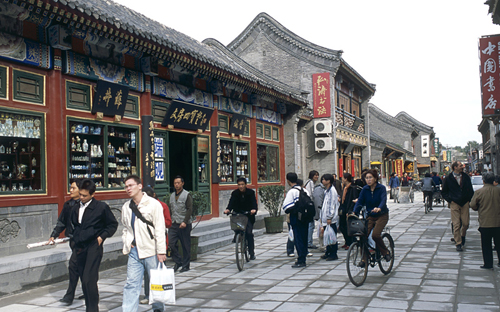
historical royal street and traditional shopping area, quaint Qian Men
Dajie has a 1920s-style tram line and birdcage-like streetlamps. Running
west off the northern end of Qian Men is Dazhalan Jie, an old hutong
area that is great for exploring on foot or by rickshaw. It is full of
Qing-era specialty shops selling pickles, silks, tea, and traditional
Chinese medicine. To the west of Dazhalan is Liulichang Jie, with many
restored buildings and many fascinating antique shops.Subway: Qian Men

Dazhalan Jie

Liulichang Jie
Underground City
At
the height of the Sino-Soviet rift in the 1960s, Mao Zedong gave orders
to carve out a vast network of bombproof tunnels beneath Beijing. Part
of this subterranean hideaway is open to the public. Guides show
visitors around a circuit of dank tunnels, where signs illustrate the
earlier functions of rooms, variously designated as hospitals, armories,
and stores for food and water. Unlit passageways branch off from the
main corridors, but many are blocked, and it is dangerous to wander off
alone.62 Xi Damochang Jie
6702 2657
Subway: Chongwen Men
¥20
Legation Quarter
At
the end of the Second Opium War, in 1860, foreign delegations were
permitted to take up residence in a quarter southeast of the Forbidden
City. On main Dong Jiao Min Xiang and surrounding streets, the first
modern foreign buildings in Beijing took root. The embassies have long
since left, and new occupants have moved in.The former American
legation, for instance, is now a restaurant, bar, and lifestyle complex.
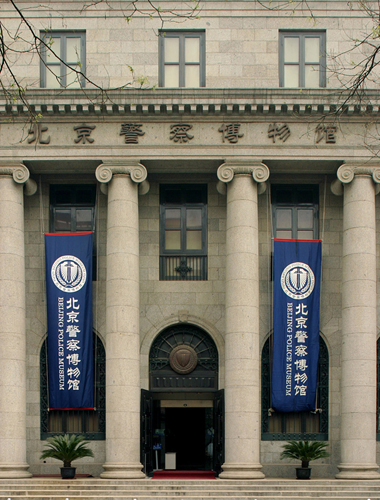
Also here are the former City Bank of New York, now the Beijing Police Museum, and St. Michael’s Church.

Beijing Police Museum, Legation Quarter
Subway: Qian Men
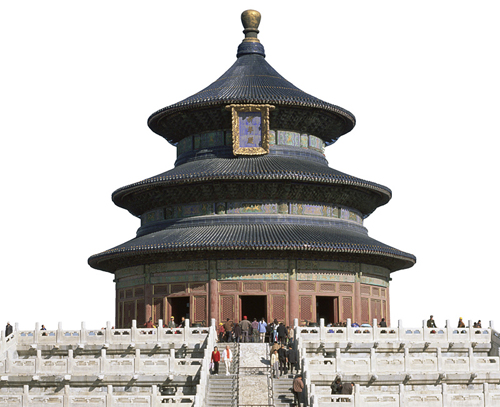
Temple of Heaven
The
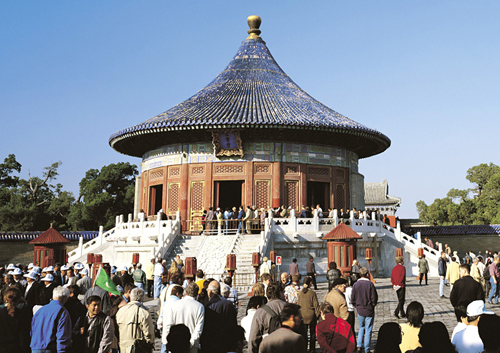
name refers to a vast complex that encompasses a large, marble
sacrificial altar, the iconic three-story Hall of Prayer for Good
Harvests, the smaller Imperial Vault of Heaven, and many ancillary
buildings, all set in a landscaped park. Allow at least a half day to
take in everything .

Imperial Vault of Heaven

Temple of Heaven
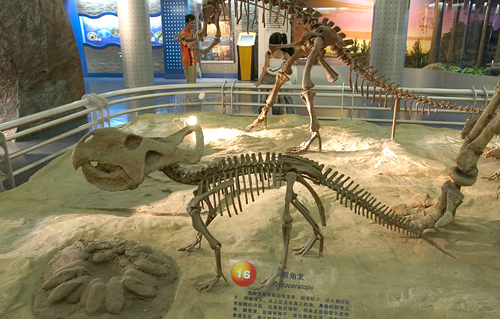
Natural History Museum
An
overbearing piece of 1950s architecture houses a great collection of
dinosaur skeletons, as well as stuffed pandas and other animals. There
are also fish, both dead (preserved in formaldehyde) and alive (in the
aquarium). Visitors of a nervous disposition may want to skip the
partially dissected human cadavers, also pickled in formaldehyde, which
are displayed up on the third floor.

Natural History Museum
Ancient Architecture Museum
Housed
in the Hall of Jupiter, part of the Xiannong Tan temple complex, this
museum offers an excellent introduction to the ancient construction
techniques of Beijing buildings, all helpfully illuminated with detailed
models. A fascinating three-dimensional plan shows the city as it was
in 1949, its city walls and gates largely intact.21 Dongjing Lu
6301 7620
Bus 15 to Nanwei Lu
Open 9am–4:30pm daily
¥15
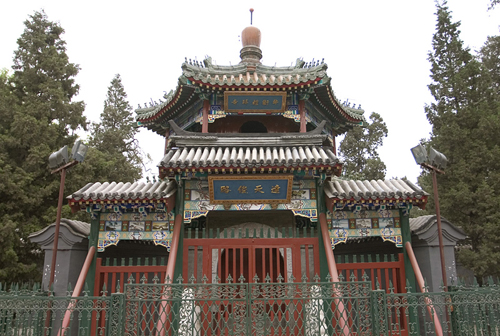
Cow Street Mosque (Niu Jie)
Beijing’s
oldest and largest mosque dates back to the 10th century. It’s an
attractive building with Islamic motifs and Arabic verses decorating its
halls and assorted stelae. Astronomical observations were made from the
tower-like Wangyue Lou. The courtyard is lush with greenery, making it
an idyllic escape from the city streets. Visitors should dress
conservatively, and non-Muslims are not allowed to enter the prayer
hall.

Cow Street Mosque
88 Niu Jie
6353 2564
Subway: Xuanwu Men, then bus
Open 8am–sunset daily
¥10
Fayuan Temple
This
temple dates back to AD 696 and is probably the oldest temple in
Beijing. All this time later, it remains a hive of activity. The layout
is typical of Buddhist temples. Near the gate, the incense burner is
flanked by the Drum and Bell Towers to the east and west. Beyond, the
Hall of the Heavenly Kings is guarded by a pair of bronze lions. The
Scripture Hall at the temple’s rear stores sutras, while another hall contains a 16-ft (5-m) statue of Buddha.7 Fayuan Si Qian Jie
6353 4171
Subway: Xuanwu Men, then bus
Open 8:30am–3:30pm daily
¥5
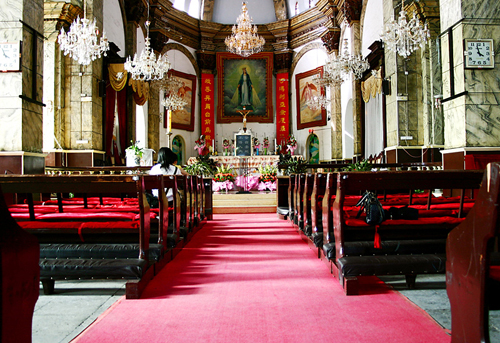
South Cathedral
The
first Catholic church to be built in Beijing stands on the site of the
residence of the first Jesuit missionary to reach the city, Matteo
Ricci. Arriving in 1601, the Italian won the favor of the Wanli emperor
by presenting him with gifts of European curiosities such as clocks and
mathematical instruments. Ricci founded the church in 1605, although the
present building dates to 1904, replacing a structure that was burned
down during the Boxer Rebellion. It boasts some fine stained-glass
windows.

South Cathedral
141 Qian Men Xi Dajie
Subway: Xuanwu Men