The geographical, spiritual, and historical heart of
Beijing, Tian’an Men Square and the Forbidden City together represent a
yin and yang arrangement; one is a mind-bogglingly vast, empty,
rectangular public space, the other is an even more massive, rectangular
walled private enclosure. One represents modern China, complete with
its Socialist monuments, refrigerated Great Leader and resonances of
recent political upheaval, while the other is a silent repository of
ancient imperial glories. There is enough to see around the square and
in the Forbidden City to make it worth setting aside a whole day for
each. One day will present a vivid impression of China as it was, and
the other an equally striking portrait of the country as it is now. And
after all that, wander around the corner for a look at the new National
Grand Theater and a glimpse of the China of the future.
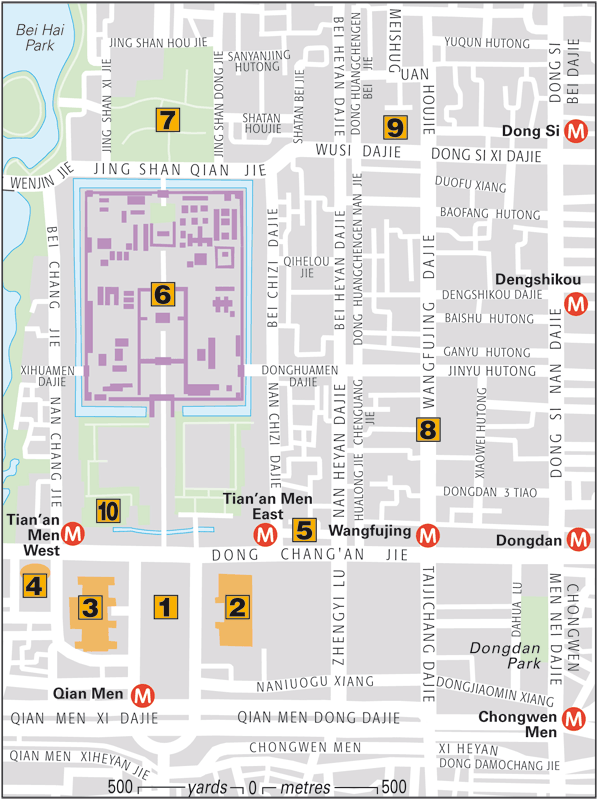
Top 10 Sights
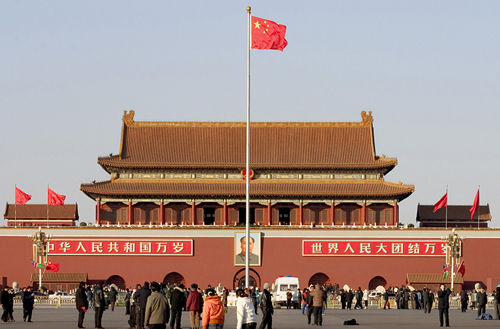
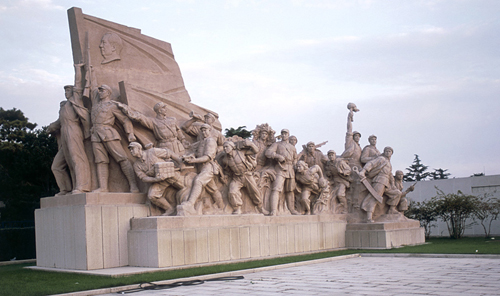
Tian’an Men Square
Although
now thoroughly synonymous with Beijing, until relatively recently there
was no Tian’an Men Square. For centuries this was just a main
thoroughfare leading to the Gate of Heavenly Peace (Tian’an Men) and the
approach to the Forbidden City. The area was cleared in the first half
of the 20th century, then quadrupled in size in 1959, supposedly
allowing for up to one million people to gather. Many of the buildings
flanking the square were erected at this time .

Tian’an Men Square
China National Museum
This
imposing building houses both the Museum of Chinese History and the
Museum of the Revolution. Of the two, the former is by far the more
interesting, with an unsurpassed collection of great works of Chinese
art; the halls here are also used for temporary exhibitions. The Museum
of the Revolution contains models, documents, and photographs connected
with the history of the Chinese Communist Party – for political
enthusiasts only. The China National Museum is closed for refurbishment
until 2010.East side of Tian’an Men Square
6512 8901
Subway: Tian’an Men East
Closed until 2010
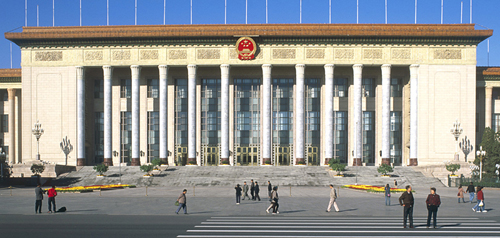
Great Hall of the People
This
the Chinese parliament building, home of the nation’s legislative body,
the National People’s Congress. Regular tours visit the banquet room
where US President Nixon dined in 1972 and the 10,000-seat auditorium
with its ceiling inset with a massive red star. The building is closed
to the public when the Congress is in session.

Great Hall of the People
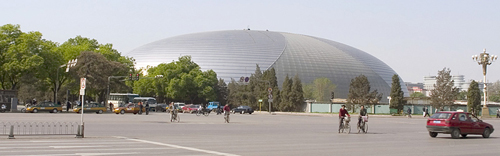
National Grand Theater
Completed
in 2006, Beijing’s new opera house is already a major city landmark.
Designed by French architect Paul Andreu, it is built of glass and
titanium and takes the form of a giant parabolic dome – earning it the
nickname “The Egg.” The high-tech lighting that illuminates the exterior
is reflected in a moat, while the entrance is through an underwater
tunnel.2 West Chang An Jie
6655 0000
Subway: Tian’an Men West

National Grand Theater
Imperial City Museum
Much
of the Imperial City of Beijing was destroyed under the Communists. A
model in the museum illustrates the extent of what has been lost,
including the wall that once encircled the city, the gates, and a great
many temples. There are also exhibits on the hutongs, plus collections
of armor, weapons, and ceramics.Forbidden City
The
Forbidden City is Beijing’s top “must-see” sight. A seemingly endless
collection of pavilions, gates, courts, and gardens, the complex
encompasses five centuries of colorful, occasionally lurid, imperial
history. Trying to see everything in one go will bring on a severe case
of Ming fatigue, and it is recommended that you tackle the palace over
at least two visits .

Forbidden City
Jing Shan Park
Jing
Shan (Coal Hill) lies immediately north of the Forbidden City. The hill
was created from the earth that was excavated while building the moat
around the palace complex during the reign of the Ming Yongle emperor.
The hill’s purpose was to protect the emperor and his court from malign
northern influences, which brought death and destruction according to
classical feng shui. The park is dotted with pavilions and halls, but
the highlight is the superb view south from the hill-top Wancheng
Pavilion.1 Wenjin Jie
6404 4071
Bus: 5, 111, 124, 810
Open 6am–9pm daily
¥2
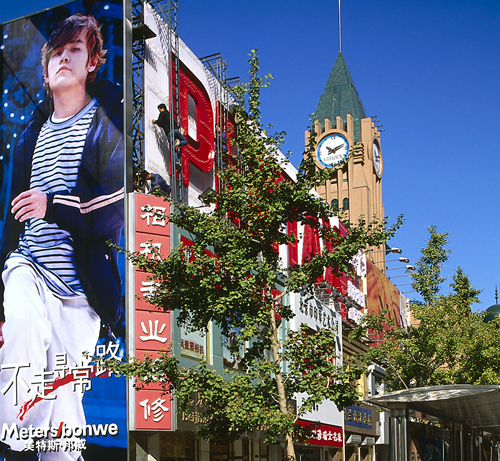
Wangfujing Dajie
Beijing’s main shopping street is filled with department stores and giant malls (see Shops, Malls, and Markets),
as well as stores selling silk, tea, and shoes. Another highlight is
the Night Market, with its range of open-air food stalls (see Wangfujing Night Market). A little to the north is St. Joseph’s, one of the city’s most important churches .Subway: Wangfujing
Night Market
Open 5:30pm–10pm daily

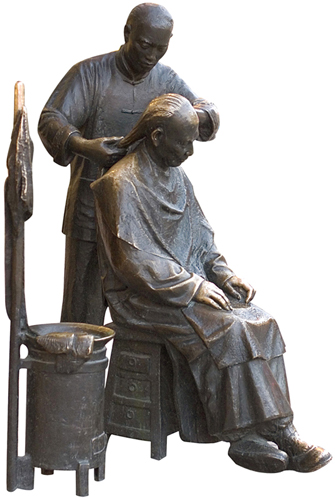
Wangfujing street sculptures

Wangfujing Dajie shopping street
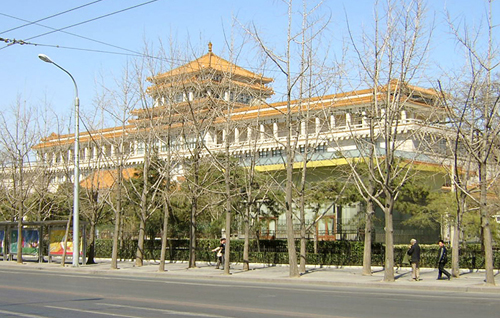
National Art Museum of China
The
largest art gallery in China was one of ten key buildings erected in
1959 to celebrate the tenth anniversary of the founding of the People’s
Republic. It has no permanent collection but its 14 halls, spread over
three floors, host a constant rotation of temporary exhibitions of
Chinese and international art.1 Wusi Dajie
8403 3500
Subway: Dong Si
Open 9am–5pm daily; last entry 4pm
¥20; audio guides ¥10 (plus ¥100 deposit)

National Art Museum of China
Zhong Shan Park
Northwest
of the Tian’an Men, Zong Shan (also known as Sun Yat Sen Park) offers
respite from the crowds thronging the nearby sights. The park was once
part of the grounds of a temple and the square Altar of Earth and
Harvests remains. In the eastern section is the Forbidden City Concert
Hall, Beijing’s premier venue for classical music.6605 2528
Subway: Tian’an Men West
Open 6am–9pm daily
¥3