Officially known as the Palace Museum, this
magnificent complex is a grand monument to the 24 emperors who ruled
from its halls over a period of almost 500 years. The symbolic center of
the Chinese universe, the palace was the exclusive domain of the
imperial court from its completion in 1420 until the last of the
emperors was forced to abdicate at the beginning of the 20th century.
The modern world intruded in 1949, when the public were finally admitted
through the palace gates.
-
North of Tian’an Men Square
-
8511 7048
-
Subway: Tian’an Men West or Tian’an Men East
-
Audio guides are available for ¥40 (plus ¥100 deposit)
-
www.dpm.org.cn
|
|
Pu Yi, ascended the throne
at the age of three in 1908, but his brief reign was brought to an
early end in 1912 by a new Republican government. The young ex-emperor
continued to live in the Forbidden City until ejected in 1924. He was
later imprisoned under the Communists, until Mao granted him amnesty in
1959. He died in 1967, after working for seven years as a gardener.
|
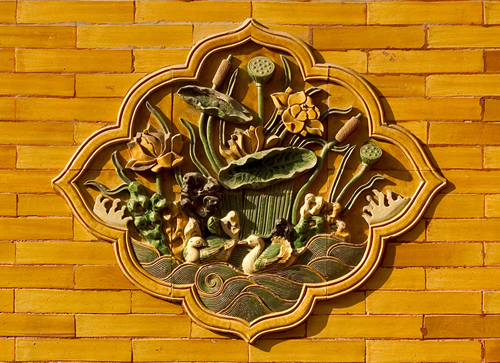
Glazed panel with lotus and mandarin ducks
|
There are various snack kiosks near the ticket office, and one restaurant inside the Forbidden City.
|
|
|
Most visitors buy
their tickets at the Meridian Gate, but to avoid the lengthy queues you
could enter the Forbidden City from the north via the Gate of Divine
Prowess, and visit in reverse.
|
|
Top 10 Features
-
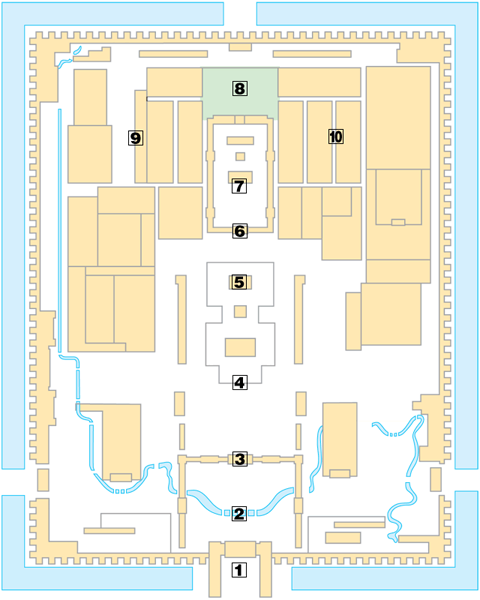
Meridian Gate
In
Chinese it is the Wu Men. This is the traditional entrance to the
palaces. From the balcony the emperor would review his armies and
perform ceremonies marking the start of the new lunar year.
-
Golden Water
Five
marble bridges, symbolizing the five cardinal virtues of Confucianism,
span the Golden Water, which flows from west to east in a course
designed to resemble the jade belt worn by the court officials.
-
Gate of Supreme Harmony
The
fourth and final great gate gives access into the Outer Court, the
heart of the Forbidden City. The gate is guarded by two large bronze
lions, classic imperial symbols of power and dignity. The lion on the
right is the male; the one on the left with a cub under its foot is the
female.
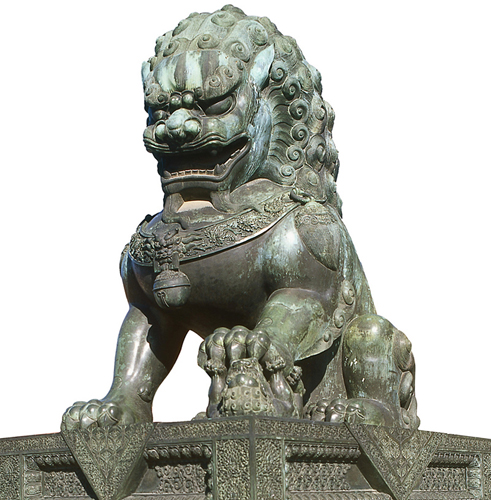
Bronze guardian lion
-
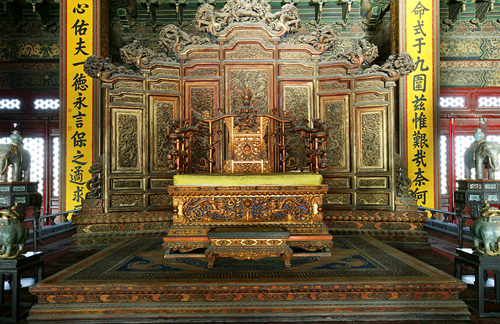
Hall of Supreme Harmony
Raised
on a triple tier of marble terraces, this largest of halls houses a
sandalwood throne, used in the coronations of 24 emperors.
-
Hall of Preserving Harmony
The
most spectacular aspect of this hall is the great carved ramp on the
north side, sculpted with dragons and clouds, and made from a single
piece of marble weighing more than 200 tons.
-
Gate of Heavenly Purity
The
only building in the whole palace not to have been burnt down at least
once, and thus the oldest hall of all. It is the boundary between the
Outer Court (official) and Inner Court (private).
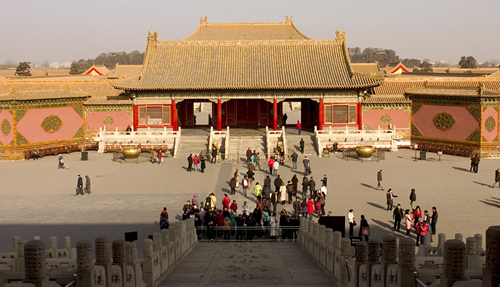
-
Inner Court
The
Inner Court is more intimate than the formal Outer Court, because this
is where the emperor, empress, and the many concubines actually lived.
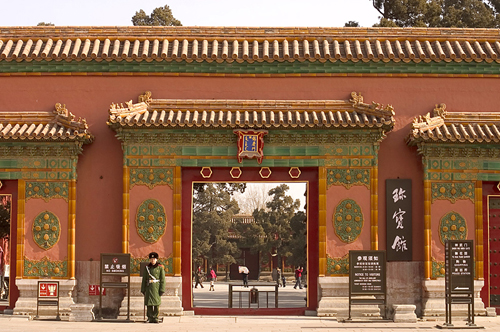
-
Imperial Garden
The
emperor Qianlong wrote that, “Every ruler, when he has finished his
public duties, must have a garden in which he can stroll, and relax his
heart.” This formal garden, the oldest in the Forbidden City, has two
beautiful pavilions.
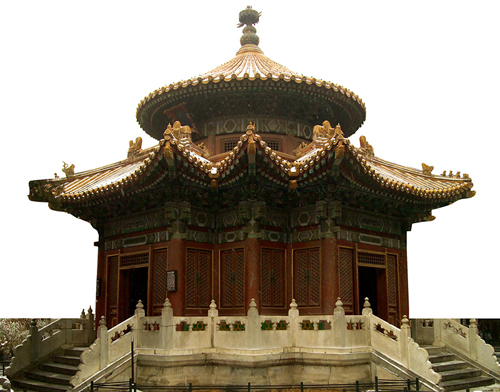
-
Western Palaces
Much
of the western flank of the complex is off limits, but some of the
halls neighboring the Inner Court are visitable, including the Palace of
Eternal Spring, where trompe-l’oeil paintings at the ends of passageways make them appear infinitely extended.
-
Eastern Palaces
East of the Inner Court are smaller halls where the emperor’s harem lived. Also here is the well down which the Empress Cixi had her nephew’s favorite concubine thrown.