Forbidden City Collections
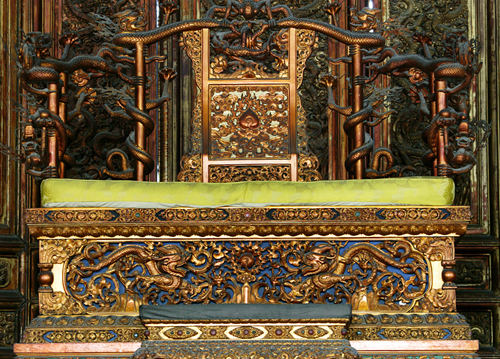
Imperial throne
-
Musical instruments
In
true imperial fashion, the more lavish the musical entertainment, the
more glory it reflected on the emperor. Court musicians used gongs of
all sizes and guqins (zithers), wooden flutes, and heavy bronze bells adorned with dragons, as well as the unusual sheng,
a Sherlock Holmes-style pipe with reeds of different lengths sprouting
from the top. The collection is displayed in the Silver Vault of the
Imperial Palace, on the west side of the Outer Court. -
Scientific instruments
Enlightened
Qing emperor Kangxi (1654–1722) appointed Europeans as court officials,
and instructed his imperial workshops to copy Western scientific
instruments. These included the first calculator, astronomical and
drawing tools, sun dials, moon dials, and a special table with
measurements and scientific notations scratched on each side leaf, made
especially for the imperial studies. The instruments are part of the
Imperial Treasures of the Ming and Qing Dynasties exhibit, on the west
side of the Inner Court. -
Stone drums
The
Hall of Moral Cultivation holds the palace’s collection of stone drums.
These are enormous tom-tom shaped rocks that bear China’s earliest
stone inscriptions dating back to 374 BC. These ideographic carvings are
arranged in four-character poems, which commemorate the glorious
pastureland and successful animal husbandry made possible by the Emperor
Xiangong’s benevolence. -
Jewelry
Also
in the Hall of Moral Cultivation are three of the six halls of jewelry
(head north for rooms four through six), including the only hall to
display actual jewelry rather than agate cups or jade sculpture. Hall
number three has thick jade rings, lapis lazuli court beads, elaborate
headdresses made of gold filigree phoenixes, and surprisingly, jadeite
Christian rosary beads.
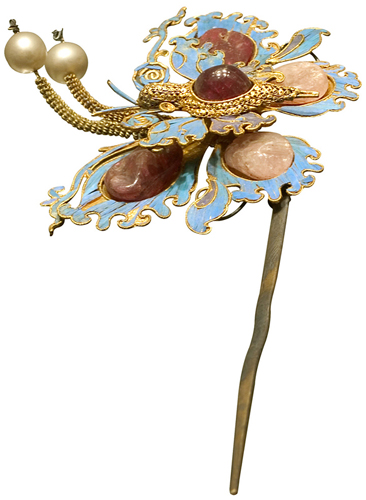
Butterfly brooch
-
Beijing Opera
The
pleasantly named Pavilion of Cheerful Melodies sports a three-story
stage large enough to accommodate one thousand actors. It was once
rigged with pulleys and trapdoors to create dramatic entrances for
supernatural characters. The exhibits include a behind-the-scenes model
stage, as well as costumes, instruments, scripts, and cast lists. There
are screens showing reconstructions of old court performances.
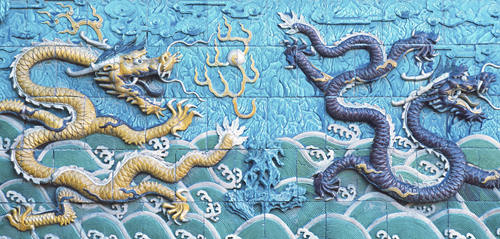
Nine-dragon screen
-
Jade
The
Hall of Quintessence was once where dowager empresses went to die; it
now exhibits jade artifacts spanning thousands of years. Pieces range
from simple cups and ladles to enormous and intricate sculptures of
Buddhas in traditional scenic settings. The Chinese considered working
this “hard” stone a metaphor for character development and the pursuit
of perfection. -
Every
three years, court officials would select girls between the ages of 13
and 17 to join the eight ranks of imperial concubines. The Yonghe
Pavilion exhibits clothing, games, herbal medicine, and a food
distribution chart relating to the young imperial consorts, as well as
the all-important “wedding night bed,” which is covered in a richly
embroidered red silk decorated with Chinese mythological symbols.
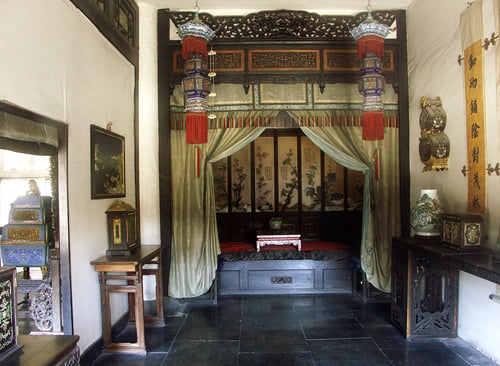
Imperial wedding bed
-
Clocks and watches
Arguably
the finest of the many and varied palace collections, the clocks and
watches fill the Fengxian Pavilion in the southeastern corner of the
eastern Inner Court. The size and creativity involved in some of the
pieces – which are primarily European – is astonishing. One particularly
inventive model has an automaton clad in European dress frantically
writing eight Chinese characters on a scroll, which is being unrolled by
two other mechanical figures.
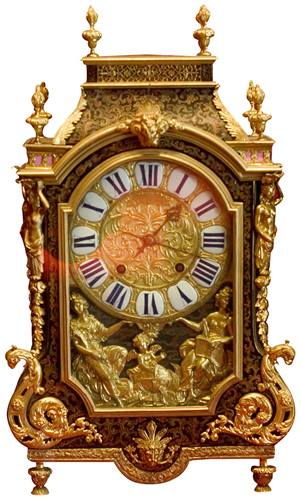
Ornate carriage clock
-
Ceramics
In
a ceramic salute to the Silk Road, several linked halls around the
Inner Court display tomb figurines from the Sui (581–618) and Tang
(618–906) dynasties. Still caked with earth, statues range from six
inches to three feet (15 cm to 1m) in height, and depict overweight
court ladies, Buddhas on elephants, and floppy-humped camels. A film
offers some background on the pottery finds. -
Empress Cixi
The Xianfu Pavilion is a memorial to the Empress Cixi’s
devious rise to power, as well as to the great lady’s imperial
extravagances, which so nearly crippled her country. Clothes, jewelry,
embroidered socks, imported perfume, jade and ivory chopsticks, and
pictures of clothes and food form the bulk of the exhibits. There are
also examples of the empress’s calligraphic skills in the form of
painted wall hangings.