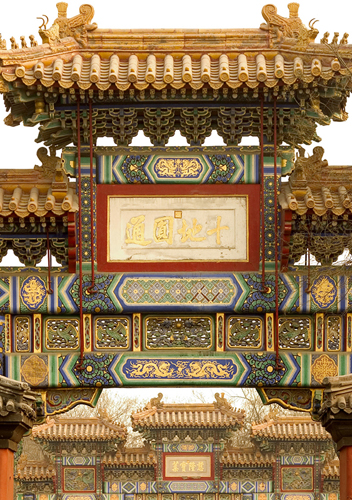
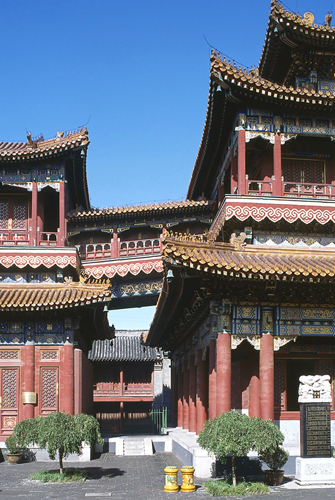
Beijing’s most spectacular place of worship is also
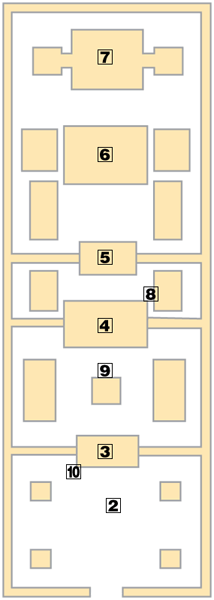
the most famous Buddhist temple outside of Tibet. It has five main
halls, as well as some stunning statuary. The path through the Lama
Temple proceeds from south to north – from earth to heaven.
While the Dalai Lama, head
of the sect to which the Lama Temple belongs, lives in exile, the second
head, the Panchen Lama, resides in Beijing. In contrast to the Dalai
Lama, the Panchen recognizes Chinese authority. However, the matter of
the true identity of the Panchen Lama is a matter of controversy. China
supports one candidate, while the Tibetans recognize another – only he
vanished in suspicious circumstances in 1995. |


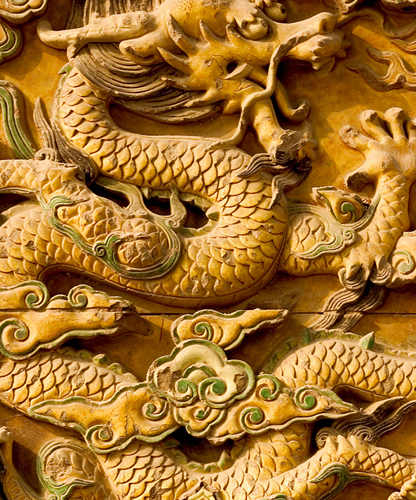
Imperial dragon decoration
There are various snack kiosks inside the Lama Temple, but it is a better idea to bring your own refreshments. |
|
Photography is not allowed within the halls, but you can take pictures of the exteriors and of the courtyards. |
|
Top 10 Features
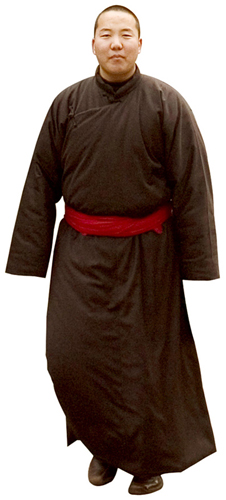
Monks
At
one time there were 1,500 monks at the temple, now there are only 70.
Although of the same Yellow Hat sect as the Dalai Lama the monks are
required to reject Tibetan independence.

Drum and Bell Towers
The
temple’s Drum and Bell towers are in the first courtyard after passing
through the main entrance. The huge bell has been removed from its tower
and placed on the ground.
Hall of the Heavenly Kings
The
first hall has a plump laughing Buddha, Milefo, back-to-back with Wei
Tuo, the Guardian of Buddhist Doctrine. They are flanked by the Four
Heavenly Kings.
Hall of Eternal Harmony
This,
the second hall, contains three manifestations of Buddha. These
represent the past, present, and future, and are flanked by 18 luohan – those freed from the cycle of rebirth.

Hall of Eternal Protection
The third hall contains Buddhas of longevity and medicine. It also has two famous tangkas,
said to have been embroidered by Emperor Qianlong’s mother. Behind the
hall is a bronze sculpture of Mount Meru, the center of the Buddhist
universe.
Hall of the Wheel of Dharma
Hall
four has a 20-foot (6-m) high statue of Tsongkhapa, the 14th-century
founder of the Yellow Hat sect of Buddhism. Dominant in Tibetan politics
for centuries, the sect is led by the Dalai Lama and Panchen Lama.
Hall of Ten Thousand Happinesses
The
final pavilion houses an 80-foot (25-m) high Buddha carved from a
single piece of sandalwood. There’s a splendid collection of Tibetan
Buddhist objects in a room behind the hall.

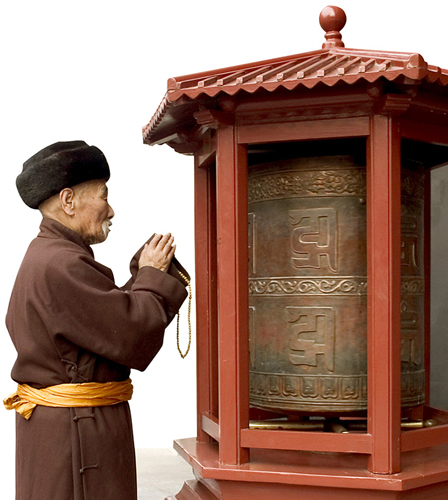
Prayer Wheel
Spinning
a prayer wheel sends a prayer written on coiled paper to heaven. A
little yellow arrow taped to the frame of the wheel reminds worshipers
which direction (clock-wise) to spin the wheel.

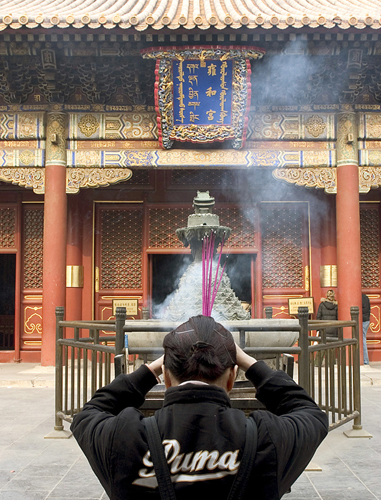
Incense Burner
There
are incense burners in front of all the many altars throughout the
temple. Shops lining the entryway to the complex and in the neighboring
streets are piled with bundles of incense sticks for sale for use at the
temple.
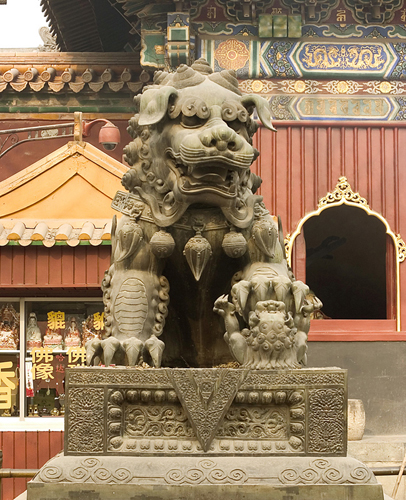
Lion Statue
A
large imperial lion is a reminder that the complex was originally the
residence of the man who would become Qing emperor Yongzheng. On
ascending the throne in 1722, and in keeping with tradition, his former
home became a temple.