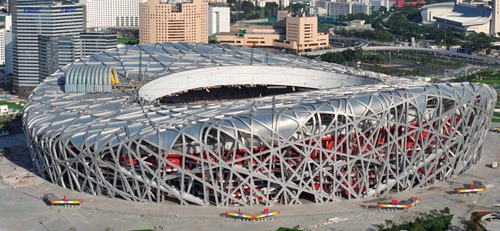
National Olympic Stadium (Bird’s Nest)
Of
all the buildings under construction in preparation for the Olympics,
the most striking is the new headquarters of China Central Television.
Designed by Dutch architect Rem Koolhaas, it is a gravity-defying loop
of horizontal and vertical sections. When completed it’s likely to
become one of the world’s most recognizable icons.

National Olympic Stadium
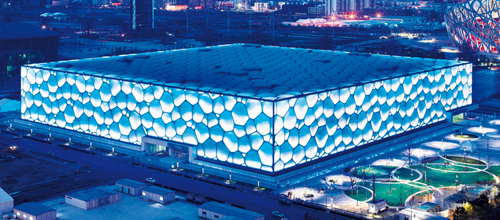
National Aquatics Center/Water Cube
Inspired
by the formation of bubbles and molecules, the Water Cube is a complex
of five pools. Now that the Games are over, it will lose two-thirds of
its seats to make room for a multipurpose leisure center that will
include an artificial beach and water slides.

National Aquatics Center
Olympic Green Convention Center
This
building hosted the fencing events during the 2008 Games, as well as
providing a home for the International Broadcasting Center. Its
distinctive shape mirrors the traditional Chinese “flying roof” and acts
as a giant rainwater collector. It is due to open as a conference venue
in July 2009.National Grand Theater (National Center for the Performing Arts)
French architect Paul Andreu’s silvery “Egg” provides a striking contrast to the monolithic, slab-like Socialist
architecture of neighboring Tian’an Men Square. The building is
surrounded by a reflective moat and accessed by an underwater tunnel. At
night, a part of the facade is transparent, so passers-by can see
what’s going on inside.The
most striking addition to the Beijing skyline is the new headquarters
of China Central Television. Designed by Dutch architects Rem Koolhaas
and Ole van Scheeren, it is a gravity-defying loop that pushes the
limits of architecture and reinvents the organization of spaces. When
completed, in 2009, it’s sure to become one of the world’s most
recognizable buildings.Television Cultural Center (TVCC)
The
most striking addition to the Beijing skyline is the new headquarters
of China Central Television. Designed by Dutch architects Rem Koolhaas
and Ole van Scheeren, it is a gravity-defying loop that pushes the
limits of architecture and reinvents the organization of spaces. When
completed, in 2009, it’s sure to become one of the world’s most
recognizable buildings.
Top 10 Socialist Monuments
Minzu Hotel
No Chinese motifs – but suitably monolithic and drab.
Chinese Military History Museum
Owes a striking debt to Moscow.
Natural History Museum
Neo-Classical Socialist Chinese – but nice inside.
National Art Museum of China
The largest art gallery in China.
Beijing West Railway Station
1995 update on 1959-style architecture.