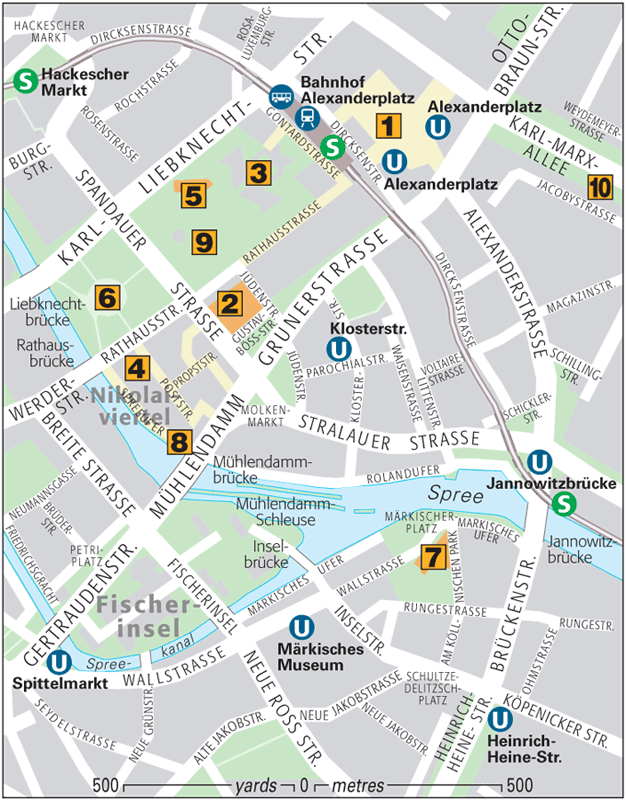
The area around
Alexanderplatz is one of the oldest parts of the city; it was here that
the twin towns of Cölln and Berlin merged to become one town in the 13th
century. Berlin’s oldest coherent quarter, the 18th-century
Nikolaiviertel and its medieval Nikolaikirche, the city’s oldest church,
lie in the shadow of the TV tower, the pride of the “capital” of former
East Germany. On the occasion of Berlin’s 750th anniversary, in 1987,
the East German government had the Nikolaiviertel restored. Very few of
the original buildings are preserved, however; most houses were rebuilt
from scratch. Only a few paces away from the alleyways of Nikolaiviertel
extends Alexanderplatz, referred to by locals simply as “Alex”. Before
World War II, Alex defined the heartbeat of the city; after the ravages
of war, it seemed vast and a little forlorn. Although the giant square
is now livelier again, especially in summer, a chilly easterly wind
still blows between the houses. The vibrancy of the square, as described
by Alfred Döblin in his novel Berlin Alexanderplatz, is only slowly returning to the area. Much building and reconstruction work is planned for Alex in the coming years.
|
|
Top 10 Sights
Alexanderplatz
The
vast, largely desolate square in the centre of East Berlin, called
“Alex” by Berliners, was one of the most vibrant places in Berlin before
World War II – and no doubt it will be again some day. Alfred Döblin
beautifully captured the rhythm of the city in his world-famous novel Berlin Alexanderplatz. Not much remains today of the once frenzied atmosphere, although there is plenty of hustle and bustle around the Galleria Kaufhof department store.Originally,
Alex was a cattle and wool market. Not many of the prewar buildings
survived – only Berolinahaus and Alexanderhaus, next to the historic
S-Bahn station Alexanderplatz, remain, both dating back to 1929. The
square was almost completely laid to waste in World War II, and most of
the surrounding soulless tower blocks were built in the 1960s. There are
now plans to build skyscrapers on Alexanderplatz.Mitte

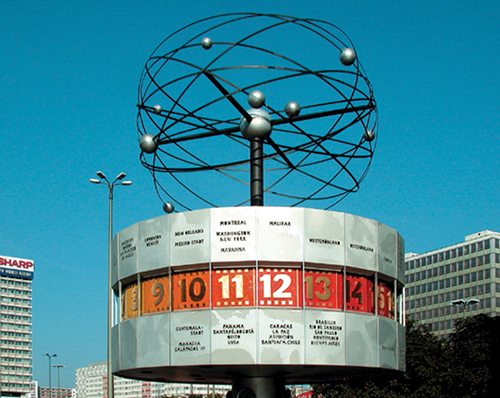
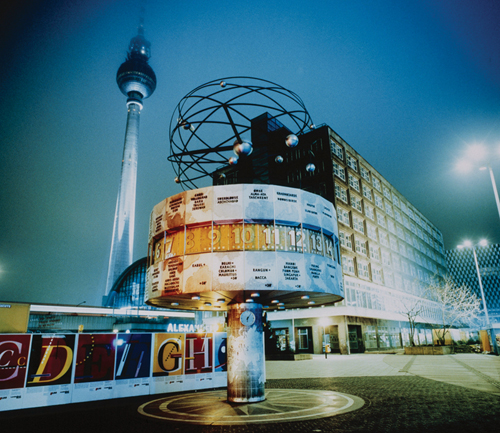
Weltzeituhr (world time clock) on “Alex”

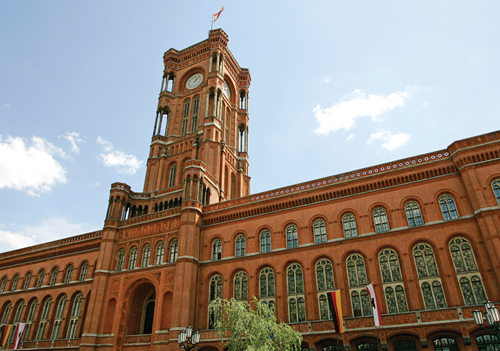
Berliner Rathaus
Berlin’s
proud town hall is the office of the Governing Mayor and is the
political centre of power in Greater Berlin. The Rathaus was built in
1861–9, according to plans by Hermann Friedrich Waesemann on the site of
an older town hall. It was designed to demonstrate the power and the
glory of Berlin, and the architect took his inspiration for the new
governmental building from Italian Renaissance palazzi.The
building is also known as the “Red Town Hall” – not a reminder of its
Socialist past, but a reference to the red bricks from Brandenburg
province from which it is built .Rathausstr. 15
9am–6pm Mon–Fri
030 90 26 0

Berliner Rathaus
Berliner Fernsehturm
The
368-m (1,207-ft) high TV tower is the tallest building in Berlin,
affording views of up to 40 km (25 miles) in good weather. There is a
viewing platform at 203 m (666 ft). The Tele-Café above rotates once
around its own axis every 30 minutes. The tower, visible from afar, was
erected in 1965–9 by the East German government to signify the triumph
of East Berlin, their “capital”.Panoramastr. 1a
Mar–Oct: 9am–midnight, Nov–Feb: 10am–midnight
030 242 33 33
Admission charge
Nikolaiviertel
Around the medieval Nikolaikirche,
the small Nikolaiviertel with its narrow nooks and crannies, Old Berlin
restaurants and souvenir shops is one of the most charming parts of the
city. The area extending between the banks of the Spree River and
Mühlendamm was razed to the ground in World War II. The East German
authorities restored it after the war – unfortunately not always
successfully: some houses were covered in prefabricated façades.Knoblauchhaus
was one of few to escape destruction. Dating from 1835, it was the
former home of the Knoblauch family (Neue Synagoge was designed by
architect Eduard Knoblauch). Today it houses a museum depicting everyday
life in Berlin, and includes a fully furnished apartment in the
Biedermeier style.Mitte, Knoblauchhaus: Poststr. 23
10am–6pm Tue, Thu–Sun, 10am–8pm Wed
030 240 02 01 71
Admission charge

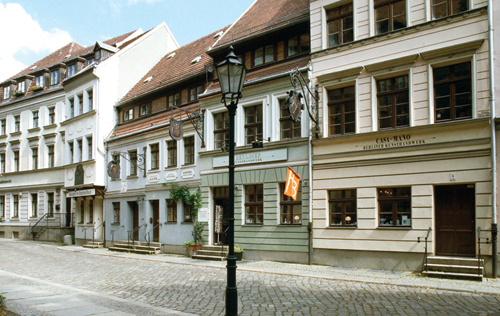
A street in Nikolaiviertel
Marienkirche
Originally
built in 1270, Marienkirche was extensively remodelled in the 15th
century. Thanks to its Baroque church tower, designed by Carl Gotthard
Langhans in 1790, it is one of Berlin’s loveliest churches. Inside, the
alabaster pulpit by Andreas Schlüter (1703) and the main altar (1762)
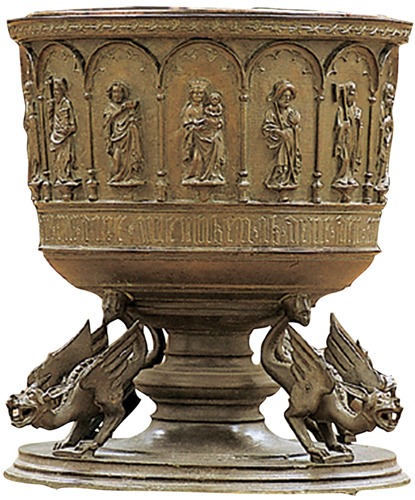
are particularly worth seeing. The 15th-century Gothic font and a 22-m
(72-ft) long fresco, Der Totentanz (The
Dance of Death) from 1485 are its two oldest treasures. The church was a
thorn in the side for the East German government because the cross on
its tower is reflected in the TV tower.Karl-Liebknecht-Str. 8
Apr–Oct: 10am–9pm daily; Nov–Mar: 10am–6pm daily
030 242 44 67

Font in Marienkirche
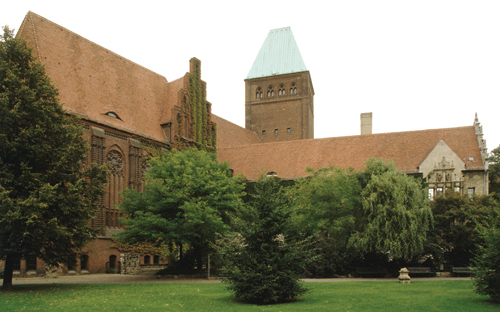
Märkisches Museum
Berlin’s
municipal museum displays architectural treasures such as doorways and
the head of one of the horses from the top of the Brandenburg Gate, plus
various items relating to theatre and music in Berlin.Am Köllnischen Park 5
10am–6pm Tue–Sun, noon–8pm Wed
030 30 86 215
Admission charge

Märkisches Museum
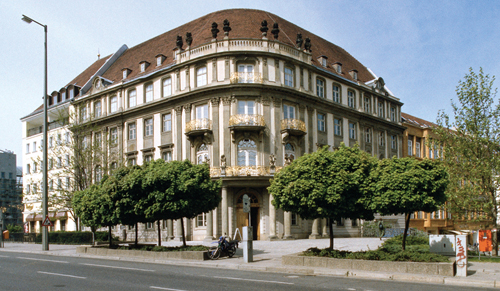
Ephraim-Palais
The
curved Baroque palace, built in 1766 for the wealthy merchant Nathan
Veitel Heinrich Ephraim, was once regarded as the city’s most beautiful
spot. Rebuilt after the old palace was demolished, it is now a museum
with exhibitions on Berlin art history.Poststr. 16
10am–6pm Tue & Thu–Sun, noon–8pm Wed
030 24 00 21 21
Admission charge

Ephraim-Palais
Karl-Marx-Allee and Frankfurter Allee
This
road, lined by Soviet-style buildings, was built as a showpiece for
Socialism in 1949–55. Known then as “Stalinallee”, it provided
ultra-modern apartments.Mitte/Friedrichshain