Kreuzberg is possibly
Berlin’s most notorious district, and it definitely qualifies as its
most colourful area. Here, in historic tenement blocks that are slowly
but surely being renovated, Turkish families live next door to drop-outs
and alternatives, artists and students. Social tensions, still
characteristic of Kreuzberg today, make this a varied and interesting
district – but at the same time a problematic one. The neighbouring
district of Schöneberg is markedly quieter; this part of town is not as
experimental as Kreuzberg, neither is it as elegant as Charlottenburg –
here Berlin is simply enjoyed by its inhabitants. Winterfeldtplatz is
surrounded by many inviting pubs, and in the area around Nollendorfplatz
entire roads have been taken over and transformed by Berlin’s gay
scene, with their shops, bars and night clubs.
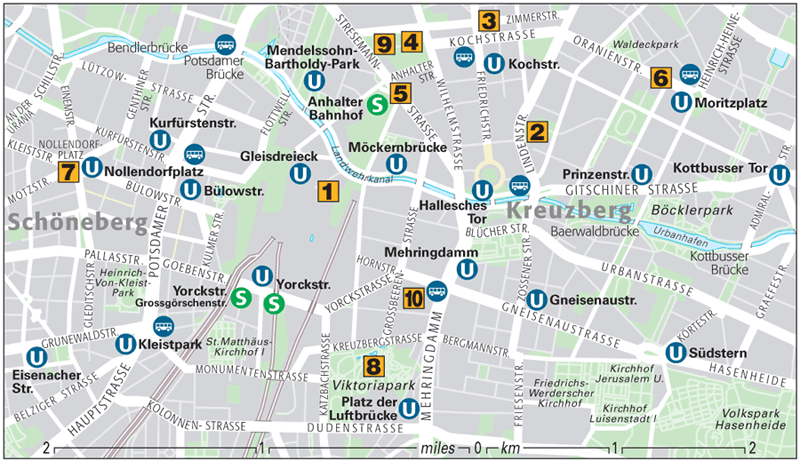
Top 10 Sights
Deutsches Technikmuseum
The
history of technology and crafts is the theme of this fascinating
museum, located in the grounds of a former station. Visitors can learn
about developments in aviation and admire 40 planes, including a Junkers
Ju 52 and a “raisin bomber”, the type of plane used for the Berlin
airlift. Old ships and steam locomotives bring back the days of the
Industrial Revolution.Trebbiner Str. 9
9am–5:30pm Tue–Fri, 10am–6pm Sat, Sun
030 90 25 40
Admission charge (free for children after 3pm)
Jüdisches Museum
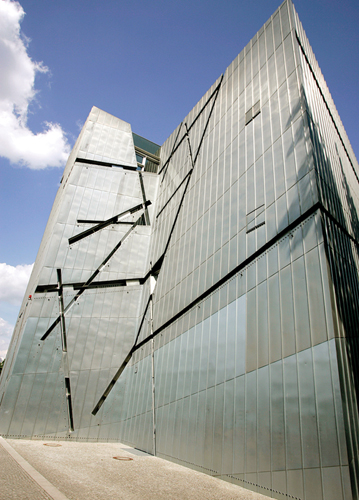
The
Jewish Museum is not only unique architecturally, but it is also one of
Berlin’s most fascinating museums. Its collections present an overview
of almost 1,000 years of German-Jewish cultural history; a special
exhibition is devoted to everyday Jewish life in Berlin from the end of
the 19th century .Lindenstr. 9–14
10am–10pm Mon, 10am–8pm Tue–Sun
030 25 99 33 00
Admission charge

Checkpoint Charlie
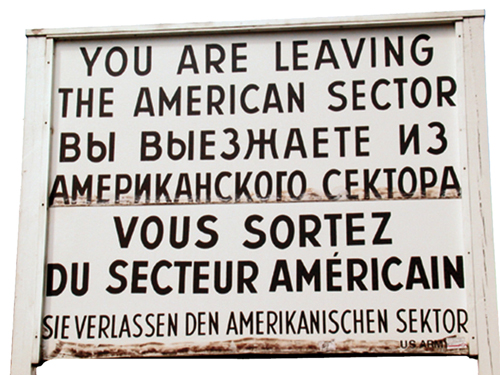
The
Haus am Checkpoint Charlie, next to the former crossing point for the
Alllied forces, has an exhibition on the history of the Berlin Wall and
the various means people used in trying to escape from East to West
Berlin, ranging from a hot-air balloon to a car with a false floor. Only
a replica of the control hut remains of the former border.Friedrichstr. 43–45
9am–10pm daily
030 253 72 50
Admission charge

The old sign at Checkpoint Charlie
Topographie des Terrors
After
1934, three terrifying Nazi institutions had their headquarters in this
area: the security service (Sicherheitsdienst, SD) was based at
Wilhelmstraße 102 in the Prinz-Albrecht-Palais; the school of arts and
crafts at Prinz-Albrecht-Straße 8 was occupied by the Gestapo; while
Heinrich Himmler, head of the SS, resided next door at No. 9, at the
Hotel Prinz Albrecht. After World War II, all the buildings were
bulldozed except for the cellars where, in 1933–45, prisoners had been
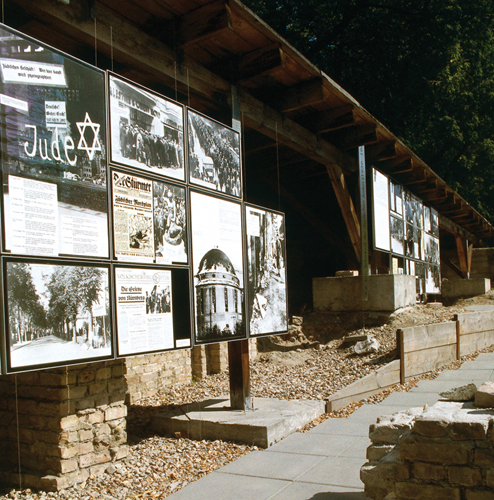
interrogated and tortured. An exhibition charts the history of the area
and a documentation centre opens in 2010.Stresemannstr. 110, entrance Niederkirchner Str. 8
May–Sep: 10am–10pm daily; Oct–Apr: 10am–6pm daily
030 25 48 67 03

Exhibition of Nazi crimes at Topographie des Terrors
Anhalter Bahnhof
Only
pitiful fragments remain of the railway station that was once the
largest in Europe. The giant structure was erected in 1880 by Franz
Schwechten as a showcase station: official visitors to the Empire were
meant to be impressed by the splendour and glory of the German capital
as soon as they reached the railway station. In 1943 the station was
badly damaged by bombs and in 1960 it was pulled down. The waste ground
behind the façade was meant to become a park; today the Tempodrom is
based here, hosting concerts and cabaret shows.Askanischer Platz 6–7
Oranienstraße
Oranienstraße
is the heart of Kreuzberg. It is the wildest, most colourful and most
unusual street of the district, where alternative shops and pubs jostle
for space with doner kebab take-aways and Turkish greengrocers. All
aspects of life and politics in Kreuzberg are centred around this road.

Nollendorfplatz
Nollendorfplatz
and neighbouring Winterfeldtplatz are right in the centre of
Schöneberg. The former square has always been a focal point for the gay
scene in Berlin, and a plaque at U-Bahn station Nollendorfplatz
commemorates approximately 5,000 homosexuals killed in concentration
camps by the Nazis. Today, gay life is concentrated more in the
surrounding streets. Before World War II, Nollendorfplatz was also a
centre of entertainment. The Metropol-Theater, today a discotheque, then
boasted Erwin Piscator as its innovative director. And next door lived
the writer Christopher Isherwood, whose novel formed the basis of the
famous musical “Cabaret”.

Façade of the Metropol
Viktoriapark
This
rambling park was set up as a recreational space for workers in
Kreuzberg in 1888–94 to plans by Hermann Mächtig. It has an artificial
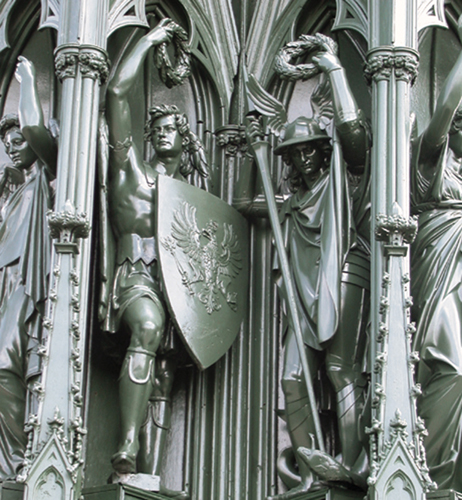
waterfall, and the Neo-Gothic Schinkel memorial at the top of Kreuzberg,
66 m (216 ft) high, commemorates Prussian victory in the Wars of
Liberation against Napoleon.Kreuzbergstr.

Memorial by Schinkel in Viktoriapark