Potsdam is an important part of European
cultural history – a splendid centre of European Enlightenment, which
reached its climax in the 18th century in the architectural and artistic
design of Frederick the Great’s palace. The palace complex of
Sanssouci, with its beautiful, extensive park, is both magnificent and
playful and has been designated a World Heritage Centre of Culture by
UNESCO. Every year, it enchants millions of visitors from around the
world. The town of Potsdam, numbering some 300,000 inhabitants, is the
capital of the federal province of Brandenburg. This former garrison
town has much to delight its visitors, including small palaces and old
churches, idyllic parks and historic immigrant settlements.
The Potsdam ConferenceIn July and August 1945, the heads of government |
|
|
|
NOTE
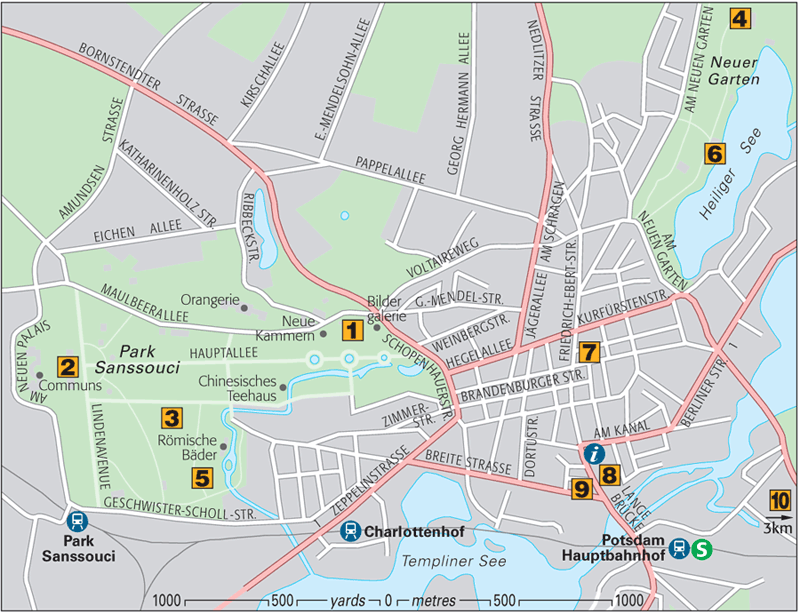
Top 10 Sights
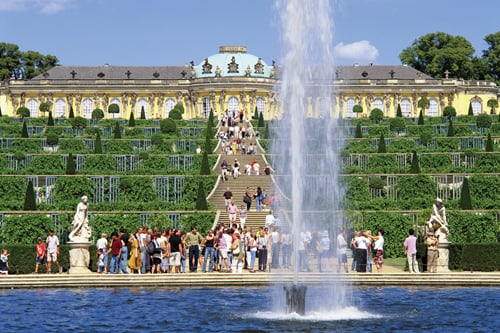
Schloss Sanssouci
The
Prussian King Frederick the Great wished to live “sanssouci”, in a
palace outside the boundaries of the hated city – the French phrase
means “without worries”. In 1745, Frederick commissioned his favourite
architect Georg Wenzeslaus von Knobelsdorff to plan and construct this
magnificent Rococo palace according to his own designs.The
main building with its yellow façade rises proudly above the former
terraced vineyards, leading up to the domed building and its elegant
marble hall at the centre of the palace complex. In both its design and
shape, the marble hall pays homage to the Pantheon in Rome. To its left
and right are some very attractive rooms designed by von Knobelsdorff
and Johann August Nahl; these include the famous concert room, adorned
with paintings by Antoine Pesne, and Frederick’s library. In this wing,
the monarch liked to play the flute or to philosophize with Voltaire.
Valuable paintings by Frederick the Great’s favourite painter, the
French artist Antoine Watteau, adorn the palace walls.Maulbeerallee
Apr–Oct: 10am–6pm Tue–Sun; Nov–Mar: 10am–5pm Tue–Sun
guided tour obligatory
0331 969 41 90
Admission charge

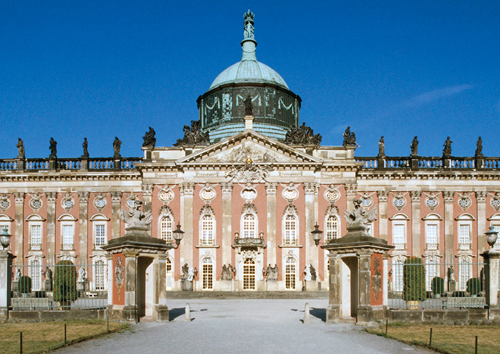
Neues Palais
To
the north of Sanssouci palace park rises the Baroque Neues Palais. One
of Germany’s most beautiful palaces, it was built in 1763–9 for
Frederick the Great according to designs by Johann Gottfried Büring,
Jean Laurent Le Geay and Carl von Gontard. The vast two-storey structure
comprises 200 rooms, including the Marmorsaal (marble hall), a lavishly
furnished ballroom, and the Schlosstheater, where plays are once more
performed today. Frederick’s private chambers are equally splendid,
especially his study furnished in Rococo style, the upper gallery with
valuable parquet flooring and the Oberes Vestibül, a room clad entirely
in marble.Am Neuen Palais
Apr–Oct: 10am–6pm Wed–Mon
audio guide available
guided tour obligatory
0331 969 42 02
Admission charge

Neues Palais
Schlosspark Sanssouci
It
is easy to while away an entire day in the extensive palace park, which
covers 287 hectares (709 acres) of land. Of the many charming buildings
hidden in the lavishly designed landscape garden, the Rococo-style
Chinesische Haus, built in 1754–6 by Johann Gottfried Büring, is
especially worth seeking out.Originally it served as a tea-house and dining room, and it now houses an exhibition of porcelain pieces from East Asia.
The Römische Bäder (Roman Baths), a group of pavilions next to the
lake, are also inspired by historic models. Modelled on an Italian
Renaissance villa, they were built between 1829 and 1840 by Friedrich
Karl Schinkel as guest and bathing houses.The
Orangerie, constructed in 1851–60 by Friedrich August Stüler, was also
originally intended to accommodate the king’s guests. Today it houses a
small gallery of paintings.Chinesische Haus
Am Grüen Gitter
mid-May–mid-Oct: 10am–6pm Tue–Sun
0331 969 42 25
Römische Bäder
Lennéstr
late-Apr–end-Oct: 10am–6pm Tue–Sun
0331 969 42 25
Orangerie
Am der Orangerie 3–5
May–Oct: 10am–5pm Tue–Sun
0331 969 42 80

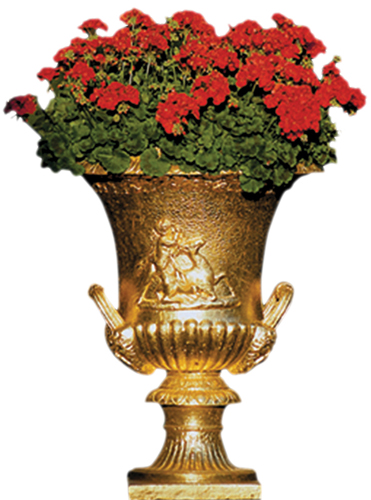
Vase in Park Sanssouci
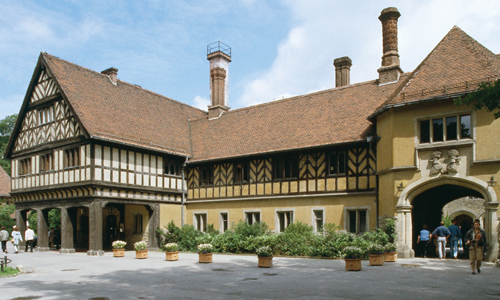
Schloss Cecilienhof
This
little palace, built in the style of an English country manor house,
entered the history books in 1945, when Germany’s fate was sealed by the
Potsdam Conference. Built in 1914–17, the palace is a UNESCO World
Heritage Site and is now used as a hotel. It also houses a small
exhibition documenting the Conference and the palace’s furnishings.Im Neuen Garten
Apr–Oct: 10am–6pm Tue–Sun; Nov–Mar: 10am–5pm Tue–Sun
0331 969 42 44

Schloss Charlottenhof
A
small Neo-Classical palace in Park Sanssouci, built in 1829 by Schinkel
for the heir to the throne, Friedrich Wilhelm IV. Particularly worth
seeing is the tent-like Humboldtsaal.Geschwister-Scholl-Str. 34a
May–Oct: 10am–6pm Tue–Sun
0331 969 42 28
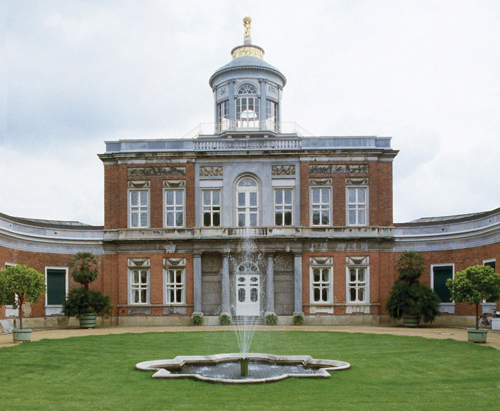
Marmorpalais
This
small, early Neo-Classical palace at the side of the lake was built in
1791–7 by Carl Gotthard Langhans and others. It features an elegant
concert hall as well as contemporary furniture and porcelain.Heiliger See (Neuer Garten)
Apr–Oct: 10am–6pm Tue–Sun; Nov–Mar: 10am–5pm Sat, Sun
0331 969 42 46

Marmorpalais
Holländisches Viertel
A
pleasant way to explore the district of Potsdam is a walk through the
historic Old Town, with its art galleries, cafés and restaurants. Built
between 1733 and 1742, the area originally served as a settlement for
Dutch workers after whom it is now named. The small red-brick buildings
are decorated with attractive stucco ornaments.Friedrich-Ebert-, Kurfürsten-, Hebbel-, Gutenbergstr
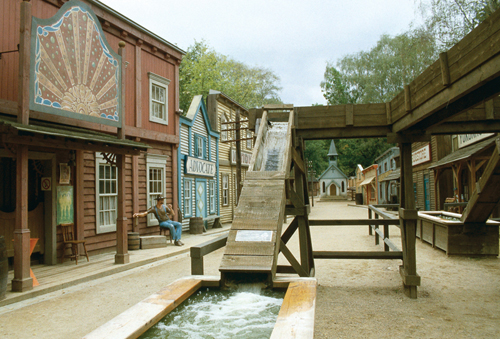
Filmpark Babelsberg
The
Filmpark offers visitors a tour of the legendary UFA-Studios, which
were among the world’s most important when they operated here in
Babelsberg from 1917 to 1945. Exciting U-boat trips, stunt performances
and special effects are shown.Großbeerenstr
Apr–Oct: 10am– 6pm daily
0331 721 27 50