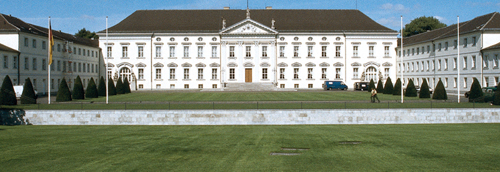
Schloss Bellevue
Built
according to plans by Philipp Daniel Boumann in 1785–90, this palace
was the residence of the Hohenzollerns until 1861. Since 1994 the
stately building with its Neo-Classical façade has been the official
residence of the President of the Federal Republic. The modern,
egg-shaped Presidential Offices stand immediately next to the old
palace.Spreeweg 1
Not open to the public

Schloss Bellevue
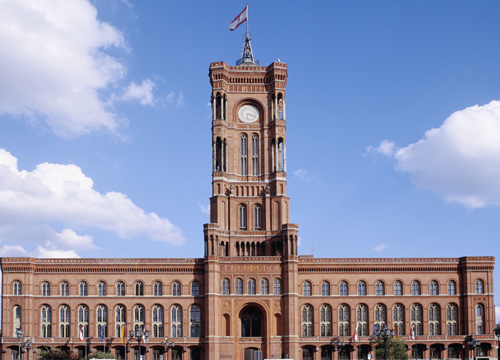
Berliner Rathaus
Berlin’s
Town Hall, also known as “Red Town Hall” because of the red bricks from
Brandenburg Province with which it is built, harks back to the proud
days when Berlin became the capital of the new Empire. Built in 1861–9
according to designs by Hermann Friedrich Waesemann, the town hall was
one of Germany’s largest and most magnificent buildings, built to
promote the splendour of Berlin. The structure was modelled on Italian
Renaissance palaces, and the tower is reminiscent of Laon cathedral in
France. The exterior was decorated with Die Steinerne Chronik (the stone chronicle) in 1879, depicting scenes from the city’s history .Rathausstraße 15
8am–6pm daily

Berliner Rathaus
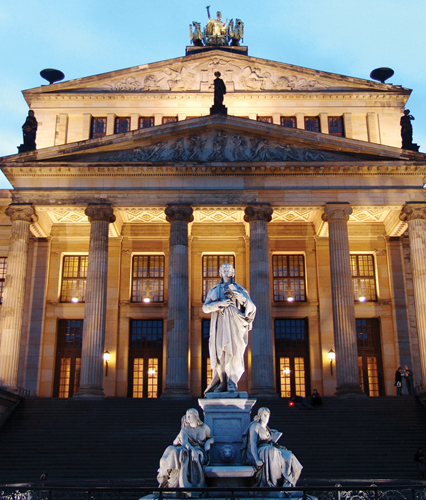
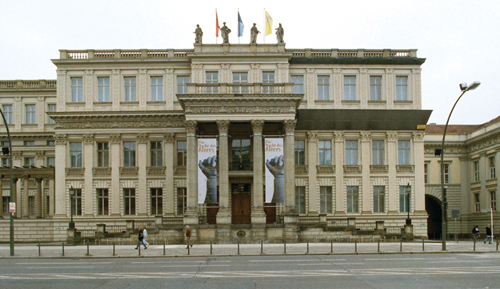
Konzerthaus
The Concert Hall, one of Karl Friedrich Schinkel’s masterpieces, was until recently known as Schauspielhaus
(theatre). The building has a portico with Ionic columns, and a large
number of statues of allegorical and historical personages, some riding
lions and panthers, as well as deities, muses and bacchants.

Portico of the Konzerthaus
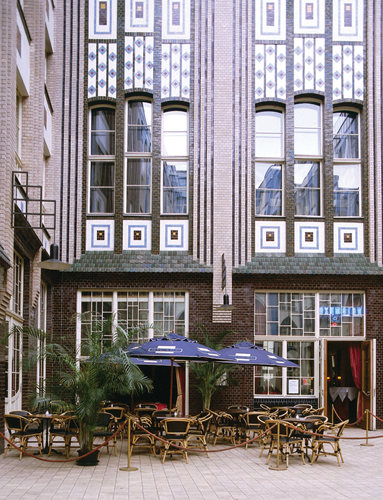
Hackesche Höfe
This
complex of 19th-century warehouses consists of nine interlinked
courtyards, some of which are decorated in Art-Nouveau style, originally
by August Endell. In the early 1990s the complex was completely
renovated. The first courtyard is particularly attractive: coloured
glazed tiles with geometric patterns decorate the house from the
foundations up to the guttering. In the last courtyard, trees are
grouped around an idyllic well. The Hackesche Höfe is one of Berlin’s
most popular hotspots; restaurants, cafés, a cinema and the Chamäleon
variety show attract visitors from afar.Rosenthaler Str. 40–41
9am–2am daily

Hackesche Höfe
Altes Museum and Lustgarten
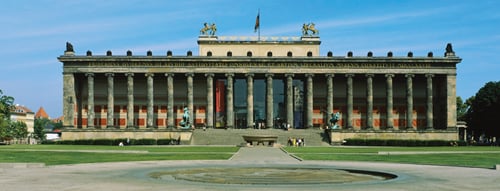
The
façade of the Old Museum, possibly one of the most attractive
Neo-Classical museums in Europe, is remarkable for the shiny red marble
used in its construction, which is visible behind 18 Ionic columns.
Built in 1830 according to plans by Karl Friedrich Schinkel, it was at
the time one of the first buildings to be created specifically as a
museum. Originally it was to house the royal collection of paintings;
today it is home to a collection of antiquities and the Egyptian Museum.
In front of the museum, on Museumsinsel,
are the gardens designed by Peter Joseph Lenné. Conceived as the king’s
herb garden, it is today decorated with a granite bowl by Gottlieb
Christian Cantian, weighing 70 tons.

Altes Museum