Gemäldegalerie
Architecture in the Kulturforum
The Kulturforum was
planned to fill the large area between Potsdamer Straße and Leipziger
Platz that had been destroyed during World War II. The original idea for
a varied townscape of museums and parks is credited to the Berlin
architect Hans Scharoun, who had designed plans for this in the years
1946 and 1957. It was also Scharoun who, with the construction of the
Philharmonie in 1963, set the character of the Kulturforum: the
tent-like, golden roofs of the music hall, the Kammermusiksaal and the
Staatsbibliothek, all designed by Scharoun and – after his death –
realized by his pupil Edgar Wisniewski, are today among Berlin’s
best-known landmarks. All the buildings are characterized by the
generous proportions of their rooms. In their day, the Scharoun
buildings were highly controversial but today they are considered to be
classics of modern architecture.
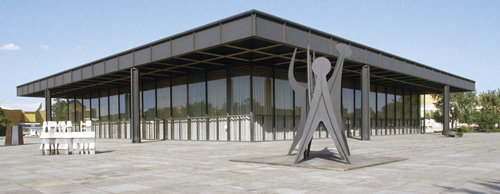
Mies van der Rohe’s Nationalgalerie
The Neue Nationalgalerie, built to plans by Mies van der Rohe in
1965–8, is the only museum in the world designed by this Bauhaus
architect. Having emigrated to the USA in 1937, van der Rohe returned to
Berlin for its construction.
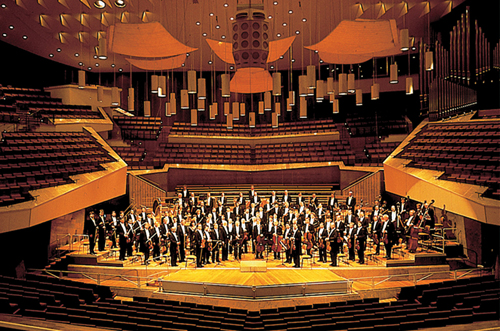
The Philharmonie, designed by Hans Scharoun – famed for its superb acoustics
Top 10 Architects
Hans Scharoun (Philharwmonie)
James Stirling (Wissenschaftszentrum)
Heinz Hilmer (Gemäldegalerie)
Christoph Sattler (Gemäldegalerie)
Friedrich August Stüler (St. Matthäuskirche)
Edgar Wisniewski (Kammermusiksaal)
Rolf Gutbrod (Kunstgewerbemuseum)
August Busse (altes Wissenschaftszentrum)
Bruno Doedens (Henriette-Herz-Park)