The Pergamonmuseum is one of the most important
museums of ancient art and architecture in the world. The museum was
built in 1909–30 by Alfred Messel and Ludwig Hoffmann to house Berlin’s
collection of antiquities as well as vast temples and palace rooms in
their original size. These works of art, excavated by German
archaeologists in the Near East at the end of the 19th century, were
shown here for the first time.
Museumsinsel, Bodestr. 1–3 (entrance Am Kupfergraben) 030 209 055 77
www.smb.museum
10am–6pm Mon–Sun, 10am–10pm Thu Admission charge
|

On the Museumsinsel there
is a café at the Bode-Museum (Antique Sculpture Collections) and also at
the Altes Museum (Egyptian Museum), which is a little closer to the
Karl-Liebknecht-Straße. |
|
Visitors wishing to
explore all the museums on Museumsinsel on the same day, should buy a
day ticket for €15. However, Sundays are generally best avoided because
of the long queues and large groups of visitors. |
|
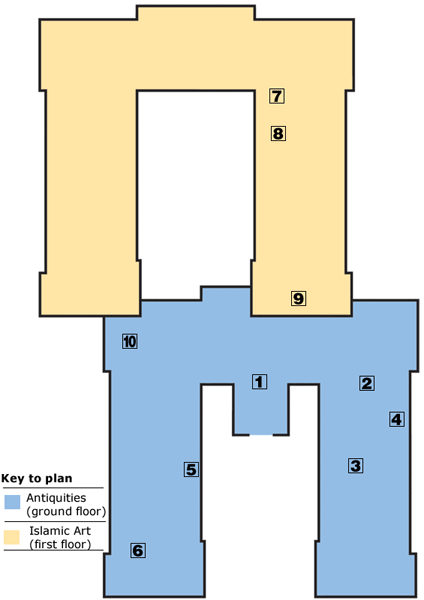
Top 10 Exhibits
Pergamon Altar
The
colossal Pergamon Altar, dating from the year 160 BC, is the largest
and most important treasure of the Berlin museums. The altar was part of
a much larger temple complex in the Greek town of Pergamon (today the
town of Bergama in Turkey), excavated in the 19th century by the German
archaeologist Carl Humann (see also Figures on the Pergamon Altar).
Market Gate of Miletus
This
vast gate (AD 120) is over 16 m (52 ft) high. To the right of the
entrance, a hairdresser has carved an advertisement for his shop into
the stone.
Assyrian Palace
The
interior of this palace from the days of the Assyrian kings (12th
century BC) has been completely restored and boasts impressive statues
of lions.
Ishtar Gate
The
imposing Ishtar Gate and the Processional Way that led to it are fully
preserved. The original avenue in ancient Babylon was 180 m (590 ft)
long. The gate was built in the 6th century BC, during the reign of
Nebuchadnezar II. Original faïence wall tiles depict the sacred lions.
Goddess Persephone
The
5th-century BC Greek statue of the goddess of the underworld sports a
mysterious smile, the expressive symbol of her divinity.
Goddess Athena
The
beauty ideal prevalent in Greek antiquity is perfectly reflected in
this statue’s features. It is one of many valuable and impressive
sculptures worth exploring in the collection of antiquities.
Aleppo Room
Dating
from the early 17th century, this small room features magnificent
wooden cladding taken from the house of a Christian merchant’s family in
Syria. A beautiful example of Ottoman architecture, the room originally
served as a reception hall.
Roman mosaic
This magnificently executed Roman floor mosaic dates back to the 3rd or 4th century AD. It was excavated in Gerasa in Jordan.
Palace of Mshatta
A gift from
Sultan Hamid II to Kaiser Wilhelm II, this desert palace, built in AD
744 in Jordan, has an elaborately decorated southern façade.
Temple of Athena
Dedicated to Athena of Nikephoros, this full-scale temple from the 2nd century BC has a simple yet elegant design.
Figures on the Pergamon Altar
Eastern Altar Frieze
The
eastern side of the altar frieze – the side first lit up by the rising
sun – depicts the battle between the gods and the giants.
The God Apollo on the Eastern Frieze
Like
no other deity on the altar, the god Apollo is depicted as a noble man
of ideal beauty, thus bearing witness to the artistic mastery of
Classical sculpture in Greece.
The Titaness Phoebe
An
impressive figure depicted on the southern frieze, Phoebe is shown,
with her daughter Asteria, fighting an enormous giant with a torch,
sword and lance.
Zeus in Battle
On
the eastern frieze, the father of all the gods on Mount Olympus fights
three giants at the same time. Zeus is armed for this battle with his
most dangerous weapons – thunder and lightning.
The Goddess Athena
The
goddess Athena is also shown on the eastern frieze, as a powerful
figure of light who drags her opponents to their deaths by their hair.
The Gods of the Sea
Three
pairs of sea gods are depicted on the staircase frieze (on the northern
staircase): Doris and Nereus, Oceanus and Tethys as well as Triton and
Amphitrite.
The Goddess Aphrodite
Victorious, the fighting goddess rises proudly above two dead giants.
Statues of Women
Larger-than-life figures of women, found near the altar in the excavations, are displayed in front of the Pergamon Altar.
The Beisser Group
The
so-called Beisser Group on the northern frieze is a group of unknown
deities. One god, almost defeated, desperately tries to fight off a
giant who has clamped his teeth into his arm.
Telephos Frieze
The
frieze in the upper altar courtyard depicts Telephos, son of Hercules.
The kings of Pergamon thought themselves to be descended from Telephos
and worshipped him accordingly.
Saving the Museumsinsel
The “island of museums” is a
treasury of antique architecture – yet it has been slowly decaying.
Since 1992 a total of €1.6 billion has been spent on the renovation and
modernization of Museumsinsel. A “master plan” hatched by renowned
architects, such as David Chipperfield and O M Ungers, will transform
the complex into a unique museum landscape – just as it was first
conceived in the 19th century by Friedrich Wilhelm IV, when he
established the “free institution for art and the sciences”. By 2014,
all the museums will be linked by an “architectural promenade”, creating
a conceptual and structural link between the various parts. This
promenade will consist of a variety of rooms, courtyards and vaults as
well as exhibition halls. The core of the complex will be a new central
entrance building. Once renovated, the museums will gradually reopen –
the Alte National galerie opened in 2001, the Egyptian collection
returned to the Altes Museum in 2005 and the renovated Neues Museum
opened in late 2009. The Museums insel is now a UNESCO World Heritage
Site.
Top 10 Events in the Altar’s History
The Pergamon Altar is built, c.160 BC
Excavation by Carl Humann, from 1870
Transfer of the Altar to Berlin, 1902
Start of construction of Museumsinsel, 1909
Pergamon Altar inaugurated in Berlin, 1930
Reception for the Olympic Games at the Altar, 1936
Bombs destroy the museum, 1943
Reconstruction of the Museum, 1957
The IOC dines at the Altar, 1992
Bode-Museum reopened in 2006