Exhibitions in the Filmmuseum

S-Bahn sign

Café Josty sign
Marlene Dietrich
This
exhibition of the film star’s estate includes costumes, touring
luggage, photographs, letters and notes, posters and film clips.
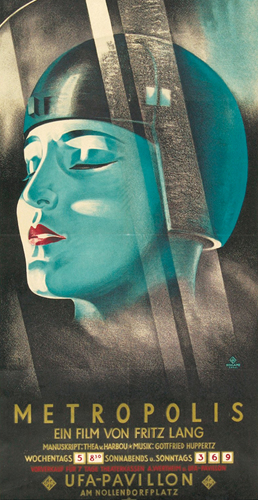
Metropolis
This
film, directed by Fritz Lang in 1927, has an alarming vision of a
future world as its subject. Models and props from the film are on
display.

Caligari
The best known German film of the 1920s, The Cabinet of Dr Caligari (1920), was a masterpiece of Expressionist filmmaking by Robert Wiene.
Leni Riefenstahl
This exhibition reveals the technical tricks used in the Nazi propaganda film Olympia, made by Leni Riefenstahl in 1936–8.
Film and National Socialism
This
exhibition features documents relating to the propaganda uses of film,
everyday cinema and the industry’s victims: some film stars allowed
themselves to be used by the Nazis, others refused to cooperate. The
life and work of the actor Kurt Gerron, who was persecuted and murdered,
is documented as an exemplary case.
Post-War Cinema
The
story of films and film-making in East and West Germany, with props and
costumes of popular stars of post-war German cinema such as Hanna
Schygulla, Romy Schneider, Heinz Rühmann and Mario Adorf.
Artificial Worlds
The tricks employed by special effects studios, ranging from the first effects of the 1930s to computer animation.
Transatlantic
This exhibition of documents, letters, keepsakes and souvenirs retraces the careers of German film stars in Hollywood.
Pioneers and Divas
The infant days of cinema are featured here – as well as stars of the silent era such as Henny Porten and Asta Nielsen.
Exile
Documents relate the difficulties encountered by German filmmakers when making a new start in the USA in 1933–45.

Façade of the Filmmuseum Berlin
Europe’s largest building site
In the 1920s, Potsdamer
Platz was Europe’s busiest square, boasting the first automatic traffic
lights in the world. During World War II this social hub was razed to
the ground. Untouched for almost 50 years, the empty square shifted back
into the centre of Berlin when the Wall came down. During the 1990s,
Potsdamer Platz became Europe’s largest building site – millions of
curious onlookers from around the world came to watch progress from the
famous red info box. Altogether, around €17 billion were invested to
create the present square.

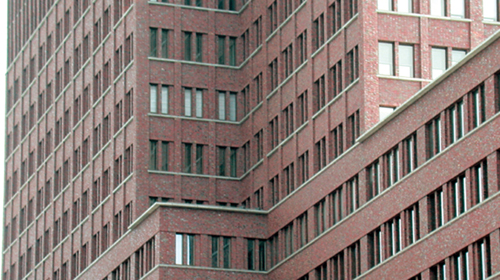
Daimler House
Moving the Esplanade
The Senate of Berlin stipulated that Sony should preserve the
“Breakfast Room” and the “Emperors’ Hall” of the Grand Hotel Esplanade,
both protected following destruction in World War II. Accordingly, in
1996, the rooms were moved – 1,300 tons were loaded onto wheels and
shifted by 75 m (246 ft) during the course of a week.

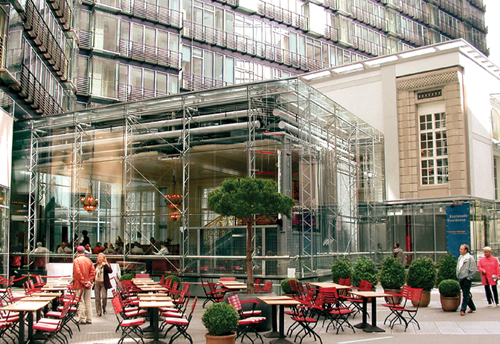
The historic Emperors’ Hall is today incorporated into the modern Sony Center
Top 10 Architects
Helmut Jahn (Sony Center)
Renzo Piano and Christian Kohlbecker (debis Headquarters, Musical-Theater, Spielbank, Weinhaus Huth)
José Rafael Moneo (Hotel Grand Hyatt, Mercedes-Benz Headquarters)
Giorgio Grassi (Park Colonnades)
Ulrike Lauber and Wolfram Wöhr (Grimm-Haus, Cinemaxx)
Sir Richard Rogers (Office Block Linkstraße)
Steffen Lehmann and Arata Isozaki (Office and Retail House Linkstraße)
Heidenreich & Michel (Weinhaus Huth)
Bruno Doedens and Maike van Stiphout (Tilla-Durieux-Park)