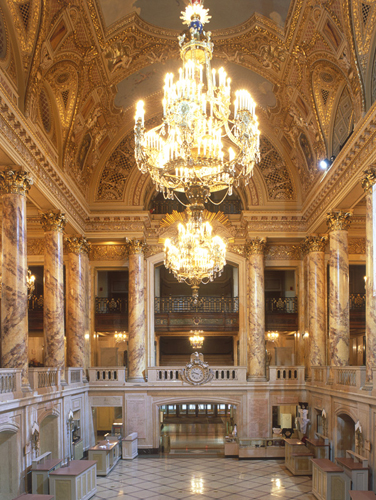
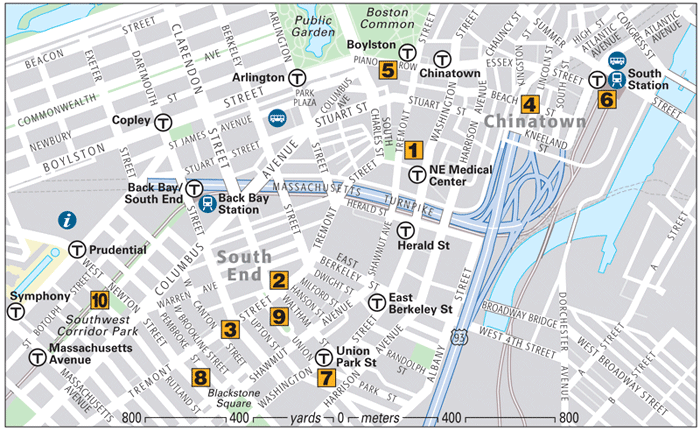
Boston’s compact Chinatown is
the third most populous Chinese neighborhood in the US, concentrating a
wealth of Asian experience in a small patch of real estate.
Theater-goers find the proximity of Chinatown to the Theater District a
boon for pre- and post-show dining. The Theater District itself is among
the liveliest in the US, and its architecturally distinctive playhouses
are nearly always active, often with local productions. Adjoining the
Theater District to the south is South End, once an immigrant tenement
area and now Boston’s most diverse neighborhood by race, cultural
background, and sexual orientation. The country’s largest historical
district of Victorian townhouses, South End has been undergoing
gentrification since the 1980s and today is home to a burgeoning and
energetic club, café, and restaurant scene.
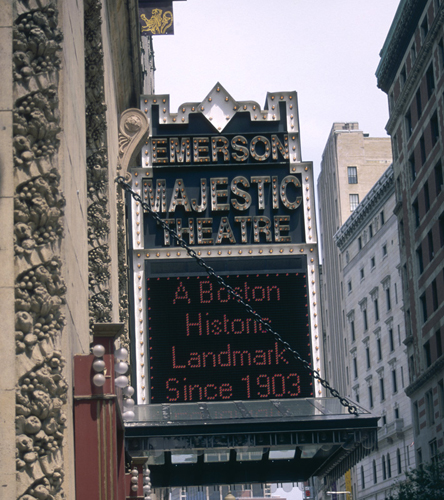
Sign, Theater District
|
|
-
Boston Center for the Arts
The
massive Cyclorama building is the centerpiece of the BCA, a performing
and visual arts complex dedicated to nurturing new talent. The center
provides studio space to more than 40 artists, and its Mills Gallery
mounts rotating visual arts exhibitions. The BCA’s four theaters, home
to four companies, host avant-garde productions of dance, theater, and
performance art . -
Tremont Street
The
section of Tremont Street between East Berkeley and Massachusetts
Avenue is the social and commercial heart of the South End. Many of the
handsome brick and brownstone townhouses have been restored to
circa-1890 perfection, some with a boutique or café added at street
level; others remain boarded up and awaiting renovation. The liveliest
corner of the South End is the intersection of Tremont with Clarendon
and Union Park streets, where the Boston Center for the Arts and a
plethora of restaurants and cafés create a compact entertainment and
dining district.
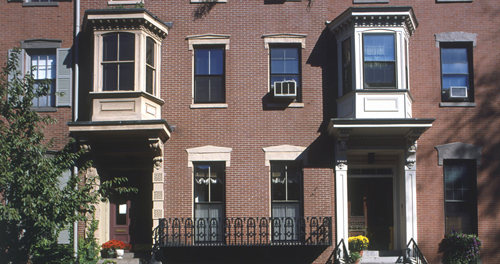
Victorian townhouses, South End
-
Beach Street & Chinatown
As
the periphery of ethnic Chinatown becomes increasingly homogenized,
Beach Street remains the purely Chinese heart of the neighborhood, home
to the traditional apothecaries and other merchants who serve a
primarily immigrant population. An ornate Dragon Gate at the base of
Beach Street creates a ceremonial entrance to Chinatown. The wall behind
the adjacent small park is painted with a dreamy mural of a Chinese
sampan boat.
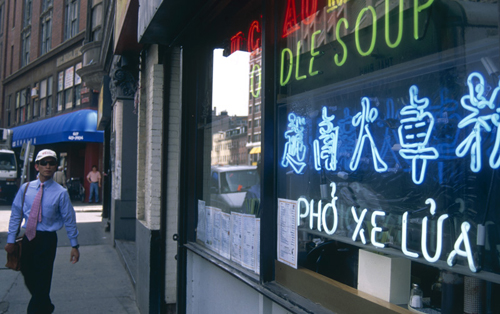
Beach Street, Chinatown
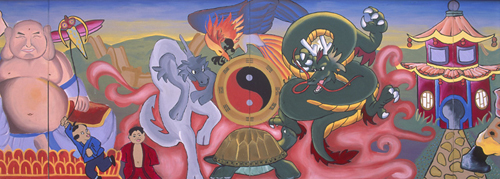
Contemporary city mural, Chinatown
-
Piano Row
In
the late 19th century, the HQs of leading piano makers Steinert, Vose,
Starck, Mason and Hamlin, and Wurlitzer were located on the section of
Boylston Street facing Boston Common, giving the block (now a historic
district) its nickname as Piano Row. Nearly a century later, those Beaux
Arts buildings still echo with music. The Colonial Theatre, its ornate
interior fully restored to the sumptuous 1900 original, is an active
venue for drama and musicals, while Boylston Place is a small-scale club
and nightlife center. -
South Station
A
brick temple to mass transportation, the Neo-Classical Revival South
Station was erected in 1898 at the height of rail travel in the US, and
was once the country’s busiest train station. Following extensive
restoration in 1989, it now serves as an Amtrak terminal for trains from
the south and west of the city, as well as a “T” stop and a social and
commercial center with a lively food court and occasional lunchtime
concerts.
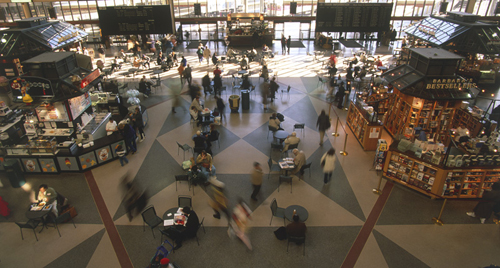
South Station
-
Holy Cross Cathedral
Holy
Cross, the largest Roman Catholic church in Massachusetts, acts as the
seat of the archbishop of Boston. The cathedral was constructed in 1875
(on the site of the municipal gallows) to serve the largely
Irish-American workers who lived in the adjoining shantytown. Today the
congregation is principally of Hispanic origin. Of note are the
magnificent stained glass windows, which include rare colored glass
imported from Munich in the 19th century, and the powerful Hook &
Hastings organ, which seems to make every piece of Roxbury puddingstone
in the building reverberate. -
Villa Victoria
Villa
Victoria is a virtually self-contained, primarily Hispanic neighborhood
that grew out of a unique collaboration among Puerto Rican community
activists, flexible city planners, and visionary architects. With its
low-rise buildings, narrow streets, and mom-and-pop stores, Villa
Victoria replicates the feel of Puerto Rican community life. At its
heart, the Center for Latino Arts sponsors classes and exhibitions, and
becomes a dance and social club in the evenings – one of the hottest
places in Boston for Latin dance.Center for Latino Arts
-
85 W Newton St
-
617 927 1707
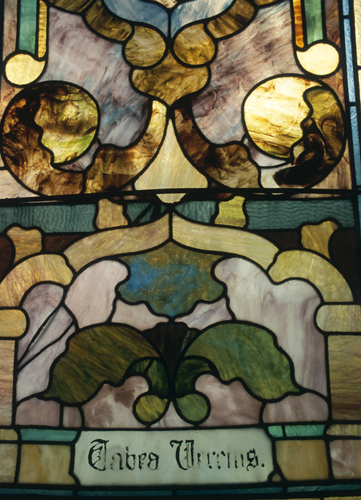
Stained glass, Center for Latino Arts, Villa Victoria
-
-
Union Park Square
Constructed
between 1857 and 1859, this small park surrounded by English-style
brick row houses was built to contrast with the French-inspired grid
layout of nearby Back Bay. Graced with lovely trees and fountains and
verdant with a thick mat of grass, the square was one of the first areas
in the South End to be gentrified. -
Southwest Corridor Park
The
first section of the five-mile (8-km) Southwest Corridor Park divides
South End and Back Bay along the “T” orange line corridor. In the
residential South End portion, a path strings together numerous small
parks. Between Massachusetts Avenue and West Roxbury, the park broadens
to include recreational amenities.