What we’re
going to look at here is how to make sure that you schedule your plans
for smooth results—no all-night cleaning marathons, no last-minute runs
to the gas station for bags of ice, and no short tempers.
Things You’ll Need
A calendar
Your lists of important family dates—birthdays, anniversaries, and so on
Your family’s planner
Putting Important Dates on Your Family’s Calendar
The more people you have
in your family, the more things you’ll have to celebrate—and the harder
you’ll find it to keep track of them. Making sure everybody knows what’s
coming up is key. So every year when you get your new planner for the
next year (or at the beginning of the new year if you’re using a system
that doesn’t require a new planner), gather the whole family together
and discuss the events you already know about for the coming year.
You’ll have annual events such as birthdays and anniversaries, and
you’ll have the year’s special events such as graduations and weddings.
Make sure that you enter
the appropriate dates into your family’s planner. You may also have
some speculative possibilities. For example, you might have a good idea
that the Cub Scout in your family will be receiving an award at the
spring Scout dinner. These dates should get “penciled in” so that as
other activities come up for the same date all family members are aware
that there may be a conflict and, at most, they can make only tentative
plans for that date. Throughout the year, other occasions for family
celebrations will come up. The dates should be brought to everyone’s
attention and entered into the family planner immediately.
This initial family
planning session of the year is also a good time to discuss any
preliminary ideas of how you’ll celebrate the important dates and who
will be involved. You might want to require everyone to be available for
a family dinner on each person’s birthday, but mom and dad may choose
to have a quiet dinner for two on their anniversary. At this point,
nothing is really definite but the dates. Still, getting a feel for how
each family member may be expected to participate will make the actual
scheduling process easier when the time comes.
Even though all of the
dates are recorded on your planner, you should safeguard against having
one of those dates arrive without your having prepared for it. So, for
each date you enter, also enter a note six weeks earlier reminding you
that the event is upcoming.
caution
When it comes to
important dates, don’t rely on your memory; use your planner. Even the
most memorable of occasions have a way of sneaking up on you.
Especially, don’t rely on other events to trigger your memory if those
other events don’t happen on a fixed date. Many national holidays are
tied to such roving days as “the first Monday of the month” and can move
around datewise by a whole week, so by the time they jog your memory,
your special day could be a week in the past!
Setting Aside Enough Time to Celebrate
Celebrations come in
all shapes and sizes, but you can categorize them into three types of
activities for the purpose of working them into your family’s schedule:
Private
family gatherings can produce some of the most treasured family
memories. These celebrations don’t involve anyone but the immediate
family. They are smaller and less formal—and require less planning and
preparation time. Birthday dinners (especially for the adults in the
family), anniversary dinners, Mother’s Day brunches, or acknowledgments
of significant achievements with special desserts all fall into this
category.Throwing
full-blown parties will seem more appropriate for other events. These
celebrations involve inviting people outside the immediate family. They
are larger and more structured—and require more planning and preparation
time. Graduation parties, weddings, and end-of-season team parties fall
into this category.Another
type of celebration is the kind where you or your family are invited
guests. These celebrations can be family events hosted by extended
family members or important milestones being celebrated by friends.
You’ll find that your planning and preparation to attend these events
will be much different from the planning and preparation when you and
your family are in charge.
No matter which type of
celebration you’re having, you’ll need to be involved in four phases:
planning, preparation, celebration, and memorializing.
Planning
You’ll know it’s time to
start the planning phase when your six-week advance reminder comes up
on your family’s schedule. This is the time to make some crucial
decisions about the flavor of the celebration. Everyone in your family
who will play a part in the event should be involved in this initial
phase because you want to make sure that everyone is in agreement about
how the celebration will shape up.
Begin by clearly
defining everyone’s roles. Decide at the beginning of the planning
process who will be involved in the making of key decisions about the
celebration. Consider the person whose milestone you’ll be celebrating
and whether that person should be participating in decisions about the
celebration. Children over the age of three usually have some pretty
definite ideas about what type of birthday party they would like to
have. On the other hand, the honoree at a retirement party might prefer
to just have to show up rather than be involved in any planning.
And sometimes the party
isn’t really about the guest of honor at all; first-year birthday
parties, infant baptism receptions, and traditional graduation dinners
with grandparents tend to be more for the hosts. Of course, the planning
of surprise parties by definition doesn’t receive input from the person
who is the reason for the party. Make especially sure to include in the
planning anyone who is likely to have a strong opinion or a hesitancy
to participate so she won’t feel that her ideas have been overlooked.
After you’ve established
who will be responsible for the planning of the event, you’ll also want
to get clear about who will make the important decisions about the
celebration. You don’t have to—and probably shouldn’t—let one person
make all of the decisions. For example, it’s certainly appropriate for a
six year old to be able to choose between yellow or chocolate birthday
cake. At the same time, a parent, while taking into consideration the
child’s preference, should be the one to determine whether a party at
the ice-skating rink is acceptable.
At this early point in
the planning phase, you’ll need a decision on what type of event it will
be. You don’t want to make this decision in a vacuum. Instead, use your
family planner to help you, by looking to see what the weeks leading up
to the event and the days immediately after the event already have in
store. A logical sequence of decision-making will go as follows:
Decide
who you’ll want to attend: just your immediate family or a more
extended group. One aspect of this decision is what the person who’s
reaching the milestone would prefer. Some people like big parties in
their honor, and other people prefer quiet family gatherings. Another
aspect is the type of milestone. More people invite friends to a 25th
wedding anniversary celebration than to a 17th anniversary event.
Sometimes the situation calls for both types of events. Many 10 year
olds like to have both a family birthday dinner and a party with their
friends.Consider
whether you want to have the event in your home or at another location.
Sometimes the nature of the event will determine this answer for you.
If you’re throwing an ice-skating party, then you know where it will
have to be held. Other times, family circumstances lead you toward the
answer. If your family budget is tight, remember that parties at home
where you do most of the work are less expensive. In another case, if
your general sense is that the family will be going through a very
hectic time—business trips, final exams, start of soccer season, having a
new roof put on the house—then going offsite may be your best choice.
Sometimes it’s a matter of space—the size of your house compared to the
size of the guest list.Decide
whether the festivities will be simple or elaborate. Again, take into
account the personality of the person whose accomplishment you’re
celebrating. If she prefers simple, then go simple; if she prefers
extravagant, then go elaborate. The amount of time and money you have
available also affect this decision. Generally speaking, elaborate
celebrations take both more time and more money.Determine
whether you should opt for a labor-intensive setup or one that’s easy
to do. Time and money play a major role in this decision as well. If the
family does all of the cleaning, cooking, and hosting, then you’ll save
money, but you’ll need to spend the time. If you hire a cleaning
service and order the food ready-made, or if you have the celebration at
a restaurant, then you’ll save time and energy, but you’ll need to
spend more money. (If you’re short on both time and money, then you’ll
be better off if you plan more simple festivities—hamburgers at home
instead of filet mignon at a fancy restaurant.) Another factor is your
family members’ interests. If someone in the home really enjoys making
fancy individualized favors or loves cooking elaborate gourmet meals,
then a labor-intensive celebration won’t seem so laborious.
Table 1
summarizes your options for the style of your celebration. Six weeks
before the event, your family should choose one of the options on each
line; that’s four choices in all, with the possibility of 16 different
types of celebrations.
| Just family | Invited guests |
| At home | At another location |
| Simple | Elaborate |
| Labor intensive | Easy to do |
Select one option from each row. Sixteen different combinations are possible.
Preparing
The type of
celebration you choose will determine the tasks you’ll need to schedule
to have a successful event. By scheduling wisely and sticking to your
schedule, you’ll be able to enjoy the preparation process, and you’ll
have energy—and a pleasant attitude—left over to enjoy the party! To
help you break down the preparation into its components and get them
onto your family’s planner, you can use the checklists and timelines in
the following tables. These tables include
Table 2, “If You’re Attending Any Party, Either as the Host or a Guest”
Table 3, “If You’re Hosting the Party Somewhere Other Than Your Home”
Table 4, “If You’re Planning Any Party”
Table 4. If You’re Planning Any Party
4 weeks before Plan the menu. Table 5, “If You’re Having the Party in Your Home, Whether or Not You’re Inviting Guests”
Table 6, “If You’re Inviting Guests, Whether or Not You’re Having the Party at Home”
Table 7, “If You’re Inviting Guests to Your Home”
Table 8, “If You’re Planning an Elaborate Party”
Table 9, “If You’ve Been Invited to a Party”
Table 9. If You’ve Been Invited to a Party
When you receive the invitation RSVP. Get directions to the party. 1 day before Make sure you have enough gas in your car.
The way to use these
tables is to select all of the ones that apply to the type of event
you’re planning. Then slot each of the tasks from all of those tables
into your family’s schedule. For example, if you were having your
child’s birthday party with her friends at the ice-skating rink, then
you would use the timelines in Tables 2, 3, 4, 6, and 8. On the other hand, if you were having a birthday dinner at home with your family, then you would use the timelines in Tables 2, 4, 5, and 8.
The easiest way for you to select the appropriate checklists is to read
the name of each table and see whether it applies to your event; you’ll
use Table 2
for all parties, while your use of the other tables will depend on
whether you’re the host or the guest, whether the party will be at your
home or elsewhere, and the nature of the party.
tip
When it comes time for
the final preparations, you can really do yourself a favor by scheduling
things so the preparations should be completed a half hour in advance
of the event. That half-hour cushion leaves you time to catch your
breath and begin to enjoy yourself. You’ll also be prepared in case
anyone arrives early. And, in the worst case, you’ll have time to deal
with any last-minute emergencies.
note
Does planning a party
sound too overwhelming to you? Not all celebrations need to be
scheduled. Very small or spur-of-the-moment celebrations can sometimes
seem even more special—a glass raised in a congratulatory toast, an
unexpected box of candy or bouquet of flowers, or even something as
simple as a heartfelt hug!
As you’ll see, one of
the first things you need to do when planning a celebration is to set
the date, time, and place. You’ll want to make sure when you do that you
take into account conflicts—definite or anticipated—with the schedules
of the people you would like to join in the celebration. If you’re
having a family event, you’ll definitely want to use your family planner
to avoid any conflicts that already exist. Then you’ll want to use the
planner to make a note of the event so that it will have priority over
any future scheduling. If you’re having a large event with many invited
guests, you’ll need to look at a calendar—preferably one that lists
local as well as more universal happenings—and try to avoid any
widespread conflicts. For example, you might decide it’s prudent to
avoid the day of your local school’s graduation or the grand opening of a
new community center.
caution
Don’t stockpile paper
goods for parties. You can easily get drawn in on great discounts if you
buy in bulk. But chances are you’ll want a different style of plates
and napkins the next time around. And paper goods don’t keep well; they
get crumpled if you don’t lay them flat, and they get rippled—and too
disgusting to use—if they’re exposed to any moisture. When you start
planning the party six weeks in advance, you’ll have plenty of time to
find a fresh supply of exactly what you want on sale.
Celebrating
After the planning and the
preparation, it’s finally time for the celebration itself! We’re sure
you don’t need a lengthy explanation of what to do here. Your hard work
will pay off, and you should be sure to have fun. Just a few words of
caution here:
Something is bound
to not go according to plan. If you stop to think about it, probably
some of your best memories—the ones that are retold over and over—are of
things that went wrong; things like the dog knocking over the grill and
eating all of the hamburgers. Probably the best thing you can do is be
flexible and smile.Don’t
schedule anything too close after the fun. (You may have noticed in the
timelines that we’ve even recommended leaving the cleanup until the
next day.) You’ll want to have some time to enjoy your accomplishment.
Preserving the Memories
We’ve said it before, but
this point bears repeating here: The wrapping-up phase of any project is
the easiest one to let slide. But next to the fun of the celebration
itself, the best part of personal and family milestones is the
memories—and they last a lot longer.
If someone in your
family has a hobby that lends itself to memory preservation, then you’re
halfway there. There are many complex ways of preserving memories that
some people really enjoy:
Someone who
likes video editing can take any video you have of the event and turn it
into a cohesive piece that really captures the highlights.Digital
photos, in the hands of someone with the appropriate interest, can be
edited and archived, posted on the Internet, or burned onto CDs.Scrapbooking
is an extremely popular hobby these days. Although it is
time-consuming, for an enthusiast the hours spent are truly pleasant,
and the result can be enjoyed for many years by many people.
note
Also referred to as a memory preserver, the Snaptop case by Iris, shown in Figure 1, Figure 1. A plastic scrapbook case can be either the first or the last step in preserving your precious memories.
|
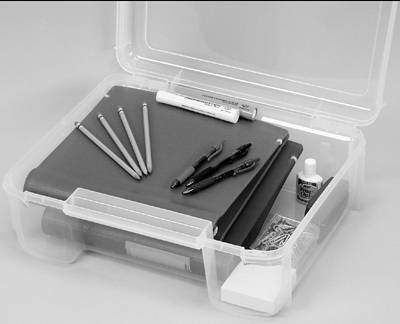
All of these hobbies take time and need to have their own place in your family’s schedule . In the meantime, the important step you
need as you wrap up the celebration is to take enough time to set aside
safely in one place all of the pieces you want preserved.
Perhaps in the past—if
you set aside things at all—you’ve used shoeboxes or shopping bags to
keep such things together. And, unfortunately, if you’ve ever gone back
to create a more presentable remembrance, you’ve probably found that
some of what you kept has been crunched, munched, or moisture-damaged.
Now that you’re becoming more organized, you’ll probably want to use
something a little less vulnerable. “Memory preservers” such as the one
illustrated in Figure 5.1
allow you to corral everything you’ll need—photos, videos, CDs, themed
paper plates and napkins, a copy of the invitation, and the like—and
keep it in good condition. In fact, if no one in your family has any
inclination to spend time creating an artistic memory, these plastic
containers may be your last step. If you label and shelve them, you’ll
be able to take them out and reminisce any time you want.
note