Food Chemistry Basics: Proteins, Fats, and Carbs (part 8) – Fats – Eating Fat

7.2 Eating Fat

To sum up, the various fats in your food arrive in the form of
saturated, monounsaturated, or polyunsaturated fats, and often a
mixture of all three of these substances.

Olive oil, which you can use in your homemade salad dressing,
contains the following types of fats: monoFats (about 75 percent);
satFats (about 14 percent), and polyFats (about 11
percent).Olive oil’s principal monounsaturated fatty acid is an 18-carbon chain
fat called oleic acid.

Note

Olive oil is a liquid at room temperature. The
higher the number of double bonds in the fat’s chemistry, the more
likely it will be a liquid at room temperature. Animal fats tend to
contain more monounsaturated (one double bond) and saturated fats,
and thus tend to be solid at room temp. Vegetable oils, true to
their name, are only usually liquid at room temp and contain more
polyunsaturated fats.
image with no caption

The health advice for eating fat can be summed up this way: eat
a reasonable amount of monounsaturated fats, as in olive oils,
avocados, and macadamia nuts, as well as fish and many meats, and try
to even out the ratio between Omega 6 fats and Omega 3s.

Saturated fats have recently had the air let out of their tires
as the demon of your diet , so we don’t have to be so
phobic about them. They might even have anti-inflammatory effects for
some people, particularly if you’ve replaced a lot of simple carbs or
sugars with them.

Coconut milk is fine, as are high-quality cheeses and grass-fed
meats, and the satFats you get in the small chunks of the 100-percent
high-cacao chocolate I eat (addictively) are acceptable and healthy
additions to the diet.

Figure 12
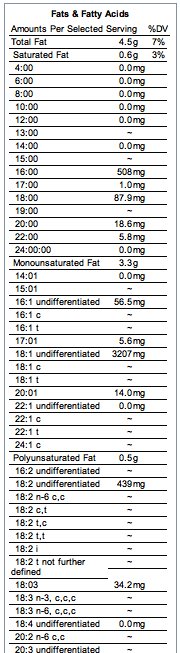
shows all the other fats (some in trace amounts) that olive oil
contains, from the handy NutritionData tool. A teaspoon of olive oil
is 100 percent fat by calories, with 5 grams totaling about 45
calories (9 calories per gram, because it’s a fat!).
For olive oil, mostly monounsaturated fat, Omega 6, and palmitic acid, a saturated fatty acid

Figure 12. For olive oil, mostly monounsaturated fat, Omega 6, and
palmitic acid, a saturated fatty acid

This is how you can find out the fat content of your food: do a
search at NutritionData, then scroll down to the boxed area reserved
for Fats & Fatty Acids. This shows that a teaspoon of olive oil
also contains almost half a gram (439 mg) of linoleic acid, or Omega 6
fats, a subset of polyFats. There’s the oleic acid: “18:1
undifferentiated”—more than three grams of it.

I told you those fat notations could get pretty geeky!

Rather than just a teaspoon of oil, let’s analyze the fat
content of typical fare for an American Friday night: a large pizza
slice with pepperoni. The dish sounds delectable, but, like all of
life’s vicissitudes, that dinner’s nutritional profile is likely to be
a mixture of joy and regret.

How Does the “Paleo” Diet Measure Up?

There’s been an explosion of Romantic Primitivism in
Western culture. It must have something to do with how moribund the
so-called benefits of modern civilization have become (you can only
spend so much time in cubicles staring at screens with cell phones
plastered to your ear).

Just look at how popular escapist journeys into the
backcountry or the outback and Burning Man have become. Every region
now boasts multiple weekend races where the participants are
required to mimic the opening scene of the film
Gladiator, beating their bare chests, shaking
toy spears, and sprinting off with war cries into the woods. The
nutrition counterpart of this Spartan movement is the Paleolithic,
or Paleo, diet, which is making a comeback after about 50,000
years.

The Paleo diet is a delicious combination of meats, fish,
veggies (e.g., tubers like sweet potatoes), fruits (mostly of the
berry kind), nuts, and “offal” (not awful!), as in bone marrow and
liver pate. I had a bison heart recently from the Full Circle Bison
Ranch in southern Oregon; it was delicious and nutritious (marinated
in balsamic vinegar and spices, then baked for a while on a low
temperature). Many people, like myself, add dairy to Paleo, as in
whole milk, cheese, and eggs (the real Paleo diet most likely
included bird’s eggs, but certainly no cheese or cow’s or goat’s
milk).

The Paleo diet has measured up quite well lately in the few
studies that have compared it with other dietary regimens, according
to a 2010 journal wrap-up.25 Here are a few quotes
from the article:

A randomized controlled trial of 29 patients with
ischemic heart disease and either glucose intolerance or [Type 2
Diabetes Mellitus] (T2DM) were randomized to 12 weeks of a
Paleolithic (i.e., lean meat, fish, fruit, vegetables, root
vegetables, eggs, and nuts) or a Mediterranean-like Consensus diet
based on whole grains, low-fat dairy products, vegetables, fruits,
fish, oils, and margarines. The Paleolithic group showed an
improved glucose control and a greater decrease in waist
circumference when compared with the Consensus
group.

Fifteen patients with T2DM were randomized to
either a Paleolithic diet or a diabetes diet and then crossed over
after 3 months. Patients were on each diet for 3 months. Compared
with the diabetes diet, the Paleolithic diet produced lower mean
levels of hemoglobin A1c, triacylglycerol, diastolic blood
pressure (BP), weight, body mass index (BMI), as well as waist
circumference and higher mean serum high-density lipoprotein
levels.

Whether the Paleolithic diet will become a
suitable prescriptive alternative remains to be determined by more
extensive studies on a larger number of
participants.

Lively discussions of the Paleo diet and its practitioners can
be found on www.paleohacks.com
and other websites.

It wouldn’t be fair if we didn’t indicate the whole lineup of
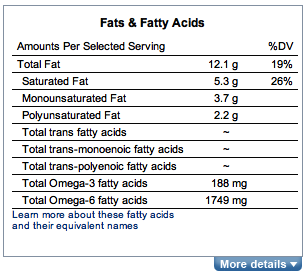
macronutrients, including protein and carbs. Figure 13 from
NutritionData shows the Fats & Fatty Acids results for a 14-inch
pizza slice with pepperoni topping.
The fatty acid lineup for a slice o’ pepperoni

Figure 13. The fatty acid lineup for a slice o’ pepperoni

The pizza slice includes 12.1 grams of fats, or 109 calories,
which happens to be 37 percent of the total 298 kcal.

Note

This is pretty high in calories for just one pizza
slice. Multiple slices would obviously be a very energy-dense meal.
Better be climbing a mountain the next morning, or better yet, back
off from the slices and eat some blueberries.

The macronutrient ratio, the whole shebang, for the pizza slice
is 46 percent carbs-37 percent fats-17 percent protein. You can assume
that the vast majority of the carbs (and thus up to half of all the
calories) came from the refined flour of the pizza crust.

Now for Something Completely Different on the Crust
Front

What follows is a recipe for pizza crust for when you want a
break from the grains, wheat, and refined flour, but you still want
to pile the fixings onto your pizza slices (recipe courtesy of
www.girlgoneprimal.com).

1 large head of cauliflower

2 cups cheese (mozzarella, cheddar, or a combo of both)

2 eggs

Optional herbs (thyme, fennel, oregano, basil & parsley
all work wonderfully)

Method:

Preheat oven to 200 degrees Celsius. Line pan or pizza stone
with baking paper.

Rice the cauliflower by putting florets into a food processor
and buzzing until finely processed (but not mushy). Place
cauliflower into a microwave-safe bowl and zap for 6-8 minutes. You
should end up with about two cups of riced cauliflower.

Mix in cheese and eggs until smooth. Spread evenly over baking
paper in a round shape. Sprinkle with herbs. Place in oven until
golden on top and starting to crisp around the edges (around 15
minutes in my oven).

Remove from oven and add desired toppings. I used sliced
tomato, sliced capsicum, mozzarella and parmesan cheese, mushrooms,
and some meat (I only had salami). I choose to sprinkle cheese on
the base, with the toppings rather than placing it between the base
and the toppings (as directed in the original recipe). The cheese in
the base helps keep the topping in place and connected to the
base.

Place completed pizza back in the oven until the cheese melts
and toppings are cooked to your preference. Cut and serve while hot.
Also delicious reheated.

You can see that the pizza slice contains all three fatty-acid
classifications. About 44 percent of the fats come from saturated fats
(we can reasonably assume a lot of that comes from the cheese, since
mozzarella cheese, for example, is about 58 percent saturated
fat).

The saturated fat isn’t necessarily bad (five grams or so,
almost matched by a similar amount of monounsaturated fat) from a
health standpoint, compared with the refined carbohydrate represented
by the pizza crust.

Note

Oh no, here it comes again, some glum preachy advice
about not eating too much pizza! I’m imitating my son here, who’s
heard enough from me about nutrition. He calls me, with a derisive
tone, “Mr. Healthy Guy.”

The crust might contribute to the fat gains brought on by
excessive energy-dense foods. Just ease up on it, do yourself a
favor.

Saturated Fat Has Some of the Air Let Out of Its
Tires

When I was a young tyke soccer player, I used to eat
bacon and eggs for breakfast. Then, the night before a game, my
mother would make me a steak, and I used to eat the fat because it
tasted good. Then I used to go out onto the field and run everyone’s
butts off (and occasionally get my own tail kicked)—in other words,
the ingredients for that training table seemed to work. I guess
we’re supposed to conclude that I was dying of heart disease, then?
Too much saturated fat in the eggs and steak?

Many of us have grown up with public-health guidelines that
say to avoid saturated fats at all costs. Eat it, get a heart
attack. Yet, it’s very easy these days to find dissenting or at
least moderating opinions, including among health and nutrition
experts.

At the very least, you need fats to absorb fat-soluble
vitamins: A, D, E, and K (“a deck of cards—ADEK”). And fats,
including saturated, can be anti-inflammatory for some people,
particularly if they replace more inflammatory foods.

The American Journal of Clinical
Nutrition
published a study in March 2010 that cast doubt
on whether the consumption of saturated fats is a serious risk
factor for cardiovascular disease. Led by Dr. Ronald Krause of the
Children’s Hospital Oakland Research Institute, Oakland, CA, the
meta-analysis reviewed the results of 21 studies.