2. How to Prevent Foodborne Illness Caused by Parasites
Not long ago, I overheard the fishmonger at
one of my local grocery stores (which shall remain nameless to protect the guilty) tell a
customer that it was okay to use the salmon he was selling for making sushi. Given that
the fish wasn’t labeled as “previously frozen” and that it was in direct contact with
other fish in the case, there wasn’t any real guarantee that it was free from harmful
parasites or bacteria, two of the biggest concerns that consumers need to manage for food
safety. What’s a shopper to do in response to the disappearance of the true
fishmonger?
For one, start by understanding where the risks actually are. Not all fish and meats
share the same set of risks for foodborne pathogens. Salmonella, for example, tends to
show up in land animals and improperly handled vegetables, while bacteria such as
Vibrio vulnificus show up in fish that are exposed to the brackish
waters of tidal estuaries, such as salmon. Deep-water fish, such as tuna, are of less
concern. Because of these differences, you should consider the source of your ingredients
when thinking about food safety, focusing on the issues that are present in the particular
food at hand.
With uncooked and undercooked fish, one concern is parasites. Parasites are to fish as
bugs are to veggies: really common (if you’ve eaten fish, you’ve eaten worms). But on the
plus side, most parasites in seafood don’t infect humans. However, there are those that
do, Anisakis simplex and tapeworms (cestodes)
being the two parasites of general concern. A. simplex will give you
abdominal pains, will possibly cause you to vomit and generally feel like crap, and will
possibly take your doc a while to figure out. It’s not appendicitis, Crohn’s disease, nor
a gastric ulcer, and with only around 10 cases diagnosed per year in the United States,
chances are your doc won’t have encountered it before. On the plus side, humans are a
dead-end host for A. simplex. The bacteria will die after about 10
days, at which point you’ll go back to feeling normal. (Unless you have an extreme
infection, in which case, it’s off to surgery to remove ’em.) That leaves tapeworms as the
major parasitic concern in fish.
For cooked dishes—internal temperature of 140°F / 60°C—there is little risk from these
parasites directly. Cooking the fish also cooks the parasite, and while the thought of
eating a worm might be unappetizing, if it’s dead there’s little to worry about other than
the mental factor. (Just think of it as extra protein.)
Of course, raw and undercooked seafood is another matter entirely. Cod, halibut,
salmon? Fish cooked rare or medium rare? Ceviche, sashimi, cold-smoked fish? All potential
hosts for roundworm, tapeworms, and flukes. Fortunately, like most animals, few parasites
can survive freezing.
Note:
Some parasites do survive freezing.
Trichomonas—parasitic microorganisms that infect vertebrates—can
survive temperatures as cold as liquid nitrogen. Yikes!
For the FDA to consider raw or undercooked fish safe to eat, it must be frozen for a
period of time to kill any parasites that might be present:
FDA 2005 Food Code, Section 3-402.11: “[B]efore service or sale in
ready-to-eat form, raw, raw-marinated, partially cooked, or marinated-partially cooked
fish shall be: (1) Frozen and stored at a temperature of –20°C (–4°F) or below for a
minimum of 168 hours (7 days) in a freezer; [or] (2) Frozen at –35°C (–31°F) or below
until solid and stored at –35°C (–31°F) or below for a minimum of 15
hours…”
The second concern with undercooked fish is bacteria. While freezing kills parasites,
it does not kill bacteria; it just puts them “on ice.” Researchers store bacterial samples
at –94°F / –70°C to preserve them for future study, so even super-chilling food does not
destroy bacteria. Luckily, most bacteria in fish can be traced to surface contamination
due to improper handling—that is, cross-contamination from surfaces previously exposed to
contaminated items.
Note:
Don’t put cooked fish or meat on the same plate as the raw food! In addition to
being potentially dangerous, that’s just gross.
If your grocery store sells both raw and “sashimi-grade” fish, the difference between
the two will be in the handling and care related to the chances of surface contamination,
and in most cases the sashimi-grade fish should have been previously frozen. The FDA
doesn’t actually define what “sashimi grade” or “sushi grade” means, but it does
explicitly state that fish not intended to be completely cooked before serving must be
frozen before being served.
If you don’t have access to a good fish market or find the frozen fish available at
your local grocery store unappealing, and you plan on serving undercooked fish, you can
kill any parasites present in the fish by freezing: check that your freezer is at least as
cold as –4°F / –20°C, and follow the FDA rule of keeping the fish frozen for a week. If
you happen to have a supply of liquid nitrogen around—you know, just by chance—you can
also flash-freeze the fish, which should result in better texture and cut the hold time
down to less than a day.

Luckily for oyster lovers, the FDA excludes molluscan shellfish, as well as some types
of tuna and some farm-raised fish (those that are fed only food pellets that wouldn’t
contain live parasites) from the freezing requirement.
Is there a tension between safety and quality in cooking,
and if so, are there methods to achieve both? Safety and quality are two very different things. Quality is something that people
love talking about, whether it’s wine, or organic food, or how it was grown, and people
can talk themselves to death about all that. My job is to make sure they don’t
barf.

For somebody cooking at home, it’s easy for them to see a
difference in quality. It’s very hard for them to see a difference in safety until
they get sick, I imagine? There are tremendous nutritional benefits to having a year-round supply of fresh
fruits and vegetables. At the same time, the diet rich in fruits and vegetables is the
leading cause of food-borne illness in North America because they’re fresh, and anything
that touches them has the potential to contaminate. So how do you balance the potential
for risk against the potential benefits? Be aware of the risks and put in place safety
programs, beginning on the farm. If you look at cancer trends in the 1920s, the most predominant cancers were stomach
cancers. All everyone ate during the winter were pickles and vinegar and salt. Now
that’s almost completely eradicated because of fresh food. But now you have to prevent
contamination from the farm to the kitchen, because more food is eaten fresh. There are
tradeoffs in all of these things. In preparing hamburger and chicken, there is an issue
with cooking it thoroughly and validating that with a thermometer, but most of the risk
is actually associated with cross-contamination. Potatoes are grown in dirt, and birds
crap all over them, and bird crap is loaded with salmonella and campylobacter. When you
bring a potato into a kitchen or a food service operation, it’s just loaded with
bacteria that get all over the place. What’s the normal time between ingestion and
symptoms? It’s around one to two days for salmonella and E. coli. For
things like listeria, it can be up to two months. Hepatitis A is a month. You probably
can’t remember what you had yesterday or the day before, so how can you remember what
you ate a month ago? The fact that any outbreak actually gets tracked to the source I
find miraculous. In the past, if a hundred people went to a wedding or a funeral, they
all had the same meal. They all showed up at emergency two days later, and they would
have a common menu that investigators would look at to piece it together. Nowadays,
through DNA fingerprinting, it’s easier. If a person in Tennessee and a person in
Michigan and a person in New York have gotten sick from something, they take samples and
check against DNA fingerprints. There are computers working 24/7 along with humans
looking to make these matches. And they can say these people from all across the
country, they actually have the same bug, so they ate the same food. Think of spinach contamination in 2006. There were 200 people sick, but it was all
across the country. How did they put those together? Because they had the same DNA
fingerprint and they were able to find the same DNA fingerprint in E.
coli in a bag of spinach from someone’s kitchen. Then they were able to
find the same DNA fingerprint from a cow next to the spinach farm. It was one of the best cases with the most
conclusive evidence. Normally, you don’t have that much evidence. What to do about it isn’t very clear-cut, but when you look at most outbreaks,
they’re usually not acts of God. They’re usually such gross violations of sanitation
that you wonder why people didn’t get sicker earlier. With a lot of fresh produce
outbreaks, the irrigation water has either human or animal waste in it, and they’re
using that water to grow crops. These bugs exist naturally. We can take some regulatory
precautions, but what are we going to do, kill all the birds? But we can minimize the
impact. When farmers harvest crops, they can wash them in a chlorinated water system that
will reduce the bacterial loads. We know that cows and pigs and other animals carry
these bacteria and they’re going to get contaminated during slaughter. So we take other
steps to reduce the risk as much as possible, because by the time you get it home and go
to make those hamburgers, we know you’re going to make mistakes. I’ve got a PhD, and I’m
going to make mistakes. I want the number of bacteria as low as possible so that I don’t
make my one-year-old sick. Is there a particular count of bacteria that is required to
overwhelm the system? It depends on the microorganism. With something like salmonella or campylobacter, we
don’t know the proper dose response curves. We work backward when there is an outbreak.
If it’s something like a frozen food, where they might have a good sample because it’s
in someone’s freezer, we can find out more. With something like salmonella or
campylobacter, it looks like you need a million cells to trigger an infection. With
something like E. coli O157, you need about five. You have to take into account the lethality of the bug. For 10% of the victims,
E. coli O157 is going to blow out their kidneys and some are
going to die. With listeria, 30% are going to die. Salmonella and campylobacter tend not
to kill, but it’s not fun. So all of these things factor into it. A pregnant woman is 20
times more susceptible to listeria. That’s why they are warned to not eat deli meat,
smoked salmon, and refrigerated, ready-to-eat foods. Listeria grows in the refrigerator
and they’re 20 times more susceptible and it can kill their babies. Most people don’t
know that either. Are there any particular major messages that you would want
to get to consumers about food safety? It’s no different than anything else, like drunk driving or whatever other campaign:
be careful. The main message about food in our culture today is dominated by food
p*rnography. Turn on the TV and there are endless cooking shows, and all these people
going on about all these foods. None of that has anything to do with safety. You go to
the supermarket today, you can buy 40 different kinds of milk and 100 different kinds of
vegetables grown in different ways, but none of it says it’s E.
coli–free. Retailers are very reluctant to market on food safety, because
then people will think, “Oh my god, all food is dangerous!” All they have to do is read
a newspaper, and they’ll know that food is dangerous. A lot of the guidelines I see talk about the danger zone of
40–140°F / 4–60°C. A lot of those guidelines are just complete nonsense. The danger zone is nice and
it’s important not to leave food in the danger zone, but at the same time it doesn’t
really get into any details. People learn by telling stories. Just telling people “Don’t
do this with your food” doesn’t work; they say, “Yeah, okay, why?” I can tell you lots
of stories of why or why not. The guidelines aren’t changing what people do and that’s
why we do research on human behavior, how to actually get people to do what they’re
supposed to do. As Jon Stewart said in 2002, if you think those signs in the bathrooms
(“Employees must wash hands”) are keeping the piss out of your food, you’re wrong! What
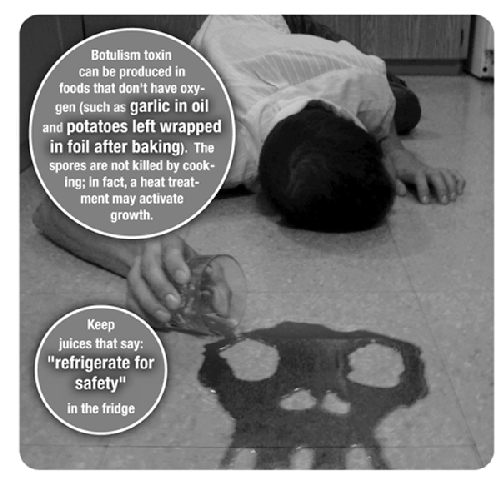
we want to do is come up with signs that work. I’m wondering what your signs look like? We have some good ones! Our favorite picture is the skull in the bed of lettuce! The
dead person from carrot juice is pretty good, too.

|
The safest way of preventing bacterial and
parasitic infections from seafood and meats is with proper cooking. The USDA recommends
cooking fish to a minimum internal temperature of 145°F / 63°C, ground beef to a minimum
internal temperature of 160°F / 71°C, and poultry to 165°F / 74°C.
If you enjoy your fish cooked only to a rare point or even raw in the middle and
you’re concerned about parasites, give frozen fish a chance. I’ve found distinct
differences in the quality of frozen fish. Some stores sell frozen product that’s
downright bad—mushy, bland, uninspiring—but this isn’t because the
fish was frozen. Some of the best sushi chefs in Japan are finding that quick-frozen
tuna is exceptionally good. Frozen at sea right after it’s caught (in a slurry of liquid
nitrogen and dry ice), the tuna doesn’t have much time to break down and so maintains
its quality during transportation.
One last comment on keeping yourself safe in the kitchen: the biggest issue isn’t
contaminated food from the store, but cross-contamination while preparing it at home.
Avoid cross-contamination by washing your hands often, especially both before and after
working with raw meat. Use hot water and soap, and wash for a good 20 seconds.