Is Your Child Ready to Go Away to School? (part 2) – Financial Preparedness

Finally, there is
financial preparedness. This goes beyond having your child develop a
budget for living expenses while away at school. Financial preparedness
means both you and your child are on the same page about the financial
implications of college choice. It means that you both clearly
understand how your family will be paying for college.

Financial
preparedness means getting clear in your own mind where you stand on the
issue of paying for college. Is it your expectation that you will pay
for any college, regardless of the cost? Does your child have the same
expectation? Can your child go anywhere she wants, as long as she can
get admitted? This is the “college first” approach, in which a student
selects the college and the parents figure out how to pay for it. Is
this the way you see it? If this is the way your child sees it, are you
two in agreement?

If you are not going to
be able to pay for college, or if you will not be able to pay the full
amount, do you expect your child to borrow money for college? If so, how
much debt are you comfortable with your child taking on to pay for
college? Is the message you are communicating to your child that no
amount of money is too great to borrow to go to certain schools? Is this
the message your child is getting from family, friends, counselors,
teachers, and college recruiters? If so, does your child understand the
long-term implications of the debt she will be taking on?

Because college
recruiters often communicate with students in the high school before
parents are involved, and because recruiters often frame the decision
about where to go to college as a “college first” decision, it is
important to examine your beliefs around college choice and communicate
them clearly to your child before you both get swept up in the emotion
of the college admissions process.

You and your
child will experience heavy marketing around choosing a college. As the
pool of traditional-age students grows smaller in the next few years,
there will be more and more recruiting pressure on your child to
consider different schools. You need to be clear about where you stand.
Talk with your child about how the decision about college will be made
in your family. Will the decision be your child’s alone? Will it be your
decision? Will it be a joint decision, based on the overall financial
situation of the family as well as your child’s best interest, both
academically and financially? This is the “cost first” approach. How
much can you afford to pay for college? Given what you can afford, which
colleges are the best fit for your child?

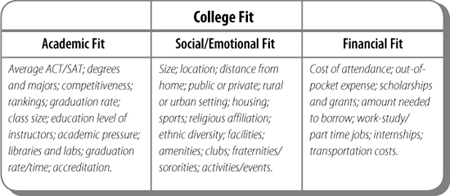
The College Fit
worksheet will help you organize your thoughts around college fit. Think
about your child’s academic, social, and financial preparedness for
college. Then identify the corresponding information about the colleges
your child is considering. This will give you more data upon which you
and your child can base the college decision.
Image

A student who is
strong both academically and socially and who has unlimited financial
resources might be encouraged to go anywhere. A student who is strong
academically but socially and emotionally tentative might be encouraged
to look at schools closer to home. A college that is a two- to
three-hour drive home for the student to recharge and refocus might be a
better fit than a college with a six-hour plane flight between school
and home. An academically strong student with good social skills but
limited financial resources might look for schools providing the best
scholarship offers, keeping in mind the need to limit student loans to
cover transportation costs and living expenses. A student with good
social skills but weak academic skills who has unlimited financial
resources might look for a private college that offers a strong academic
support program to help her build her skills to the college level and
go on to finish a college degree. An academically weak student who is
also socially weak, even with unlimited resources, might be wise to
attend college close to home until she has demonstrated she is capable
of college-level work.

There is no “one size
fits all” way to choose a college and no one “right” college for every
student. The transition to college is a major developmental milestone,
and not all students are at the same developmental stage when they
graduate from high school. College choice should be made accordingly.

Whatever
decision you and your child make, you will have to come up with the
money to pay for it. Is there a way to identify the true cost of college
before a child enrolls?

Parent Tip 26

Grade inflation is the practice of giving higher grades for academic work than the work merits.

There are many
pressures on high school teachers to reduce standards. Pressure comes
from a variety of sources, including parents, school administrators,
politicians, and students themselves. If grade inflation is going on at
your high school, it will distort your view of your child’s college
readiness.

Seek out more
objective data. In assessing college readiness, have your child take a
standardized test like the ACT or COMPASS to get a broader picture of
his or her skills. Given the amount of money you will be paying for
college, make sure you have good data upon which to base your college
decision.

Parent Tip 27

Presumably, if your
child makes good grades on standardized tests like the ACT and SAT, she
has learned to “play school” effectively. But this is not always the
case. A student may earn good test scores on standardized tests while
exerting very little effort in high school. The ability to test well
without studying will not be enough to sustain your child academically
at the college level.

Your child will
need to have strong study skills outside of class in order to be
successful in college-level work. A student with high standardized test
scores but poor study skills will face extra challenges freshman year.

Parent Tip 28

A good way to get ahead
of the game when it comes to time management in college is to sit down
with your child, once he has gone through new student orientation and is
enrolled in classes, and have him map out a weekly planning grid like
the one that follows this tip.

First, have him write in his weekly class schedule. Then have him mark out the times he will be working.

Next,
have him mark out times for personal care, including meals and
exercise. Finally, have him calculate his needed study time for the
credit hours he is taking, applying the two for one rule: two hours of
study for each hour in class. Ask him to identify where on the planning
grid he might have time to study. When could he study and where might he
do so? If the residence hall is too noisy, where are some other places
on campus that might be more conducive to study?

Having a student create a
weekly time log is often an eye-opener. It gives the student a visual
picture of where he is spending his time and an opportunity to regroup
if his time management plan is not producing the results he wants in
college.

Parent Tip 29

If your child
scores into remedial courses in college, this is a red flag about his
readiness to go away to school. Your child is already behind the pack
going out of the starting gate.

You need to
identify your child’s academic weaknesses while he is in high school and
seek out academic support. It is unrealistic to expect a student who
has not learned good study strategies in high school to suddenly turn
around and demonstrate good study skills in college when all parental
structure has been removed.

After your child has
taken the ACT or COMPASS test as a junior, set up a meeting with your
high school counselor. Map out a game plan of classes and support
services for senior year that will help your child build his skills to
the college level.

Parent Tip 30

To help your child
with the social/emotional transition to college, have a debriefing
session with your child after she attends freshman orientation. Using a
map of campus, have your child show you the following places:

• The student health center.

• The fitness center, bike trail, or jogging path she can use to keep up an exercise routine.

• The college library.

• The location of the academic support services for writing, math, and course-specific tutoring.

• The counseling center where she can go for help.

Parent Tip 31

In dealing with the
financial-aid process and other administrative matters, you have a
choice to make. You can choose to do everything for your child yourself
or you can teach your child how to navigate the college bureaucracy on
her own.

Most parents who
encourage their child to go away to college do so because they believe
that their child will learn many things outside the classroom. In skills
language, many parents think that by living communally in a residence
hall, managing her own free time, socializing with new people, and
managing money, their child will gain important adaptive and functional
skills that will benefit her throughout life.

But some of the most
critical life skills learned outside the classroom involve navigating
the bureaucracy of higher education. If you do this work yourself, you
deny your child the opportunity to learn important skills.

The following are some functional skills you can teach your child through interactions with the bureaucracy of higher education.

• How to use complex software to transact personal business.

• How to communicate effectively using e-mail.

• How to communicate verbally to get your needs met.

• How to read the fine print before you sign anything.

• How to budget.

• How to think through the implications of borrowing money before you do so.

Here are some of the adaptive skills you can teach your child through interactions with the bureaucracy of higher education:

• Responsibility

• Courtesy

• Accuracy

• Attention to detail

If you do all your
child’s college administrative transactions for her, you are sabotaging
her long-term growth and development. While it is always easier in the
short run to do the job yourself, it is not in the best long-term
interest of your child for you to do so.

Parent Tip 32

To teach your child how
to manage her own business affairs in college, you will first need to
figure the process out yourself. This means getting access to your
child’s administrative student account.

There are two main
kinds of electronic accounts your child will use in college. One is a
student account that gives your child access to classroom-management
software. The other is a student account that lets your child do
administrative business with the college.

You should have access to your child’s administrative account. You should not have access to your child’s classroom account.

Classroom-management
software allows your child to perform classroom-related functions such
as turning in assignments electronically, communicating with instructors
about classes, checking grades as the semester progresses, accessing
supplemental course materials, and so on. Two widely used
classroom-management programs are Blackboard and Web CT.

Student-administration
software lets your child perform administrative tasks such as enrolling
in classes each semester, checking final grades, reviewing transcripts,
paying for college, checking the status of financial aid, and
communicating with college personnel about these functions. Student
administration software often has a college-specific label like “My
State U.”

You have no business in
your child’s classroom-management account. This is like sitting beside
your child in the classroom. You must let your child sink or swim on her
own academically in college. You can direct her to resources on campus
that will help her if she tells you she is struggling, but you should
not be monitoring the day-to-day interactions of her classes.

On the other hand, you should get access to your child’s administrative account for several reasons:

• You are paying for college.

• It may be the only way you will be able to see your child’s final grades.

• It is the only way you will be able to teach your child how to perform key administrative functions herself.

Because of federal
privacy laws, your child will have to give you access to her
administrative records. In a technological age, this is simple. Ask your
child to give you her user ID and password for her
student-administrative account. In addition, if your child receives
financial aid, have her go to the financial aid office and fill out a
consent form letting you, as a parent, talk with financial aid personnel
about your child’s account.

Parent Tip 33

At each step of the
administrative process, it is important for you to ask yourself, “Am I
going to do this for my child or am I going to teach my child how to do
this herself?”

Things you should do yourself:

• Complete your income tax forms as early as possible each year because all financial aid hinges on parental tax information.

• Complete the
FAFSA (Free Application for Federal Student Aid) each year even if you
think your family income is too great to qualify for federal need-based
aid. Your child probably qualifies for federal non-need-based aid, but
to be considered for this money, you must complete the FAFSA.

• Educate
yourself as to the important dates: the financial aid deadline, the
earliest date to enroll, the date fees are due, the last date to
withdraw with a full refund, partial refund dates, and so on.

• Monitor your child’s progress meeting administrative deadlines.

• Teach your child how to advocate for herself in dealings with college personnel.

• Have a clear understanding of your own financial situation before you sign on for student loan debt.

Things you should encourage your child to do:

• Log in to her student account on a regular basis.

• Check her student e-mail on a regular basis.

• Schedule and attend all testing, advising, enrollment, and orientation sessions.

• Enroll as early as possible each semester.

• Watch for financial aid deadlines.

• Turn in financial aid paperwork on time, whether in person or online.

• Be nice to the people working in the financial aid office.

• Meet with an academic advisor each semester to verify course selection.

• Go to the career center by the second semester of her freshman year to get help selecting a major.

• Advocate for herself with her instructors.

• Seek out academic support services before there are problems in a class.

Things you and your child need to have an honest discussion about before she goes to college:

• How much money your child will be borrowing.

• Where the financial aid money will be spent.

• A budget for living expenses while in college.

• How any student loans will be repaid.

• The use of student loans to pay for needs rather than wants.

• The implication of failed or dropped classes on financial aid eligibility.

• Who pays for failed or dropped courses.

• The comparative values of financial aid offers and the fact that the biggest scholarship is not always the best deal.

• Your own ability to pay for a particular college.

• The financial impact of losing a scholarship because of poor grades.

• Signing credit card offers, including retail store accounts.

• Who pays any credit card balances.

Parent Tip 34

If you are tempted
to get into your child’s classroom-management account because you pay
the bills, stop and think about it. Put yourself in the instructor’s shoes. Would you want 30 outside people monitoring and critiquing your work every day?

Perhaps you work in a
“this call may be monitored” kind of environment. Perhaps you respond
well to that kind of supervisory oversight. But if you don’t, think
about how it would feel if you had to work that way.

Education is about
process as much as course content and grades. It is your child’s
responsibility to engage in the process. It is your child’s
responsibility to communicate with her instructor and seek out help when
needed. And it is your child’s responsibility to accept the
consequences if the outcome is not what you or she had expected.

Parent Tip 35

Each year U.S. News and World Report
publishes a list of college rankings. This report is based on a number
of criteria, including the fall-to-fall retention rate for students (how
many freshmen come back to the same institution the next year), the
graduation rate of students who earn a degree in six years or less, and
the average class size.

Here are some additional questions to ask college recruiters as you and your child develop your own list of college rankings:

• What are the top five classes in freshman enrollment?

• What is the
withdrawal or failure rate in each of the top five classes (i.e., how
many students in these classes earn a grade of D or F or withdraw from
the class before the semester is over)?

• What are the top
five undergraduate majors at this institution? How many students apply
to these majors each year, and how many are accepted?

• What is the average student loan debt of graduates of this institution?

• What percentages of first-year students are enrolled in remedial math, writing, and reading classes?

The answers to these questions will help you evaluate whether an institution will be a good fit for your child.

Parent Tip 36

The “college
effect” describes an increase in health-risk behaviors related to
alcohol use the first semester in college. Students who formerly
abstained from alcohol
may begin drinking, and students who have been drinking in high school
may escalate their drinking now that they are free from parental
control.

It is important
not to overreact or underreact to college drinking. Educate yourself on
the issue. Many Web sites have excellent resource information on the
topic. If you suspect your child is having alcohol problems, insist he
go to the college counseling center and get an assessment before going
back to school the next semester. Confronting your child in this way
could be just the wake-up call he needs to change course before it is
too late.

Parent Tip 37

One reason to have your child begin basic career exploration in high school is to reduce stress freshman year.

The first year
of college is a huge transition for even the best and the brightest of
students. Your child will have enough on his plate meeting the increased
academic demands of college while making new friends and enjoying a
social life. Career planning is, and should be, on the back burner.

At the same time,
when your child chooses his classes for sophomore year, he needs to have
a tentative major in mind. This is because certain courses are required
sophomore year for entry into a major as a junior. Since sophomore
enrollment usually takes place on many campuses during the spring of
freshman year, your child will need to have a tentative idea of a
college major near the end of freshman year to choose the right classes
to be on track to graduate in four years.

Parent Tip 38

One of the many
issues within higher education today is the tension between a business
model of higher education and an academic model. These conflicting
models can exist within the same institution and create confusion for
students and parents. When is a college like any other business? When is
it not? When is your child a customer and when is he a student?

Enrollment
management is a business model of higher education. It is focused on
increasing net revenue through marketing and customer service. Students
and parents are brought into the institution under a business model.
Often families have more than a year of interaction with college
personnel before new student orientation begins.

The
traditional professor-student relationship is an academic model. It is
focused on student learning and helping students learn through all their
experiences, including their mistakes and failures. Students and
parents are expected to switch gears and relate to the college in an
academic model once the student is accepted into school.

It is helpful to give
this matter some thought before you interact with college personnel. It
is also helpful for college personnel to give this matter some thought
before they interact with you!

Parent Tip 39

One reason to have a
conversation with your child sooner rather than later about how your
family will decide where a he or she will go to college is the
increasing use of electronic communication in college recruiting.
Colleges are using social networking resources like Facebook and Twitter
to communicate with students. Information is distributed directly to
potential students in a way that appeals to teenagers and their criteria
for choosing a college. The goal of the recruiting process is to create
a large pool of applicants. The more students that apply, the easier it
is for the college to select the best mix of students to advance its
enrollment management goals.

As a parent, you have
no idea how any of the online interactions your child has with
recruiters will be used in the enrollment management process. Social
networking as a recruitment tool is too new for you to predict how it
will impact your child’s college decision.

You need to get ahead
of the game. Have a conversation with your child about how your family
will be making the college decision and the need for caution in sharing
too much personal information in social networking exchanges with
college reps.

Parent Tip 40

The decision to go away
to college or attend college while living at home is not an
all-or-nothing decision. A student can live at home for an agreed-upon
time and then transfer to another institution.

If this is your
family game plan, it is important for your student to work closely with
the advising office at both schools to make sure all courses will
transfer and that all prerequisite courses for a major are included in
the plan of study.

Parent Tip 41

If cost is an issue
to you, make sure your high school counselor knows what your priorities
are and which colleges you are considering.

Many people,
including educators, are unaware of how much of today’s financial aid
packaging consists of loans rather than grants and scholarships. If this
will be an issue for you, make sure those influencing your child
understand your position. Giving a young person a college education is a
tremendous gift, but so is making sure a young person can start adult
life with little or no debt.

Parent Tip 42

If your child has
not completed college composition and college algebra courses in high
school, he may be required to take a placement test before enrolling for
those courses as a college freshman. Some schools use the ACT or SAT
tests to place students in first-semester college courses, while others
have their own placement tests to determine which courses a student must
take.

If your child
will be taking a placement test before enrolling, make sure he does some
review before taking the test. If your child did not take a math course
senior year, it is especially important for him to review math concepts
before the placement test so he does not score into remedial courses in
college. Have your child go to the public library and check out a study
guide to use to refresh his skills in writing, reading, and math before
taking any college placement test.

Parent Tip 43

When your child
calls from college and talks about a problem he is experiencing, he may
be venting or he may need your help. You won’t know until you listen.
Rather than jump into action to fix the problem, say something like,
“Tell me what you’ve done already to solve the problem.” By listening
carefully and letting your child brainstorm solutions to his own
difficulties, you will be teaching problem-solving and self-advocacy
skills rather than taking the problem away from your child and fixing it
yourself.

Parent Tip 44

The easiest way to
determine if you are over the top on any of your parental interventions
is to ask yourself, “Would I want to work with my child if this
behavior was going on?”

If your child were working in the office cubicle next to yours and assigned to your project team, how would you react if

• His mother called his supervisor to challenge his performance review?

• His dad had online access to your team discussion board and project timelines?

• His mother rewrote his monthly sales reports?

• His dad sat in the waiting room while he interviewed for a job?

• His dad called your supervisor to complain about you?

Stop and think about
it. Are you sabotaging the development of your child’s adaptive skills
by doing things he should be doing for himself? Are you giving him a
vote of “no confidence” when it comes to dealing with life? Are you
denying him the opportunity to learn from his mistakes?

In four or five short
years, your child will be entering the workforce. At that time, he will
need to have the skills employers want. The most valued skills employers
consistently say they are looking for include the following:

• Adaptability

• Commitment

• Communication

• Cooperation

• Being a team player

• Customer focus

• Dependability

• Honesty

• Integrity

• Initiative

• Innovation

• Quality focus

• Engagement

What
is your child’s portfolio when it comes to demonstrating these skills?
What are you doing as a parent to help your child develop these key
skills?