6. 356°F / 180°C: Sugar Begins to Caramelize Visibly
Unlike the Maillard reaction, which requires the
presence of both amino acids and sugars and has a number of interdependent variables
influencing the particular temperature of reaction, caramelization
(the decomposition via dehydration of sugar molecules such as sucrose) is relatively
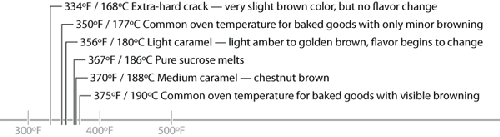
simple, at least by comparison. Pure sucrose melts at 367°F / 186°C; decomposition begins
at lower temperatures (somewhere in the range of 320–340°F / 160–170°C) and continues up
until around 390°F / 199°C. (Melting is not the same thing as decomposition—sucrose has a
distinct melting point, which can be used as a clever way of calibrating your oven.
Like the Maillard reaction, caramelization results in hundreds of compounds being
generated as a sugar decomposes, and these new compounds result in both browning and the
generation of enjoyable aromas in foods such as baked goods, coffee, and roasted nuts. For
some foods, these aromas, as wonderful as they might be, can overpower or interfere with
the flavors brought by the ingredients, such as in a light gingersnap cookie or a brownie.
For this reason, some baked goods are cooked at 350°F / 177°C or even 325°F / 163°C so
that they don’t see much caramelization, while other foods are cooked at 375°F / 191°C or
higher to facilitate it.
When cooking, ask yourself if what you are cooking is something that you want to have
caramelize, and if so, set your oven to at least 375°F / 191°C. If you’re finding that
your food isn’t coming out browned, it’s possible that your oven is running too cold. If
items that shouldn’t be turning brown are coming out overdone, your oven is probably too
hot.
Fructose, a simpler form of sugar found in fruit and honey, caramelizes at a lower
temperature than sucrose, starting around 230°F / 110°C. If you have other constraints on
baking temperature (say, water content in the dough prevents it from reaching a higher
temperature), you can add honey to the recipe. This will result in a browner product,
because the largest chemical component in honey is fructose (~40% by weight; glucose comes
in second at ~30%).
Temperatures related to sucrose caramelization and
baking.
Caramel Sauce
Caramel sauce is one of those
components that seems complicated and mysterious until you make it, at which point
you’re left wondering, “Really, that’s it?” Next time you’re eating a bowl of ice
cream, serving poached pears, or looking for a topping for brownies or cheesecake, try
making your own.
Traditional methods for making caramel sauce involve starting with water,
sugar, and sometimes corn syrup as a way of preventing sugar crystal formation. This
method is necessary if you are making a sugar syrup below the melting point of pure
sucrose, but if you are making a medium-brown caramel sauce—above the melting point of
sucrose—you can entirely skip the candy thermometer, water, and corn syrup and take a
shortcut by just melting the sugar by itself.
In a skillet or large pan over medium-high heat, heat:
1 cup (240g) granulated sugar
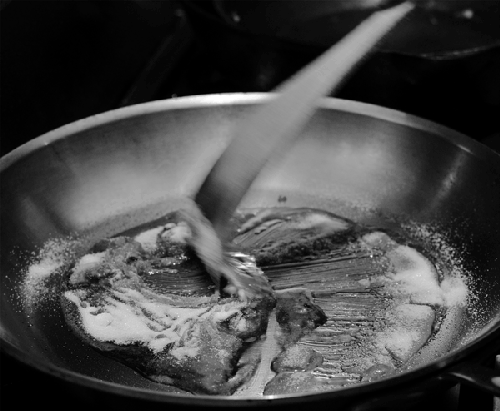
Keep an eye on the sugar until it begins to melt, at which point turn your burner
down to low heat. Once the outer portions have melted and begin to turn brown, use a
wooden spoon to stir the unmelted and melted portions together to distribute the heat
more evenly and to avoid burning the hotter portions.
Once all the sugar is melted, slowly add while stirring or whisking to
combine:
1 cup (240g) heavy cream
Notes
This thing is a calorie bomb: 1,589 calories between the cup of heavy
cream and cup of sugar. It’s good, though!Some recipes call for adding corn syrup to the sugar as you heat it.
This is because the sucrose molecules, which have a crystalline structure, can
form large crystals and chunk up in the process of heating. The corn syrup
inhibits this. If you heat the plain sugar with a watchful eye and don’t stir it
until it gets hot enough, the corn syrup isn’t necessary. (It would be necessary,
however, if you were only heating the sugar to lower temperatures—temperatures
below the melting point—for other kinds of candy making.)Try adding a pinch of salt or a dash of vanilla extract or lemon juice
to the resulting caramel sauce.Different temperature points in the decomposition range yield
different flavor compounds. For a more complex flavor, try making two batches of
caramel sauce, one in which the sugar has just barely melted and a second where
the caramel sauce is allowed to brown a bit more. The two batches will have
distinctly different flavors; mixing them together (once cooled) will result in a
fuller, more complex flavor.Sucrose has a high latent heat—that is, the sugar molecule is able to
move and wiggle in many different directions. Because of this, sucrose gives off
much more energy when going through the phase transition from liquid to a solid,
so it will burn you much, much worse than many other things in the kitchen at the
same temperature range. There’s a reason pastry chefs call this stuff “liquid
Napalm.”