The spiritual and political heart of the city, the
Palace of Westminster was built here a thousand years ago as a royal
household, seat of government and abbey. The square was planned as part
of the rebuilding programme following a fire that destroyed the Palace
in 1834. Usually known as the Houses of Parliament, the new Palace of
Westminster stands opposite Westminster Abbey. On the north side of the
square, Parliament Street leads to Whitehall and No.10 Downing Street,
the Prime Minister’s residence.
Parliament Square SW1
www.parliament.uk
The
Strangers’ Galleries at the Houses of Parliament have limited seating
for visitors during debates. Times are given at St Stephen’s gate, or
phone 020 7219 4272 Tours can be arranged through MPs at www.parliament.uk Tickets for summer opening of parliament are available from 0844 209 0382
|
The 659 publicly
elected Members of Parliament sit in the House of Commons, where the
Prime Minister and his or her government sits on the right-hand side of
the Speaker, who ensures the House’s rules are obeyed. The opposing
“shadow” government sits on his left. The neighbouring House of Lords is
for an unelected upper chamber which has around 700 members and limited
powers. The Prime Minister attends a weekly audience with the Queen,
who today has only a symbolic role. |

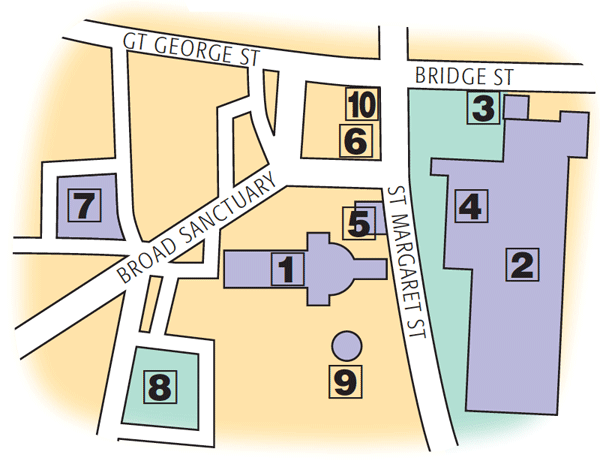
Plan of the Square
The basement café in Central Hall is a good place for a snack. |
|
To avoid long lines for the Strangers’ Galleries go after 6pm Mon–Thu. |
|
Top 10 Sights
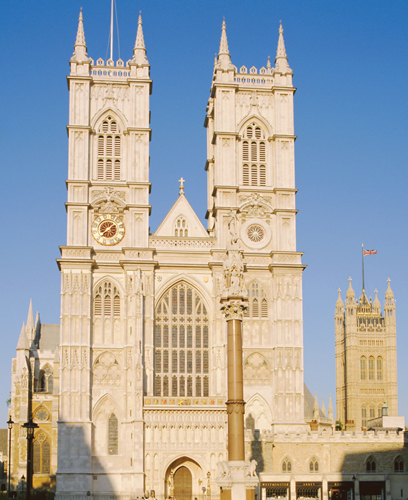
Westminster Abbey

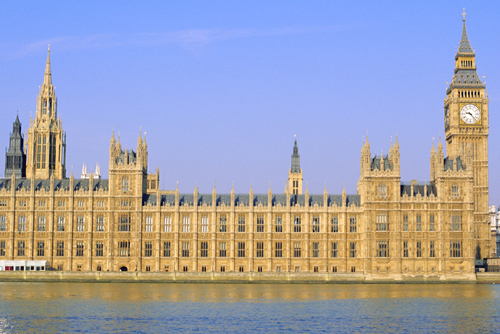
Houses of Parliament
A
Gothic revival building from 1870 by Sir Charles Barry and Augustus
Welby Pugin, the Houses of Parliament cover 8 acres and have 1,100 rooms
around 11 courtyards. The Commons Chamber is where Members of
Parliament sit and debate policy.

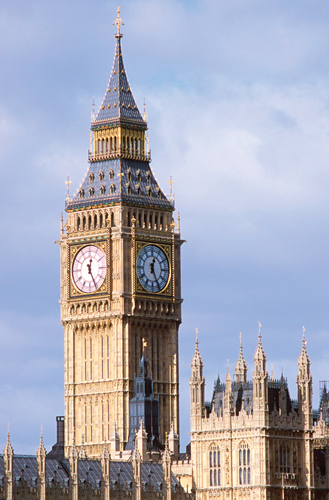
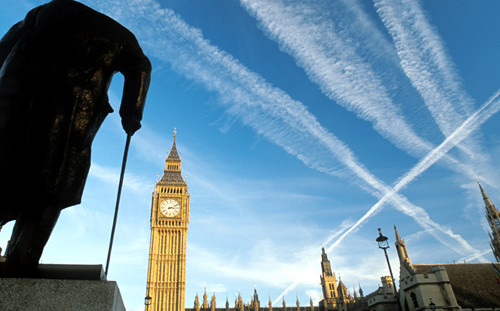
Big Ben
The
huge Clock Tower of the Palace of Westminster is popularly known as Big
Ben. However, the name actually refers to the clock’s 14-tonne bell,
named after Sir Benjamin Hall, who was Chief Commissioner of Works when
it was installed in 1858.

Westminster Hall
Westminster
Hall is about all of the original palace that remained after the 1834
fire. For centuries the high court sat beneath its marvellous hammerbeam
roof.
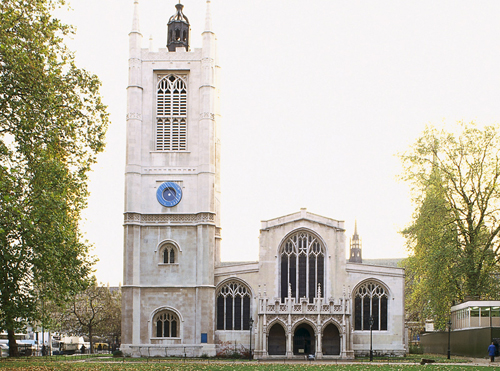
St Margaret’s Church
Winston
Churchill was among many eminent figures to marry in this 15th-century
church. William Caxton (1422–91), who set up the first printing press in
England, and Sir Walter Raleigh, who established the first British
colony in America, are both buried here. Charles I is also remembered.

Winston Churchill Statue
This
powerful statue of Britain’s wartime leader (1874–1965), dressed in his
famous coat, is one of several statues in the square. These include
prime minister Benjamin Disraeli (1804–81), American president Abraham
Lincoln (1809–65), and many other statesmen and soldiers.

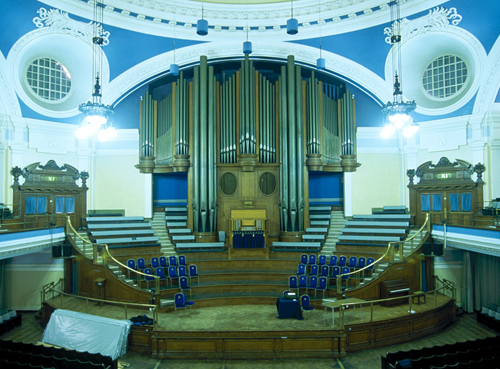
Central Hall
This
large assembly hall, built in a Beaux Arts style, was funded by a
collection among the Methodist Church who wanted to celebrate the
centenary of their founder John Wesley (1703–91).

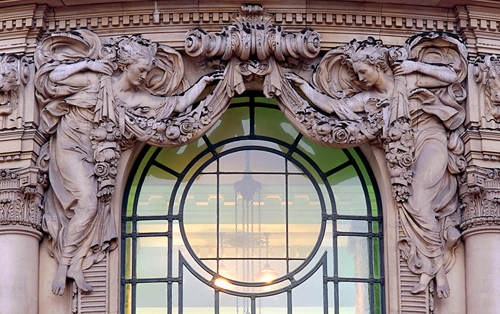
Detail above Central Hall window

Dean’s Yard
Buildings
around this secluded square were used by monks before the Dissolution
of the Monasteries in the 1530s which closed their school here. A new
Westminster School was founded by Elizabeth I in 1560 and it remains one
of Britain’s top public schools.

Jewel Tower
Built
in 1365 to safeguard the treasure of Edward III, this is an isolated
survivor of the 1834 fire. A small museum about the history of
parliament is housed inside.
Statue of Oliver Cromwell
Oliver
Cromwell (1599–1658) presided over England’s only republic, which began
after the Civil War. He was buried in Westminster Abbey, but when the
monarchy was restored in 1660, his corpse was taken to Tyburn and hanged
as though he were a criminal.