Two of Madrid’s most lively
barrios lie just off the Gran Vía. Chueca was originally home to the
city’s blacksmiths and tile makers. Run down for many years, it has
enjoyed a renaissance after being adopted by Madrid’s gay community –
the area puts on its glad rags every summer for the Gay Pride
celebrations. The 19th-century buildings around Plaza de Chueca have
been given a new lease of life as trendy bars and restaurants.
Neighbouring Malasaña was the focus of resistance against the French in
1808. Like Chueca, it became rather seedy, but is now a mainstay of
Madrid nightlife.
Manuela MalasañaThe seamstress, who became a national heroine |
Sights
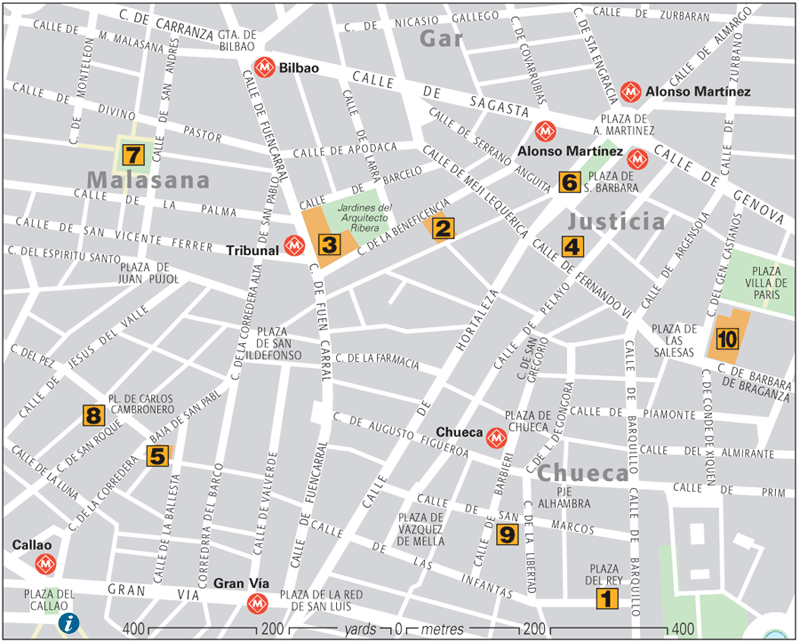
Casa de las Siete Chimeneas
The
“house of the seven chimneys” dates from around 1570 and is one of the
best preserved examples of domestic architecture in Madrid. The building
is said to be haunted by a former lover of Felipe II – not as far
fetched as it sounds, as a female skeleton was uncovered here at the end
of the 19th century. The house later belonged to Carlos III’s chief
minister, the Marqués de Esquilache, whose attempts to outlaw the
traditional gentleman’s cape and broad brimmed hat, on the grounds that
rogues used one to conceal weapons and the other to hide their faces,
provoked a riot and his dismissal.Plaza del Rey 1
Closed to the public
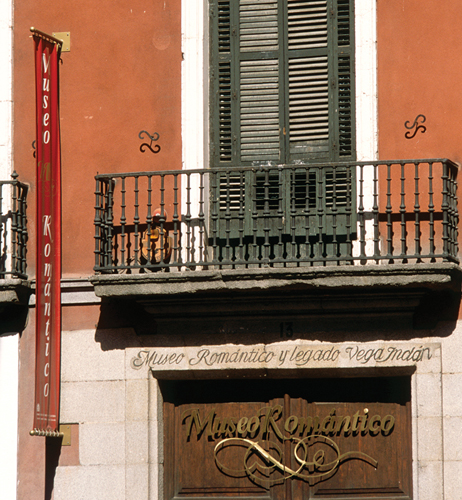
Museo Romántico
This
unusual but evocative museum, as its name suggests, recreates the
Madrid of the Romantic era (c.1820–60), with rooms furnished and
decorated in the style of the period. The real attraction, however, lies
in the ephemera: fans, figurines, dolls, old photograph albums, cigar
cases, visiting cards and the like, which all help to summarize the era.
Among the paintings is a magnificent Goya in the chapel and a portrait
of the Marqués de Vega-Inclán, whose personal possessions form the basis
of the collection. By common consent, the archetypal Spanish Romantic
was Mariano José de Larra, a journalist with a caustic pen, who shot
himself in 1837 after his lover ran off with another man. The offending
pistol is one of the museum’s prized exhibits.Calle de S Mateo 13
Closed for restoration until 2010
Adm

Museo Romántico
Museo de Historia
This
former poorhouse is now a museum tracing the history of the capital
from the earliest times to the present day. Prize exhibits include
mosaic fragments from a local Roman villa, pottery from the time of the
Muslim occupation, a bust of Felipe II, and Goya’s Allegory of the City of Madrid (Dos de Mayo).
The star attraction is a wooden model of the city, made in 1830 by León
Gil de Palacio. As you leave, take a look at the elaborately sculpted
Baroque portal, dating from the 1720s.Calle de Fuencarral 78
Open 9:30am–8pm Tue–Fri (to 2:30pm in Aug), 10am-2pm Sat–Sun
Some areas closed for refurbishment until 2010
Free
Palacio Longoria
The
finest example of Art Nouveau architecture in Madrid was created for
the banker Javier González Longoria in 1902. The architect was José
Grases Riera, a disciple of Antoni Gaudí. Magnificently restored in the
1990s, the walls, windows and balconies are covered with luxuriant
decoration suggesting plants, flowers and tree roots .Calle de Fernando VI, 8
Closed to public
Iglesia de San Antonio de los Alemanes
The
entire surface area of this magnificent domed church is covered with
17th-century frescoes depicting scenes from the life of St Anthony of
Padua. The congregation included the sick and indigent residents of the
adjoining hospice, who were allocated a daily ration of bread and boiled
eggs. (The church still has a soup kitchen).Corredera Baja de S Pablo 16
Open for services
Free
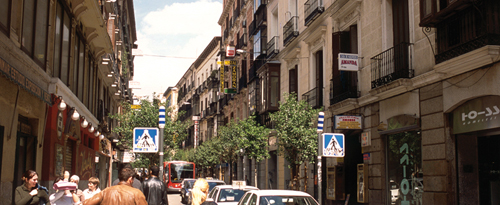
Calle de Fuencarral
This
narrow street, permanently clogged with traffic, is worth negotiating
for its original and offbeat shops. High street fashions are represented
by outlets such as Mango (No. 9) but for something more outré,
check out the party fashions at No. 47, or the seductive underwear at
Chocolate (No. 20). La Reserva (No. 64) sells silver jewellery handmade
by Navajo Indians, as well as Mexican belts and snakeskin wallets. Café
Po zo (No. 53) offers its own blends of coffee and tea, while Retoque
(No. 49), founded in 1920, goes in for picture frames and modern art
posters.

Calle de Fuencarral
Plaza del Dos de Mayo
This
square in the heart of Malasaña commemorates the leaders of the
insurrection of May 1808, Luis Daoíz and Pedro Velarde, who are buried
in the Plaza de Lealtad.
The site was chosen because, in those days, this was the artillery
barracks of the Monteleón Palace, the main focus of resistance to the
French. The brick arch now sheltering a sculpture of the two heroes was
the entrance to the building. In the 1990s the square was taken over by
under-age drinkers who gathered here at weekends for binges known as botellón. Though it has now been reclaimed by local residents, it is best avoided at night.Iglesia San Plácido
Founded
in 1622 by Don Jerónimo de Villanueva, a Madrid nobleman, the early
history of this convent was darkened by scandal. Rumours of sexual
misconduct among the novices led to an investigation by the Inquisition
which implicated the chaplain, the abbess and the Don himself. It was
even rumoured that Felipe IV made nocturnal visits to the convent via a
passageway under the street. Today the main attraction is the splendid
Baroque church (1655). The retable over the altar contains a magnificent
Annunciation by Claudio Coello.Calle S Roque 9
Open for services
Free

Iglesia San Plácido
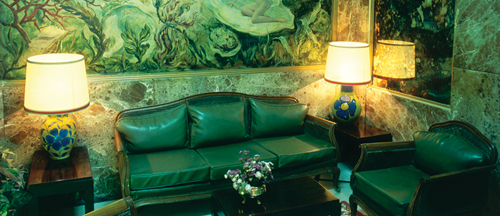
Hotel Mónaco
At
the turn of the 20th century the Mónaco was a well known brothel
frequented by members of the Spanish nobility including, so rumour has
it, King Alfonso XIII. Now a respectable hotel, the breakfast room
retains some of the original features, such as the leather booths, while
the rest has been redecorated in Art Deco style .Calle de Barbieri 5

Hotel Mónaco
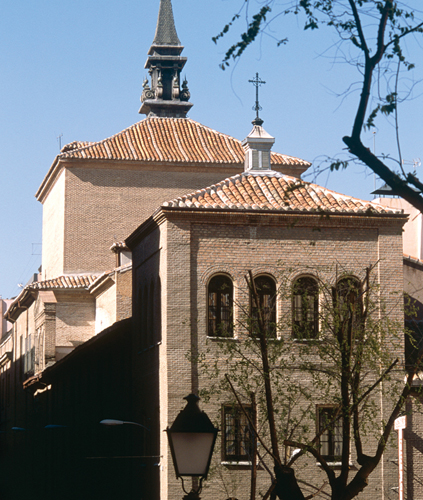
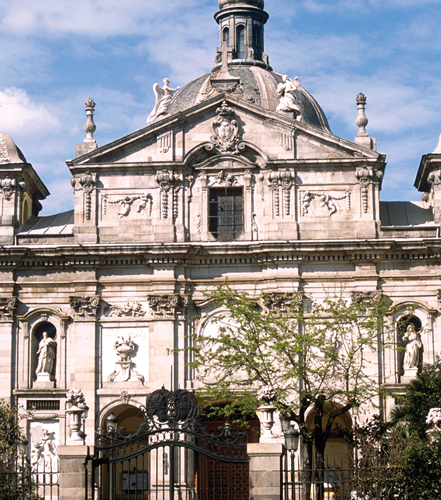
Iglesia de las Salesas Reales
The
monastery of the Royal Salesians was founded by the wife of Fernando
VI, as a refuge from her overbearing mother-in-law should the king die
before her (in fact, she died first). You can still see the lavish
Baroque church (1750), sculptures and decorative details on the façade
and the tombs of Fernando and his wife by Francesco Gutiérrez.Calle de Bárbara de Braganza 3–5
Open for services
Free

Iglesia de las Salesas Reales