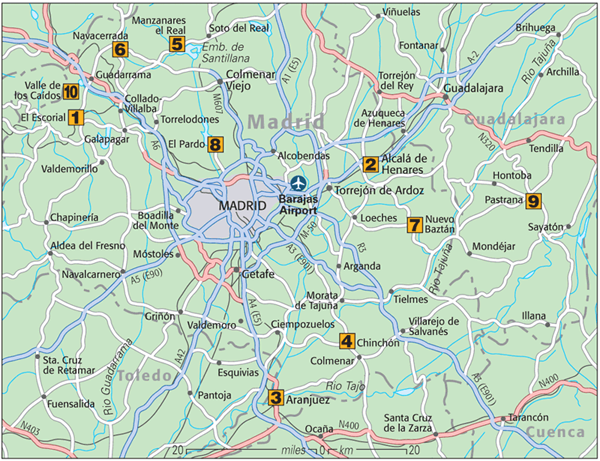
The Comunidad de Madrid is a
vast region covering 8,000 sq km (3,000 sq miles), with a population now
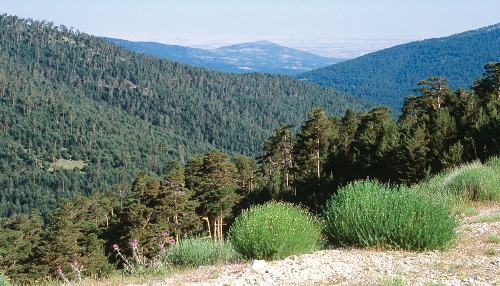
exceeding five million. To the north of the capital is the Sierra de
Guadarrama, a majestic mountain range, stretching more than 100 km (60
miles) east–west, and visitors to El Escorial, Valle de los Caídos, or
Manzanaresel-Real will enjoy superb views as well as fresh mountain
air. An excursion to the university town of Alcalá de Henares can easily
be combined with Chinchón. Alternatively you could couple the latter
with Aranjuez, an oasis of gardens and orchards in an otherwise parched
landscape.
Tren de CervantesThe Cervantes train is an enjoyable way to see |
|
Sights
Alcalá de Henares
This
historic town has been designated a UNESCO World Heritage Site for its
splendid Renaissance and Baroque architecture. It was the birthplace of
Miguel de Cervantes, author of Don Quixote,
and of the ill fated Queen of England, Catherine of Aragon. The town’s
importance dates from the late 15th century when the head of the Spanish
church, Cardinal Cisneros, founded a university here. A tour of the
buildings, including the main hall with its marvellous mudéjar
ceiling, is a must, Also worth seeing is Teatro Cervantes, the oldest
public theatre in Europe, founded in the 17th century and restored in
the 1990s.Train from Atocha or Chamartín
University: Open for tours 11am–6pm Mon–Fri, 11am–2pm, 4–7pm Sat–Sun;
Adm
Aranjuez
This
gem of a town, awarded the status of UNESCO World Heritage Site in
2001, is a must see. The Palacio Real, summer residence of Spain’s
Bourbon rulers, is sumptuously decorated in the French style. No expense
was spared either on the extravagant folly known as the Casa del
Labrador, in the grounds near the River Tagus. The town has preserved
some of its corralas balconied wooden
dwellings, built around a courtyard – and its bullring (Plaza de Toros).
There are some excellent restaurants in the town and the Mercado de
Abastos is a good source for picnic provisions. Aranjuez’s strawberries,
sold from roadside stalls, make the perfect dessert. The town is also
famous for its asparagus.Train from Atocha or Chamartín
Palacio Real
Open
for tours Apr–Sep: 10am–6:15pm Tue–Sun; Oct-Mar: 10am– 5:15pm Tue–Sun
(gardens open until 8:30pm in summer, 6:30pm in winter)Closed 1 Jan, 6 Jan, 1 May, 30 May, 5 Sep, 24–25 Dec, 31 Dec
Adm (except Wed for EU citizens)
Chinchón
Life
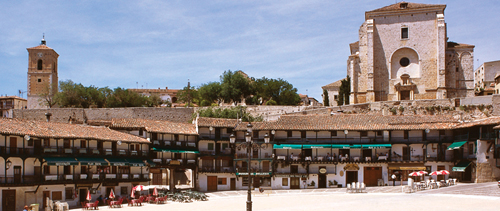
in this attractive little town revolves around the Plaza Mayor, the
galleried main square, dating from the 16th century. Originally a cattle
market, the square is the focus of a Holy Week procession on Good
Friday, a passion play on Easter Saturday and bullfights in July and
August. While you’re here, try the local speciality, anís, a liquorice flavoured liqueur (ask for “Chinchón”). Also worth seeing is the Iglesia de la Asunción, with a painting of the Assumption of the Virgin by Goya, whose brother was the local priest.Bus La Veloz from Avenida Mediterráneo 49

Chinchón
Manzanares-el-Real
This
Sierra town is dominated by its well-preserved 15th-century castle.
Almost as old is the church of Nuestra Señora de las Nieves (Our Lady of
the Snows) with its 30m (100-ft) high belltower. Hikers flock to
Manzanares to enjoy the La Pedriza regional park with its massive
granite boulders.Bus from Plaza de Castilla
Castle: Open Jun–Sep: 10am–1:15pm, 4–7:15pm Tue– Sun; Oct–May: 10am–5:15pm Tue–Sun; Closed Mon; public hols
Adm
Navacerrada
At
1,860 m (6,100 ft) Navacerrada is the gateway to the Sierra de
Guadarrama. Ski enthusiasts head straight for the Navacerrada Pass
(Puerto de Navacerrada), but the town itself should not be overlooked.
Apart from the parish church, which has an impressive 15th-century
tower, and the 16th-century Church of the Nativity, the craft shops are
worth a browse. Cafés abound on Plaza Mayor and there are hiking and
cycling trails in the surrounding forests.Bus 691 from Moncloa

Nuevo Baztán
This
settlement south of Alcalá de Henares was the brainchild of an
18th-century nobleman from Navarre, Juan de Goyeneche. Goyeneche built
the estate so that he could supervise his various industrial
enterprises, among the most advanced of the day. The Baroque palace, the
domed church of St Francis Xavier and the workers’ houses, designed by
José de Churriguera, are the main attractions.Road: A-2, then M-206 & M-219
El Pardo
El
Pardo is now a suburb of Madrid but was in open countryside when Enrico
III built a hunting lodge here in the early 15th century. The Palacio
del Pardo was built by the Bourbons and substantially enlarged during
the reign of Carlos III. More recently it was the official residence of
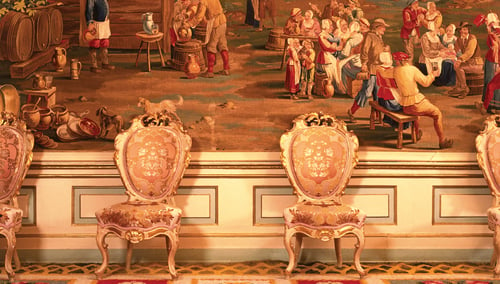
General Franco. The tapestries, from sketches by Goya, are the
outstanding feature.Bus No. 83 from Moncloa
Palacio del Pardo
Open Apr– Sep: 10:30am–6pm Mon–Sat, 9:30am– 1:40pm Sun; Oct–Mar: 10:30am–5pm Mon–Sat, 9:55am–1:40pm Sun; Closed for functions
Adm (free Wed for EU citizens)

Palacio del Pardo, El Pardo
Pastrana
What
draws visitors to the Alcarría region is the rugged scenery and peace
and quiet. In Pastrana, first take a look at the Palacio Ducal in the
main square. The Museo de la Colegiata (next to the church of the same
name) has a splendid collection of 15thcentury tapestries depicting the
capture of Tangier by Alfonso V of Portugal. Just outside town is the
Convento del Carmen, founded by St Teresa of Avila in the 16th century,
with an exhibition on her life.Road A-2 to Guadalajara, then N-320
Museo de Colegiata
Open 11am–2pm, 5–6.30pm daily
Adm
Convento del Carmen
Open 11am–1:30pm, 4–6:30pm Tue–Sun
Adm
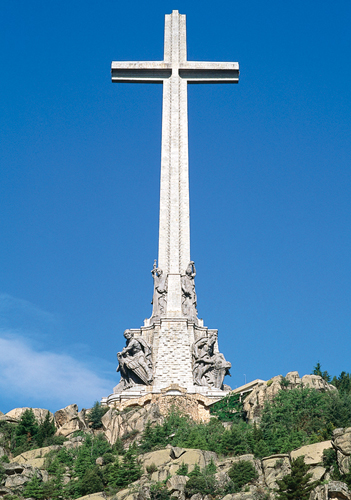
Valle de los Caídos
The
“Valley of the Fallen” was General Franco’s memorial to his war dead
from the Spanish Civil War. The crypt and basílica, cut into the
mountainside, were built by prisoners. The most striking feature is a
cross, 152 m (500 ft) high and 56 m (180 ft) wide, said to be the
tallest in the world. Franco himself is buried in the crypt.Bus from El Escorial, 3:15pm Tue–Sun
Basílica
Open Apr–Sep: 10am–6pm Tue–Sun; Oct–Mar: 10am–5pm Tue–Sun; Closed 1 Jan, 6 Jan, 1 May, 17 Jul, 10 Aug, 24–25 Dec, 31 Dec
Adm (free Wed for EU citizens)

Cross, Valle de los Caídos