This award-winning museum is also a working convent –
a haven of peace and quiet after the noise and bustle of Puerta del Sol
and the Gran Vía nearby. The building started out as a palace, owned by
the royal treasurer, Alonso Gutiérrez, but in 1555 he sold it to the
sister of Felipe II, Juana of Austria, who founded the convent four
years later. The nuns were Franciscans, but became known, because of
their aristocratic backgrounds, as the “Barefoot Royals”. The convent is
crammed with works of art – paintings, frescoes, sculptures,
tapestries, tiles, woodcarvings, embroidered vestments, liturgical gold
and silverware – donated by the nuns’ wealthy relatives. The church
(rarely open to the public) contains the tomb of Juana of Austria.
Plaza de las Descalzas Reales 3 91 45 48800
www.patrimonionacional.es
Open 10:30am– 12:45pm, 4–5:45pm
Tue–Thu & Sat; 10:30am–12:45pm Fri; 11am–1:45pm Sun; closed 1 Jan, 6
Jan, Easter, 1 May, 15 May, 9 Nov, 24–25 Dec, 31 Dec Adm €5 (free Wed for EU citizens)
|
Today the convent is
famous for its artistic treasures, but in the 16th century it was
equally renowned for its music. This was largely due to the reputation
of Tomás Luis de Victoria, chaplain to the Empress María from 1586 to
his death in 1611. Born in Avila, Victoria studied music in Rome, but
his output is infused with a mysticism more typical of the Spanish
Counter Reformation. Victoria’s religious music was among the first to
be heard in the New World. |

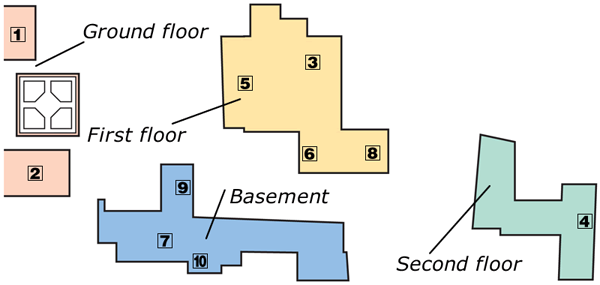
Plan of the Monasterio de las Descalzas Reales

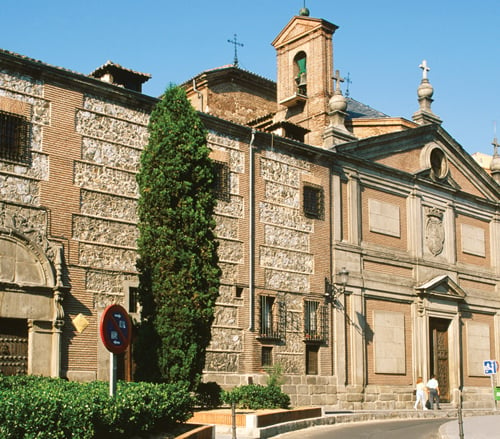
Façade
The guides ask visitors to
wait in the foyer until there are enough people to make up a tour so
allow for a delay of up to 15 minutes. While all the tours are in
Spanish only, questions in English are welcomed. |
|
Top 10 Features
Grand Staircase
Nothing
prepares visitors for this extraordinary sight. The Grand Staircase
belongs to the original palace, but the dazzling frescoes and trompel’oeil, covering walls, arches and balustrades, were added in the 17th century.
Royal Balcony
As you climb the staircase, look right and you’ll see another trompel’oeil
feature. On the “balcony” are Felipe IV and his family – Mariana of
Austria, the Infanta Margarita Teresa and the Prince of Asturias, Felipe
Próspero. The prince dates the painting by Antonio Pereda, as he died,
aged four, in 1661.
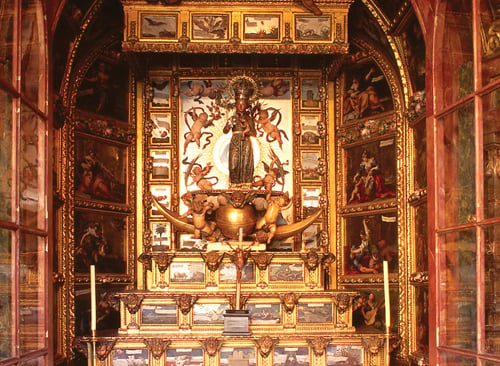
Chapel of the Virgin of Guadalupe
The
68 panels by Sebastián Herrera Barnuevo feature matriarchs of the Old
Testament. The Virgin of Guadalupe painting is a 16th-century
replacement.

Tapestry Room
The
magnificent collection of tapestries, on display in the former nuns’
dormitories, were made in Brussels in the 17th century. The 10 panels on
view represent the Triumph of the Eucharist.
Upper Cloister
The
tiny chapels surrounding the cloister were rooms of the original
palace. Outstanding among the 16th and 17th century works of art is a
wooden polychrome Recumbent Christ by Gaspar Becerra.
Antechoir
Visitors
enter through an intricately carved Plateresque doorway. Among the
paintings lining the walls of the three chapels is a beautiful Virgin and Child from the late 15th century – one of the oldest works of art in the convent.
Candilón (Funeral Room)
By tradition, when a nun died her body was placed on the tiled bier, while prayers were said under the light of a large lamp (candil).
The royal portraits include two of Felipe II’s children and Juana of
Austria, both by the 17th-century artist Alonso Sánchez Coello.
Choir
The
choir contains the tombs of Empress María of Austria (sister of Juana)
and the Infanta Margarita. One portrait over the entrance is known as
the “abandoned girlfriend” – the sitter, María of Portugal, was
betrothed to Felipe II but he married Mary Tudor of England instead.
Chapter House
The
highlight here is a series of 16th-century frescoes depicting the life
of St Francis of Assisi. Look out for two devotional works by Pedro de
Mena: Ecce Homo and La Dolorosa.
Hall of Kings
This portrait gallery was once used by members of the royal family as a retreat.