One of the most important art collections in the
world, the Thyssen Bornemisza focuses on European painting from the 13th
to the 20th centuries and is the perfect complement to the Prado and Reina Sofía.
Wealthy industrialist Baron Heinrich Thyssen Bornemisza began acquiring
Old Masters in the 1920s for his villa in Switzerland. After the
baron’s death in 1947 his son, Hans Heinrich, added modern masterpieces,
including French Impressionists, German Expressionists and the pick of
the Russian Avant Garde (see Modern Paintings in the Thyssen),
to the collection. In 1993 the state bought the collection for the
knock-down price of $350 million (the true value being estimated at
nearer $1 billion). In spring 2004 a new extension opened, displaying
Baroness Carmen Thyssen Bornemisza’s collection, which includes
important Impressionist works.
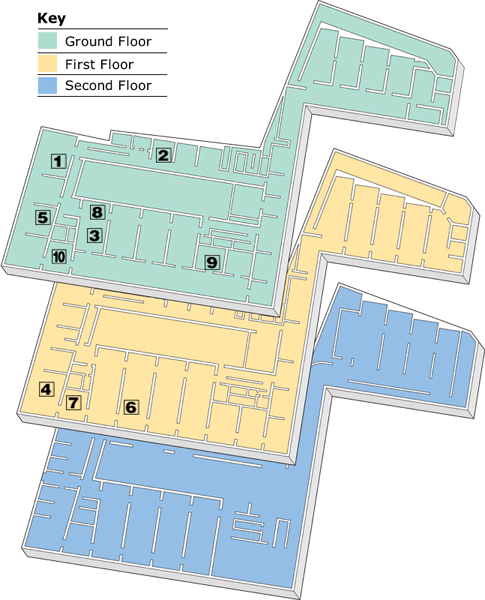
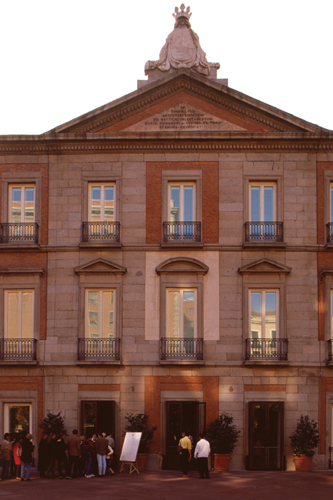
Façade
|
|
Top 10 Paintings
The Annunciation
Distorted
figures, swirling lines and bold colours are typical of the Mannerist
style which El Greco (1541– 1614) mastered in Venice, where he was
influenced by Titian and Tintoretto, both masters of the High
Renaissance. This intensely spiritual painting (c.1567–1577) reveals the
Cretan artist’s development following his move to Toledo, Spain, in
1577.Portrait of Giovanna Tornabuoni
This
sublime portrait (1488) by Florentine painter Domenico Ghirlandaio
(1449–94), was the last Baron Thyssen’s favourite. It was commissioned
to celebrate the marriage of Giovanna degli Albizzi to Lorenzo
Tornabuoni – a union of two powerful families. Tragically, Giovanna died
in child birth shortly afterwards.
Modern Paintings in the Thyssen
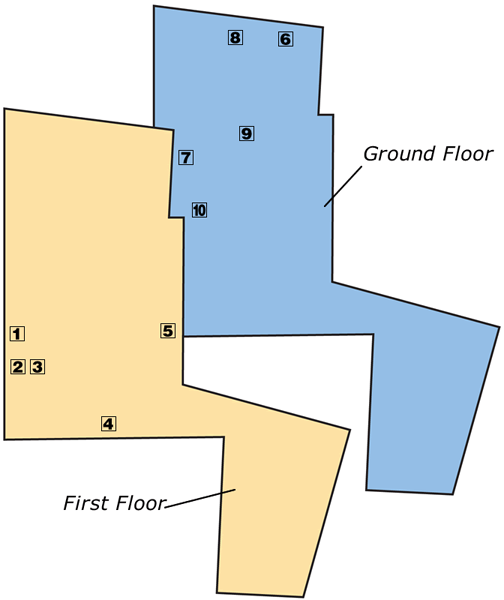
Modern Paintings Floorplan
Woman with a Parasol in a Garden
This
Impressionist painting of a garden bathed in sunlight (c.1873) is by
one of the founders of the influential movement, Pierre Auguste Renoir
(1841–1920). Renoir was apprenticed for four years as a porcelain
painter, and later attributed his technical brilliance in handling
surface and texture to his early training.This
exquisite study of a dancer in performance (1877–9) by French artist
Edgar Degas (1834–1917) is one of a series of his works devoted to the
ballet. Unlike some Impressionist painters, Degas placed great emphasis
on the importance of drawing, as the superb draughts manship of this
pastel clearly shows.Fränzi in Front of a Carved Chair
Ernst Ludwig Kirchner (1880– 1938) was an important figure in German Expressionism and a member of the group known as Die Brücke
(The Bridge), which began the movement in Dresden. These artists were
more interested in expressing feelings through their work, and
encouraging emotional responses from their audience, rather than
portraying outward reality. Fränzi, seen in this lovely 1910 work, was
one of their favourite models.The Dream
A founder member, with Wassily Kandinsky, of the influential Blaue Reiter
(Blue Rider) group, German artist Franz Marc (1880–1916) took
Expressionism in a new, spiritual direction. Colours, as in this 1912
work, are used symbolically, as are the animals in his paintings, which
represent truth, beauty and other ideals.Still Life with Instruments
Liubov
Popova (1889–1924) was one of the most innovative artists working in
Russia on the eve of the Revolution. This Cubist painting (1915),
completed after a period of study in Paris, paves the way for her Painterly Architectonic, an even bolder abstract work exhibited in Room 41.In
this moving 1931 painting by American artist Edward Hopper (1882–1967)
the bare furnishings, discarded suitcase and disconsolate posture of the
woman holding the railway timetable masterfully suggest loneliness and
dislocation – a subject the artist returned to time and again. Hopper is
the most important representative of the American social realist
school, created in the wake of the Wall Street Crash of 1929 and the
Great Depression which followed.New York City, New York
Piet
Mondrian (1872–1944) was one of the most influential abstract artists
of the 20th century. Born in The Netherlands, he moved to New York after
the outbreak of World War II. The simple geometrical forms and bold
colours of this abstract painting (1940–42) celebrate the energy and
dynamism of his adopted home.