Art Treasures in the Palacio Real

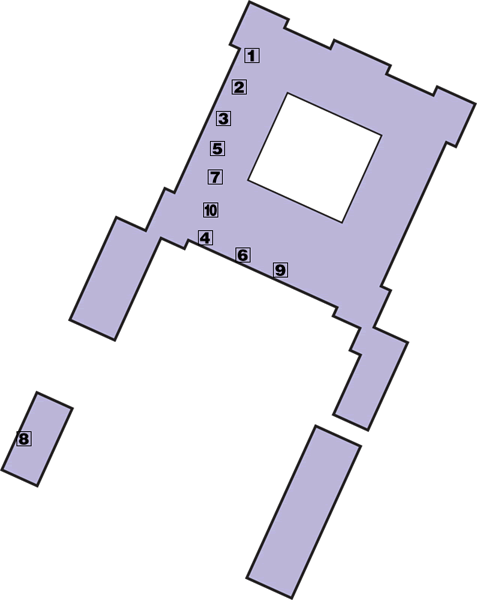
Palacio Real Floorplan
Stradivarius Violins
The priceless “Palace Quartet” (two violins, a viola and violoncello) was made in the 18th century by the world-famous luthier, Antonio Stradivari.
Vertumnus and Pomona Tapestries
These exquisite tapestries in the Gala Dining Room were made in Brussels by Willem Pannemaker in the mid-16th century.
Porcelain
Among the royal porcelain are some fine examples of Sèvres and Meissen dinnerware.

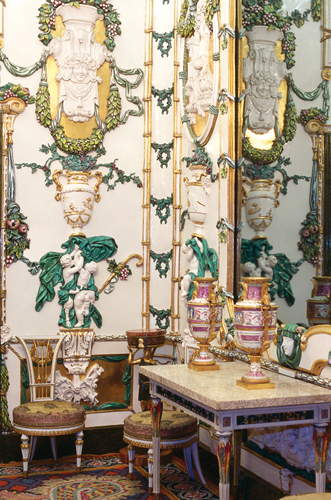
Porcelain Room
Tapestries in the Hall of Columns
These 17th-century tapestries depict scenes from the lives of the Apostles.
Goya Portraits
The quartet of portraits by Goya depicting Charles IV and his wife Maria Luisa show the queen as a Spanish maja (beauty).
Table of the Sphinxes
This 18th-century piece in the Hall of Columns has six bronze sphinxes as table supports.
Chronos
This clock was made for Charles IV in 1799; it contains a marble sculpture of Chronos, representing time.
Boabdil’s Dagger
This beautiful jewelled dagger in the Armoury belonged to the 15th-century Muslim ruler, Mahomet XII (Boabdil).
Giaquinto’s Apollo
Corrado Giaquinto’s fresco on the ceiling of the Hall of Columns shows Charles III as the sun god Apollo.
Grandeur and Power of the Spanish Monarchy
Giambattista Tiepolo’s frescoes in the Throne Room are a tour de force. Marginal figures represent Spain’s overseas possessions.
The Habsburgs and the Bourbons
The Austrian house of
Habsburg ruled Spain for nearly 200 years (1516–1700), beginning with
Carlos I (Emperor Charles V) and his son Felipe II.
By the time the first Bourbon king, Felipe V (grandson of Louis XIV of
France), came to the throne, Spain was already in decline. Felipe was
immediately challenged by the Habsburg Archduke Charles of Austria,
causing the disastrous War of the Spanish Succession (1700–13) which led
to Spain losing territories in Belgium, Luxembourg, Italy, Sardinia and
Gibraltar. The Bourbon presence also gave Napoleon the excuse to
interfere in Spanish affairs, eventually imposing his brother as king.
Although the Bourbons were restored (1813), there followed more than a
century of political turmoil, during which the dynasty’s right to rule
was continually challenged until the monarchy was finally abolished in
1931. After the death of the dictator, General Franco, in 1975, his
nominated successor, the Bourbon King Juan Carlos I, presided over the
restoration of democracy.
Top 10 Habsburg and Bourbon Rulers