For your family’s schedule to run smoothly, all
family members must do their part. Preschoolers want to emulate the
older members of the family, which gives you the perfect opportunity to
get them involved without any hassle. All you have to do is remember to
keep their involvement fun.
Selecting Appropriate Tasks
For you to be
successful both in terms of getting cooperation from your child and in
terms of getting something accomplished, you’ll want to select tasks for
your child that match his abilities. Children of preschool age
generally have eached a stage in their development at which they have
fairly coordinated large motor skills as well as the reasoning ability
to do tasks that require matching objects or counting small quantities.
They also enjoy most things that involve water. With these
characteristics in mind, you can put together a short list of chores for
each of your preschoolers. If you need some help getting started, look
at the list in Table 1. About 15 minutes of chores a day is a good target amount to use as a starting point.
Things You’ll Need
A timer
For a hard-copy preschool planner:
3- by 5-inch index cards in assorted colors
Stickers, stamps, or pictures illustrating your preschooler’s chores and activities
Colored pens, pencils, or markers
A large magnetic surface
Several small magnets
A container for the cards
For a computer-based preschool planner:
A desktop computer with a mouse
Clip art illustrating your preschooler’s chores and activities
Drawing software
Giving Your Preschooler a Personalized Planner
Just because your
preschooler can’t read or tell time doesn’t mean he’s too young to begin
using scheduling tools. Even though he can’t look at the clock and tell
you if five minutes have gone by, if you set a timer for five minutes,
he’ll know if he finished the task before the buzzer went off. You may
find that he can get the job done in an amazingly short amount of time
just to make sure he beats the clock. You can play a game in which you
reduce the amount of time you give him each time he does the task until
he reaches his most efficient performance. (You may even be inspired to
try this technique with your own chores!) Or you can set up a race
between you and your child to see which one of you can finish your
chores faster.
If you want a system
that requires less participation on your part, start by considering
that children learn to identify objects and colors before they learn to
read. With that thought in mind, set up a system as follows:
Select
different colored cards to indicate the time period of the day a chore
is to be done. For example, blue cards could be used for tasks your
child is to complete right after breakfast, and red cards could be used
for tasks to be completed while the older children clean the kitchen
after dinner. As you can see, one of the keys is to tie the time frame
to events that the young child will recognize rather than to a clock.
note
The I Did My Chores! system, shown in Figure 1, is designed for children ages 4 through 12. Suggested retail: $19.95. Website: www.ididitproductions.com Figure 1. The I Did My Chores! system holds pictures of chores on hooks |
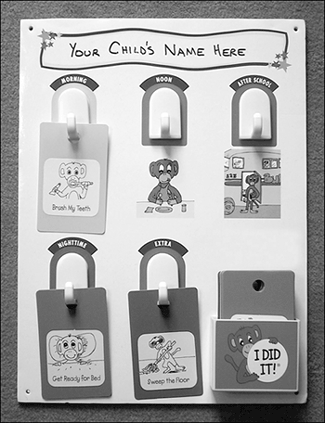
If your preschooler likes
to work with your computer—and more and more young children are
computer-savvy these days—you may want to create a special electronic
chore chart for her. The principles of using graphics rather than words
and of making the chart interactive remain the same:
Find clip art to represent the various tasks.
Depending on your own
level of computer literacy and the amount of time you have, you can
decide how creative you want to be in designing the system.
By providing your
preschoolers with simple planning tools that work for them, you’ll be
encouraging them to take an active interest in your family’s schedule as
well as providing them with a solid foundation on which to build more
sophisticated time management skills as they mature.