Four distinct neighbourhoods
flank the east bank of the Isar: Bogenhausen, Haidhausen, Au, and
Giesing. Bogenhausen is an exclusive district studded with villas and
inhabited by many prominent citizens; lively Haidhausen has the best and
most extensive bar scene; parts of Au and Giesing, on the other hand,
still have a special working-class charm. All were on the “other side”
of the Isar from the Old Town and long retained their village character.
To the west of the Isar, on the left bank, lie the Englischer Garten,
Lehel with its beautiful historic buildings, and the Glockenbach
quarter, Munich’s gay village. Most sights are found along the right
bank, such as Müller’sches Volksbad, Villa Stuck, and – on an island in
the river – the Deutsches Museum.
|
|
|
NOTE
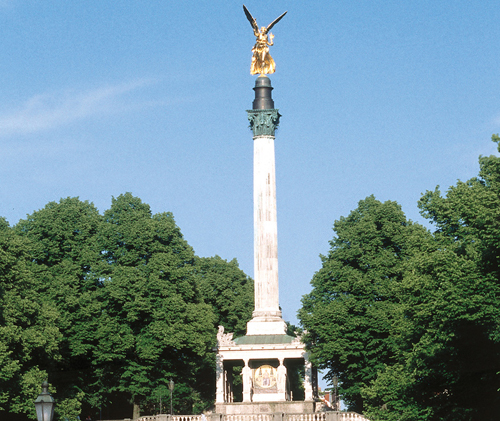
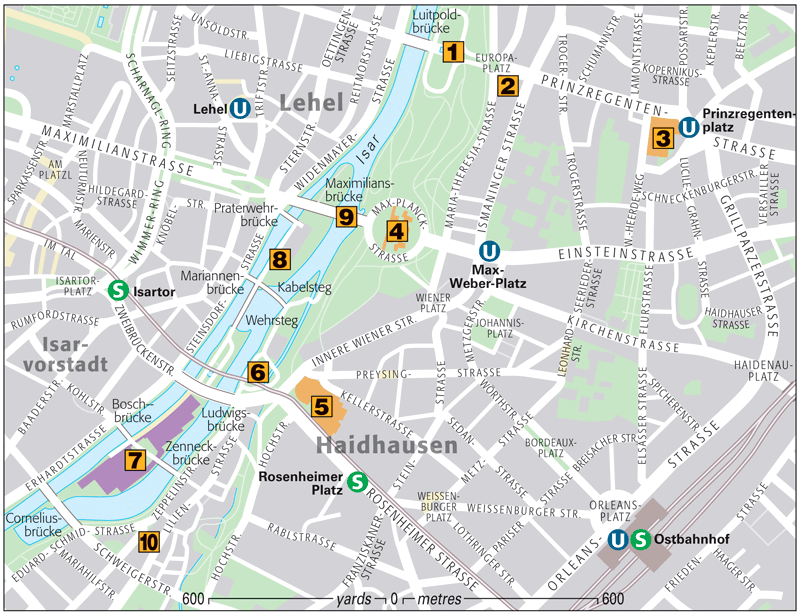
Friedensengel
Soaring
high above the banks of the Isar, the Friedensengel (Angel of Peace,
1896–99) commemorates the Franco-Prussian war of 1870–71. Based on the
Greek goddess Nike, this gilded figure stands 6 m (20 ft) tall. At its
foot, two sweeping flights of stairs lead down from the escarpment to a
terraced park with fountains on the lower end of Prinzregentenstraße.Prinzregentenstr.

Friedensengel
Museum Villa Stuck
Not
far from the Friedensengel is the villa (1897–98) of painter Franz von
Stuck, in itself a work of art. A miller’s son, Stuck quickly rose to
fame and was instrumental in the creation of a Munich style of Art
Nouveau – Jugendstil.
The villa has served as a museum since 1968. On view are Stuck’s
private rooms, a permanent Art Nouveau collection, and changing
exhibitions in the studio wing .Prinzregententheater
This theatre is one of several monumental buildings on this stretch of Prinzregentenstraße in Bogenhausen .
It was headed by August Everding, whose legacy to the city includes the
Bayerische Theaterakademie, a training ground for young stage talents.
Next door is Prinzregentenbad, a public bath. Across the street is
Feinkost Käfer, a gourmet-food shop.Maximilianeum
This
building in Haidhausen by Friedrich Bürklein (1857–74), on the high
banks of the Isar, marks the end of Maximilianstraße. The seat of the
Bavarian parliament since 1949, Maximilian II built this massive
structure as a school for gifted students from poor backgrounds. The
school is now housed in the rear building.Max-Planck-Str. 1

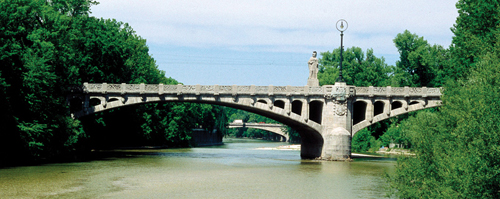
Maximilian bridge
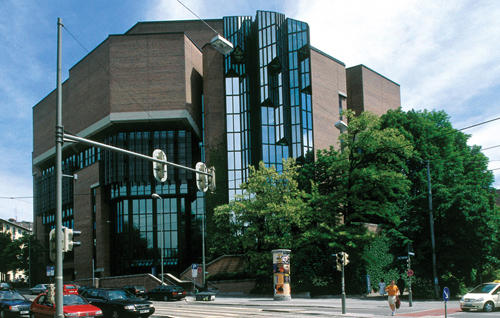
Gasteig
The
site of the former Bürgerspital hospital, and Bürgerbräu-keller, where
Georg Elser failed in 1939 to assassinate Hitler, it was transformed
into the red-brick Gasteig cultural centre between 1978 and 1985. Its
facilities include the Munich Philharmonic, the Carl Orff concert hall,
the headquarters of the adult education centre (Volkshochschule), and
the municipal library.Rosenheimer Str. 5

Gasteig
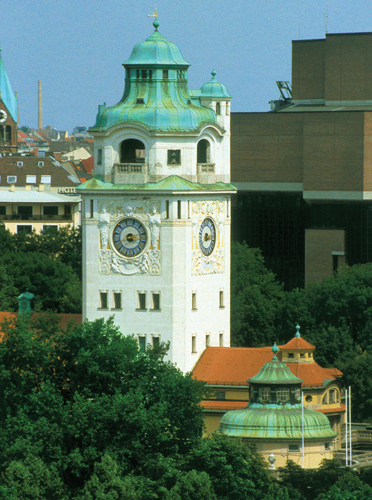
Müller’sches Volksbad
Named
after Karl Müller – a private citizen who financed the project – this
Art Nouveau bathing temple was built from 1897 to 1901 and is based on a
design by Carl Hocheder. It was the first public pool in the city and
is still one of the most beautiful today. The pool was divided into a
men’s and a women’s area: the men’s pool has a barrel vault, the women’s
a large cupola. It is worth going for a swim just to see the interior
and the facilities – which include therapeutic baths and a Roman steam
room. Afterwards, drop by Café im Volksbad.

Müller’sches Volksbad
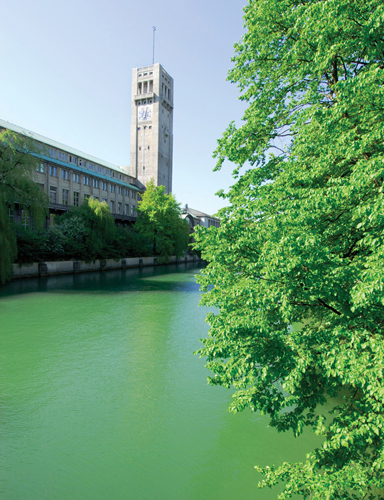
Deutsches Museum
Looking
diagonally across from the Müller’sche Volksbad, the island seen in the
Isar is home to the largest museum of technology in the world. Eighty
per cent of the Deutsches Museum was destroyed in World War II; however,
the doors to the collection were open again by 1948. Plan at least a
full day to see the principal exhibits .

Praterinsel & Alpine Museum
Immediately
adjacent to the museum island are two other small islands, Praterinsel
and Kalkinsel. The Alpine Museum, run by the German Alpine Association,
is located on Praterinsel. It documents the history of mountaineering
and features special exhibitions throughout the year. A teaching garden
displays the various types of rock found in the Alpine regions. Old
factories on Praterinsel – in the former Riemerschmid distillery – have
been converted into a cultural centre with artists’ studios. The
ensemble is home to ongoing exhibitions and special events, such as the
Comicfest. Tango fans gather in the courtyard on summer nights to enjoy
this most sensual of dances.Isar Bridges
From
the bridges that cross the Isar you can enjoy wonderful views of the
river and the cityscape. One of the most historically important is the
Ludwigsbrücke, between Deutsches Museum and Müller’sches Volksbad. Henry
the Lion ordered that the bridge, built in 1157–58 by the Bishop of
Freising, be demolished (it was located near today’s Oberföhring).This
meant the salt road was diverted – effectively usurping lucrative
customs fees from the bishopric. Henry then ordered a new bridge built
farther to the south – where today’s Ludwigsbrücke stands. The new
bridge, by which Benedictine monks had settled, was quickly surrounded
by a thriving settlement later called München (literally, “near the
monks”).Auer-Mühlbach District & Valentin-Haus
In
the past, several small creeks ran through Munich, many of which were
later filled in with concrete. One of the surviving creeks is the Auer
Mühlbach, which is most visible east of the Isar. Just south of
Ludwigsbrücke, this creek has formed a small island that is home to a
restored ensemble of historic houses. Karl Valentin’s birthplace is
nearby at Zeppelinstraße 41. The building is not open to the public.