|
|
Rott am Inn
Perched
high on the banks above the Inn River is the abbey of Sts Marinus und
Anianus, a masterpiece of Bavarian Rococo. Between 1758 and 1763 Johann
Michael Fischer rebuilt the church, incorporating the Romanesque east
towers into his design. The soaring interior is impressive with its
daring spatial design and fine decoration.

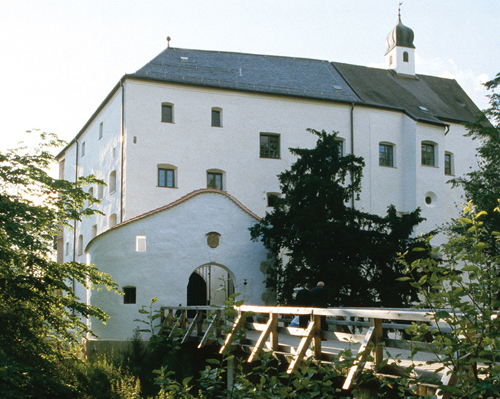
Schloss Amerang
Situated
on a rise surrounded by deep natural ditches, the palace lies just
south of the town of the same name. From the outside, the palace looks
like a medieval fortress. Its large cloistered courtyard dates from the
second half of the 16th century. Noted for its excellent acoustics, the
courtyard is a regular venue for summer concerts.Open Easter–mid-Sep: 10am, 11am, noon, 1pm, 2pm Tue–Sun
Adm

Schloss Amerang
Kloster Attel
Built
in 1715, this Baroque church belonging to the Benedictine abbey is well
worth a visit. A Roman memorial stone from AD 204 is incorporated in
the imposing church entrance. Limburg, the seat of the Hallgrafen
dynasty, was formerly located near the monastery. By relocating its
principality to Wasserburg in 1137, the family caused the cultural
flowering of that town.Wasserburg
Wasserburg
benefits from its location on a spoon-shaped promontory in the Inn
River. Typical of the Inn region, the old town is distinguished by wide,
open squares lined with arcaded, leafy walkways. Its streets are lined
with old houses with colourful painted façades, pretty bay windows, and
stepped gables. All these elements give Wasserburg an Italian air. For a
stunning view of the old town, head to the Schöne Aussicht (beautiful
vista) lookout on the opposite side of the river. A wonderful path lined
with works of art runs along this stretch of the Inn.Gars am Inn
This
former Augustine Canons’ seminary, with its early Baroque abbey, was
built by Gaspare and Domenico Zucalli between 1661 and 1690. The
interior is decorated with lavish stuccowork.Au am Inn
The
Au monastery, founded by the Augustine Canons in the 12th century,
occupies an idyllic spot on a bend in the Inn River. It was
reconstructed after a fire in the 18th century. The former library,
decorated with frescoes, is a highlight of the complex, which is now
also home to a restaurant with an attractive beer garden.Mühldorf
This
picturesque town, which lies on a peninsula in the Inn River, was an
important trading post during the Middle Ages. The old town is defined
by the 500-m- (1,650-ft-) long market square flanked by houses typical
of towns along this river – those with romantic arcades and stepped
gables. City gates mark the ends of the square. The Nagelschmiedturm,
with its Romanesque basement, is worth seeing.Altötting
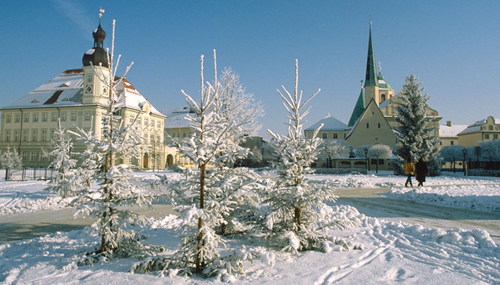
Bavaria’s
oldest pilgrimage site, Altötting lies on a hill near the right bank of
the Inn River. A small, octagonal chapel with a central aisle, the Holy
Chapel dates from 750. It was subsequently expanded by a nave. In the
interior, a silver tabernacle set into a shell-lined niche on the
eastern end contains the votive image of “Our Dear Lady of Altötting” – a
revered Black Madonna (c.1300) carved from linden wood. Another feature
of interest is the panorama re-creating the view from Golgotha in
Jerusalem at the time of the Crucifixion, which is located in a domed
structure east of the town centre. This is a monumental depiction of the
Passion of Christ, with life-life figures in the foreground
representing the stations of the cross.

Kapellplatz, Altötting
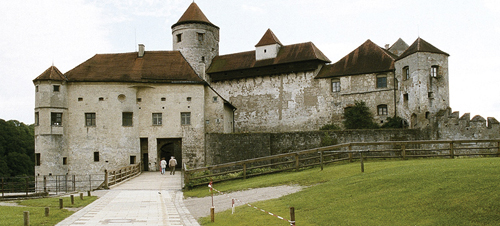
Burghausen
Burghausen
experienced its heyday in the Middle Ages when it was a centre of the
salt trade and, occasionally, the Wittelsbachs’ second seat of
government. The enormous castle, one of Germany’s largest, is
fascinating. Built in 1255, it was added to and became a fortress at the
end of the 15th century. Other highlights include the Gothic
Jakobskirche, the 16th-century town hall, and the 18th-century
Schutzengelskirche, all on the market square.Castle: Open Apr–Sep: 9am–6pm daily; Oct–Mar: 10am–4pm daily
Adm

Castle at Burghausen

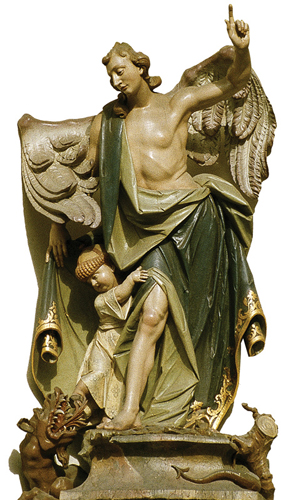
Guardian Angel, Burghausen
Tittmoning
This
is one of the most beautiful small towns in eastern Bavaria. After the
salt trade collapsed, the town succeeded in preserving its historic
image. Two city gates lead to a trapezoidal town square with stuccoed
houses. A 13th-century castle set on the hill above the town gives a
fine view of the surrounding countryside.Castle: Open May–Sep: 2pm Fri–Wed
Adm