Englischer Garten
With
373 hectares (922 acres), the Englischer Garten is the largest urban
park in Germany and the green lung of the city. It serves as a leisure
paradise in summer, when thousands lounge in the sun on the expansive
meadows, and cyclists, joggers, and roller-bladers zoom along the paths.
The surface of the Kleinhesseloher See is dotted with boats, while
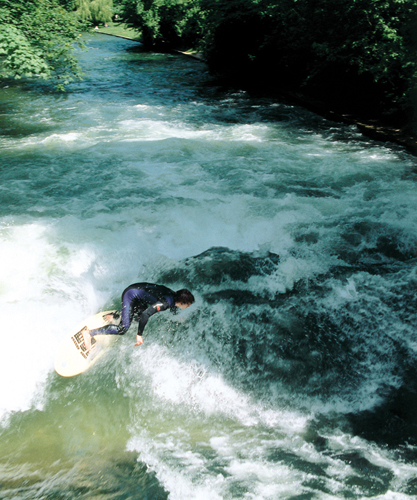
surfers try their luck on the Eisbach near the Haus der Kunst. For a
welcome refreshment, try a cool beer in one of the beer gardens
at the Chinesischer Turm, the Seehaus, the Hirschau, and the Aumeister.
An American, Benjamin Thompson, known as Count Rumford (1753–1814),
conceived the idea of the park, which was designed by Ludwig von Sckell
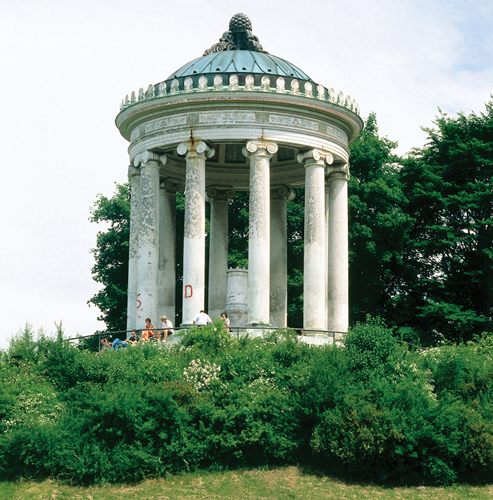
as a prime example of classical landscape park design. In 1837, the
Monopteros, a mock Greek temple, was built on an artificial hill.

Eisbach, Englischer Garten

The Monopteros in the Englischer Garten
Botanischer Garten
This
is one of the most important botanical gardens in the world. Created in
the park at Nymphenburg in 1914, some 14,000 plant species from around
the globe are cultivated here. In the greenhouses, visitors can embark
on journeys to tropical rainforests or arid deserts.

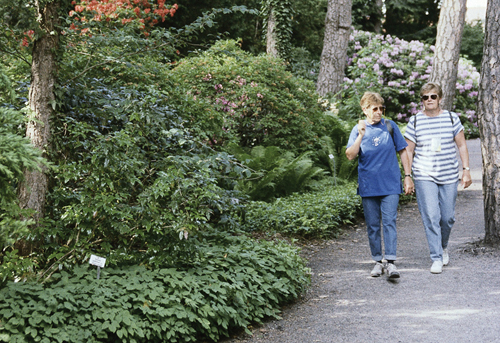
Botanischer Garten
Open Apr & Sep: 9am–6pm; May–Aug: 9am–7pm; Feb, Mar & Oct: 9am–5pm; Nov–Jan: 9am–4:30pm
Adm
Westpark
An
expanse of 72 hectares (178 acres) has been landscaped with numerous
artificial hills, paths, a lake, and ponds. Created for the
International Garden Exhibition in 1983, the western section of the park
features an impressive East Asian ensemble with Chinese and Japanese
gardens, and Thai and Nepalese pagodas. Concerts, plays, and open-air
film screenings are presented on the lakeside stage in summer.Hofgarten
In
the 17th century, the Hofgarten was laid out on the north side of the
Residenz in the style of Renaissance gardens. It is bounded on two sides
by long arcades. Rows of mature linden, chestnut, and maple trees
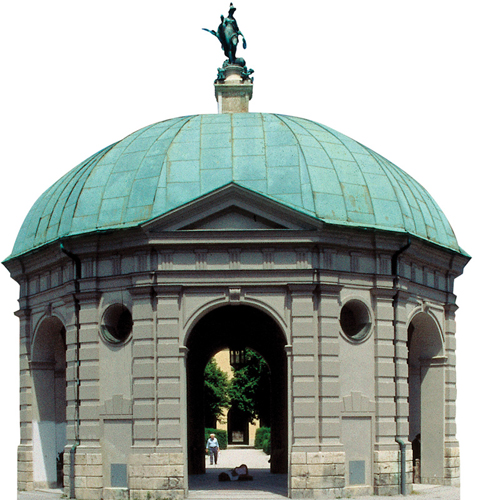
provide welcome shade for boule players in summer. Tango aficionados
meet at the Temple of Diana – a polygonal pavilion with a shallow dome –
for dances on mild summer evenings .

Temple of Diana, Hofgarten
Bavariapark
This
park lies directly behind the statue of Bavaria and the Ruhmeshalle,
and stretches westward on the Theresienhöhe. It was designed by order of
Ludwig I and received its current name after the Bavaria statue was
completed in 1850. It is an ideal place to take a break from the hustle
and bustle of the Oktoberfest.Hofgarten Schleißheim
Stretching
between the Neues Schloss in Schleißheim and Schloss Lustheim, this is
one of the few gardens from the Baroque era that has retained most of
its original form. Enrico Zuccalli (1642–1724) created the basic layout
with canals in 1684. Domenique Girard added parterres and a cascade from
1715 onward, creating the tremendous illusion of depth that
characterizes the principal axis. The cascade, located in front of the
Neues Schloss, was renovated in 1999.Oberschleißheim, Neues Schloss
River Meadows along the Isar (Isarauen) and Rose Garden
The
long stretch of the Isarauen serves as the city’s other green lung.
South of the Wittelsbacher Bridge is the rose garden. In addition to
many rose species, it features a large collection of exotic trees and
shrubs, as well as a small teaching garden with poisonous plants.Open Summer: 7am–6:30pm daily; Winter: 7am–4:30pm Mon–Fri