It was Different from the
Start, a crazy pattern of streets that broke from the city’s grid plan,
reflecting the boundaries of a rural village. As a bohemian haven, the
leafy lanes of the Village have been home to artists and writers. Jazz
musicians, beat poets, and performers like the young Bob Dylan found
their places here. Later it became popular with gays, and today cafés
and funky shops attract young people from all over the city. The village
really comes to life at night, when cafés, theaters, and clubs beckon
at every turn.
Sights
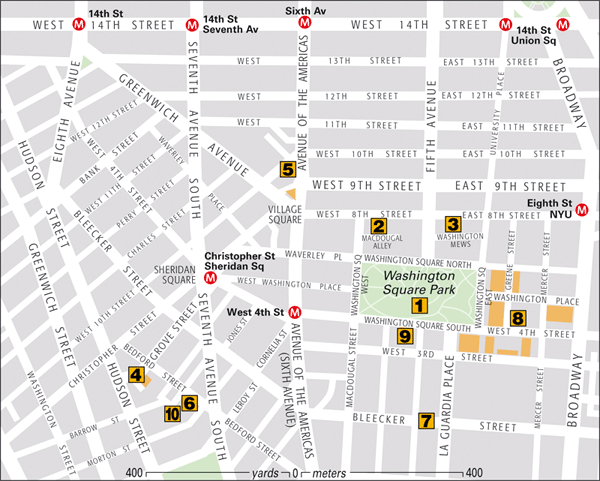
Washington Square Park
In
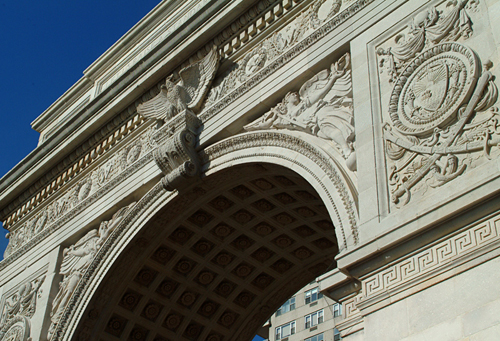
1826, a marshy area was filled to form this popular park. The restored
marble arch by Stanford White went up in 1892, replacing a wooden
version that marked the centenary of George Washington’s inauguration.
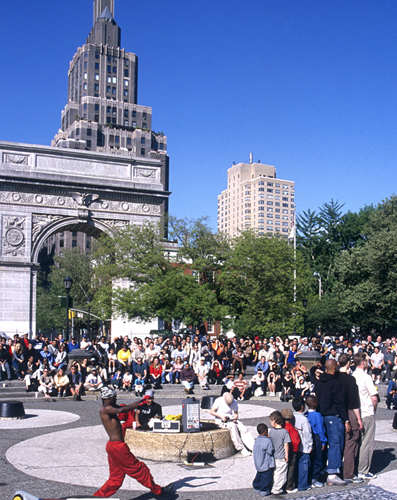
Mothers with strollers, chess players, and young lovers now occupy
benches where drug dealers once reigned. The fountain in the center is
where Bob Dylan sang his first folk songs.5th Ave, between Waverly Pl & 4th St

Washington Square Park

Street performers in Washington Square Park
MacDougal Alley
These
19th-century stables for the fine homes on Washington Square North were
converted into studios by artists early in the 20th century, causing
the street to be known as “Art Alley de Luxe.” Among the residents were
painter Guy Pene du Bois and sculptor Gertrude Vanderbilt Whitney, who
established the first Whitney Museum in 1914 at 8 West 8th Street,
adjoining her studio.East of MacDougal St, between 8th St & Waverly Pl

MacDougal Street
Washington Mews
Another
group of stables turned into houses around 1900, the Mews attracted
both writers and artists. No. 14A housed, at various times, author John
Dos Passos and artists Edward Hopper, William Glackens, and Rockwell
Kent. Writer Sherwood Anderson often stayed at No. 54 with his friend
and patron, Mary Emmett. In contrast to the modern buildings in much of
Manhattan, this type of quaint enclave is the reason many find the
Village so appealing.University Place to 5th Ave
Grove Court
This
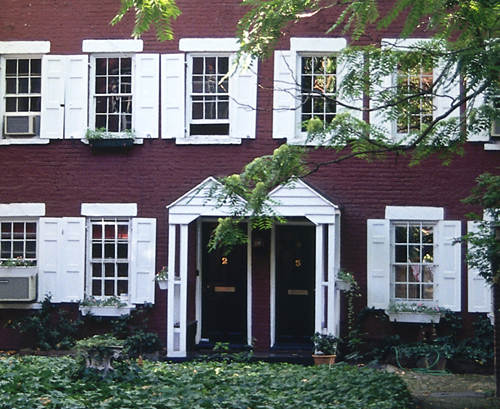
group of six townhouses in a bend in the street was developed by grocer
Samuel Cocks, who thought that having residents nearby would help his
business at No. 18. But while such private courts are prized today, they
were not considered respectable in the 1850s, and the disreputable
types who moved in earned it the nickname “Mixed Ale Alley.” O. Henry
used the block as the setting for The Last Leaf.Grove St near Bedford St

Grove Court
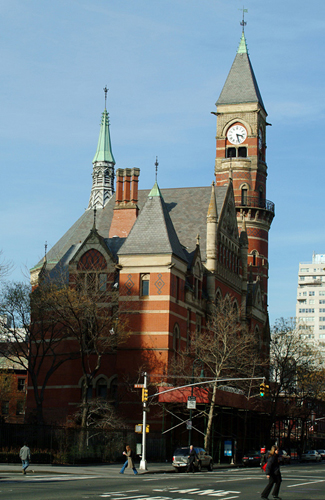
Jefferson Market Courthouse
The
site was a market in 1833, named after the former president, Thomas
Jefferson. The fire lookout tower had a giant bell that alerted
volunteer firefighters. When the courthouse was built in 1877, the bell
was installed in its clock tower. The building became a treasured
Village landmark, and, after the market had moved and court sessions
were discontinued, it was eventually saved from demolition after a
spirited local campaign and converted into a branch of the New York Public Library in the 1950s.425 6th Ave, between 9th & 10th Sts
Open noon–8pm Mon, Wed, 10am–6pm Tue, Thu, 10am–5pm Fri, Sat
Free

Jefferson Market Courthouse
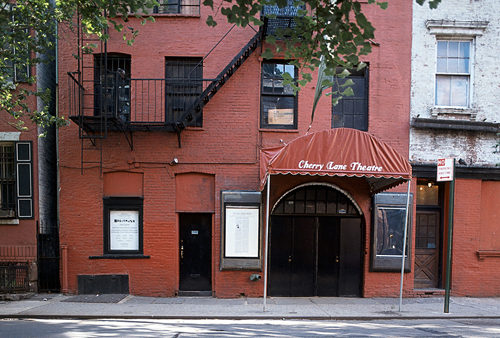
Cherry Lane Theatre
In
1924, a warehouse was converted into one of the first Off-Broadway
theaters and showcased plays by the likes of Edward Albee, Eugene
Ionesco, David Mamet, and Harold Pinter. Today, the “Cherry Lane
Alternative” uses established playwrights to mentor talented newcomers.212 989 2020

Cherry Lane Theatre
Bleecker Street
The
present line-up of ordinary shops and restaurants belies the history of
this street. James Fenimore Cooper lived at No. 145 in 1833, Theodore
Dreiser stayed at No. 160 when he came to New York in 1895, and James
Agee lived at No. 172 from 1941 to 1951. The café at No. 189, the corner
of Bleecker and MacDougal, was the San Remo bar, the favorite gathering
place for William Burroughs, Allen Ginsberg, Gregory Corso, and Jack
Kerouac, leading lights of the beat generation.Between 6th Ave & West Broadway

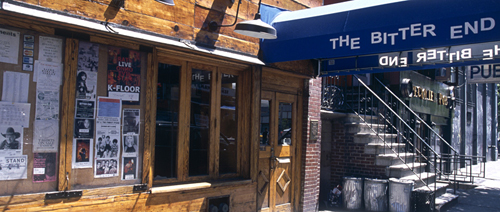
Bar on Bleecker Street
New York University
Founded
in 1831, N.Y.U. enlarged the scope of early 19th-century study from its
previous concentration on Greek and Latin to contemporary subjects: a
“rational and practical education” for those aspiring to careers in
business, industry, science, and the arts, as well as in law, medicine,
and the ministry. It has grown into the largest private university in
America and now occupies many blocks around Washington Square.Washington Square
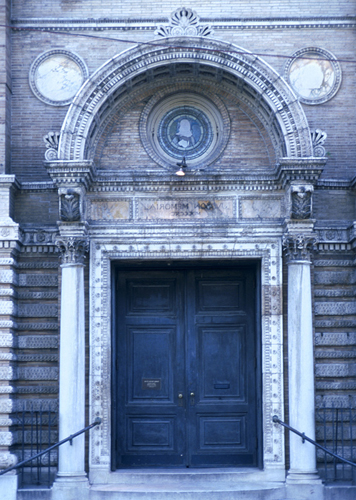
Judson Memorial Church
An
elegant work in Romanesque style by Stanford White, with stained glass
by John La Farge, the church was built in 1888–93 as a memorial to
Adoniram Judson, the first American Baptist missionary in Asia. John D. Rockefeller, Jr.
contributed to the construction. White’s use of mottled yellow brick
and white terracotta trim introduced light coloration into American
church architecture.55 Washington Square South
Open for services 11am Sun
Free

Judson Memorial Church
75 Bedford Street
New
York’s narrowest home, just 9.5 ft (3 m) wide, was built in 1873 in a
passageway in the Village. Poet Edna St. Vincent Millay lived here, as
did actors John Barrymore and, later, Cary Grant. No. 77 is the oldest
house in the Village, dating from around 1799, and at No. 103 is “Twin
Peaks,” an 1830 structure remodeled in 1925 by Clifford Reed Daily to
house artists and writers, who would presumably be inspired by the
architecture.Between Morton & Barrow Sts