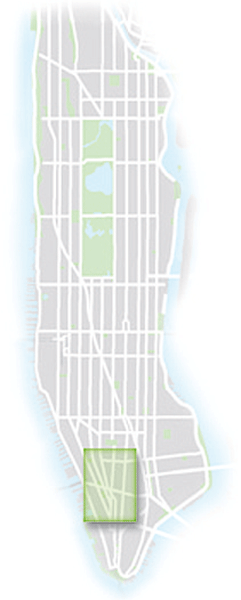
The area named for its shape
(TRIangle BElow CAnal) long consisted mostly of abandoned warehouses.
Then Robert De Niro set up his Tribeca Film Center in 1988, stylish
restaurants began to open, and the area started to draw celebrity
residents. Now TriBeCa is one of New York’s hottest neighborhoods, the
center of the city’s movie industry with the TriBeCa Film Festival and
plenty of nightlife. SoHo (South of Houston) has also come full circle.
The empty loft spaces first drew artists, then galleries, then crowds of
browsers and the restaurants to serve them. The new chic image quickly
drove up rents and drove out many galleries. Some remain, and the
streets are lined with designer clothing and home furnishing boutiques,
maintaining SoHo’s lure as the city’s favorite Sunday brunch-and-browse
neighborhood. Both areas boast the cast-iron architecture that is a New
York specialty.
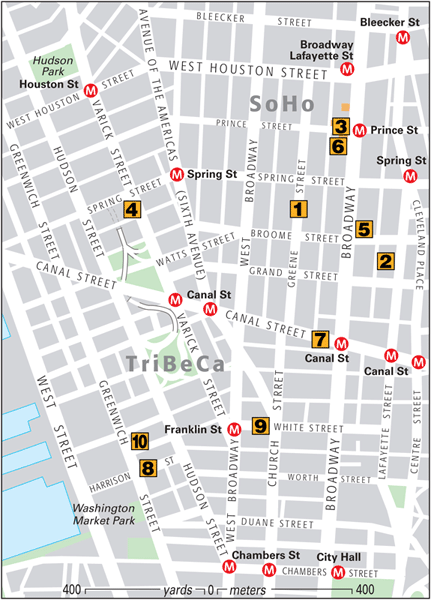
Sights
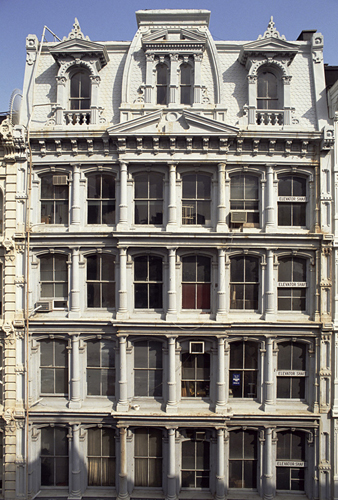
Greene Street
Cast-iron
architecture flourished in New York in the late 19th century, as a way
to produce decorative elements such as columns and arches and create
impressive buildings inexpensively. Greene Street, between Canal and
Grand streets, and between Broome and Spring streets, has 50 of these
beauties, rows of columned façades creating a striking streetscape.

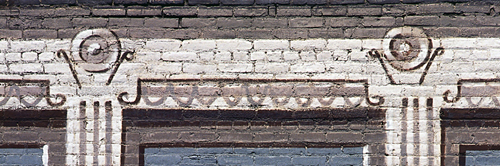
Mural, Greene Street

Children’s Museum of the Arts
Founded
in 1988, the CMA’s mission is to enable children aged one to 12 to
reach their full potential in the visual and performing arts. Children
can work with paint, glue, paper, and recycled materials to paint,
sculpt, build, and imagine. They can also play in the ball pond and art
house, design projects, explore exhibitions, and meet other children.182 Lafayette St
212 941 9198
Open noon–5pm Wed & Fri–Sun, noon–6pm Thu
Admission charge
Prada
The
sign still reads “Guggenheim SoHo” but the current occupant of the
building is an extraordinary $40 million flagship store for
trend-setting Italian retailer Prada, a sign of SoHo’s shift from art to
fashion. Dutch architect Rem Kookhaas is responsible for the ultra-hip
floating stairs, undulating walls, futuristic elevators and hi-tech
dressing rooms.575 Broadway at Prince St
Open 11am–7pm Mon–Sat, 12–6pm Sun
A
nostalgic treasure housed in a 1904 firehouse, this splendid collection
includes the city’s fire-fighting engines, equipment, garb and
memorabilia from the 18th century to the present. A moving photo display
depicts the World Trade Center attack of September 2001 and honors the
hundreds of fire-fighters lost there.278 Spring St
Open 10am–5pm Tue–Sat, 10am–4pm Sun
Admission charge
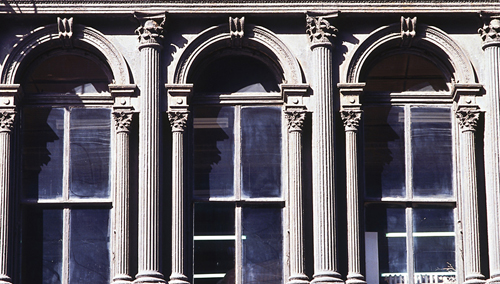
Haughwout Building
A
cast-iron masterpiece, this structure was built in 1857 to house a
fashionable china and glassware emporium. The design of colonnaded
arches flanked by taller Corinthian columns was adapted from the façade
of the Sansovino Library in Venice. This motif is repeated 92 times
across the front of the building. A 1995 restoration removed grime and
restored the elegant original pale color. This building boasted the
first Otis safety elevator, an innovation that made the skyscraper
possible.

Haughwout Building

Haughwout Building
“Little” Singer Building
By
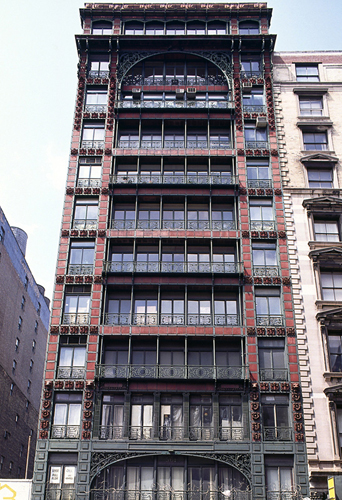
the early 1900s, cast iron was giving way to steel-framed brick and
terracotta. One notable example is Ernest Flagg’s “Little” Singer
Building (to distinguish it from a taller tower also built for Singer).
Influenced by Parisian architecture of the period, it has a charming
12-story façade and graceful cast-iron balconies.561–3 Broadway, between Prince & Spring Sts

“Little” Singer Building
Canal Street
The
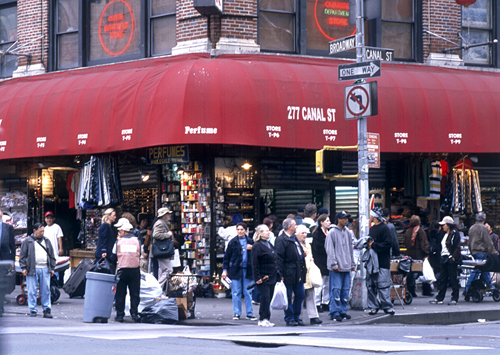
end of SoHo, the beginning of TriBeCa, and a world of its own, no
street better shows the contrasts of New York. Canal Street is crowded
with peddlers selling fake Rolex watches and Gucci bags, electronics
that may or may not be new, and bargain stores offering sneakers, jeans,
and flea-market finds. Keep walking east into Chinatown, and the
sidewalk goods shift to vegetables and displays of live and dried fish.

Canal Street
Harrison Street
This
rare group of Federal townhouses, built between 1796 and 1828, did not
exist as a row until 1975, when the houses were moved to this site to be
saved from the urban renewal that razed much of the area. At the end of
the block (No. 6) is the former New York Mercantile Exchange, a Queen
Anne building dating from 1884 and in use until 1977 when the Exchange
moved to the World Financial Center.

Harrison Street
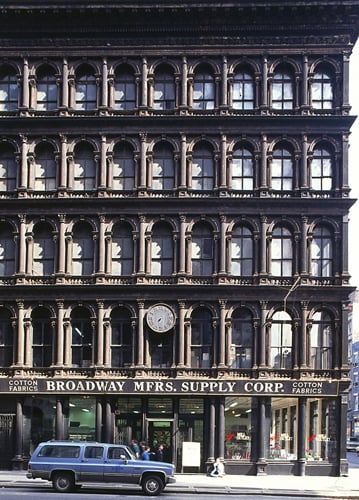
White Street
The
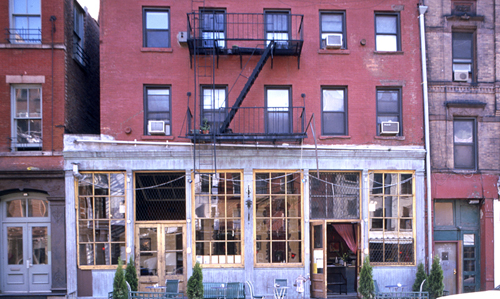
best example of cast- iron architecture in TriBeCa is a sampling of
several styles. No. 2 has Federal features and a gambrel roof; Nos.
8–10, designed by Henry Fernbach in 1869, sport Tuscan columns and
arches and use the Neo-Renaissance device of building shorter upper
stories to give an illusion of height. There is a complete change of
pace at No. 38, which houses neon artist Rudi Stern’s gallery, Let There
Be Neon.TriBeCa Film Center
A
turn-of-the-century coffee warehouse has been converted into office
space for the film and entertainment industry. The guiding spirit was
Robert De Niro, whose TriBeCa Productions was founded in 1988. Miramax
has set up offices here and the building is also home to the TriBeCa
Grill, owned by De Niro and restaurateur Drew Nieporent. The restaurant
has managed to maintain its appeal for two decades.375 Greenwich St