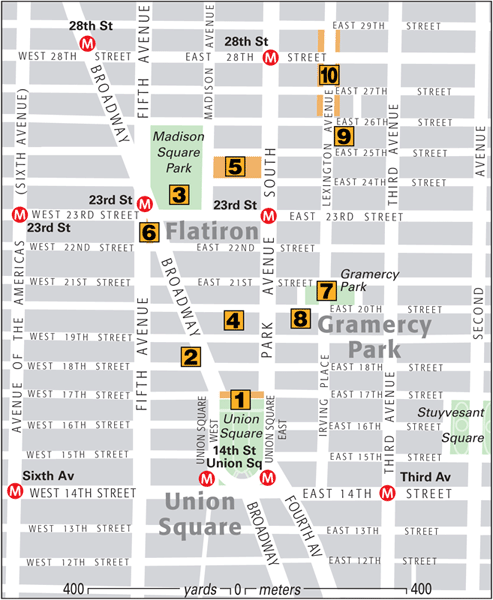
Change is in the air in this
flourishing section of Manhattan. Union Square, once a hangout for drug
dealers and scene of protest rallies, has been renovated and
transformed. A Greenmarket fills the square with fresh produce four
times a week, drawing patrons from all over the city, and the
neighborhood around the square is attracting an increasing number of new
apartments, shops, and restaurants. The shops and lively eating places
now extend up Fifth Avenue into the once-neglected Flatiron District,
named for the building at the intersection of Fifth Avenue and Broadway
at 23rd Street. Quiet Madison Square, opposite the Flatiron Building, is
the site of two of the city’s hottest restaurants and is undergoing its
own restoration. No change was needed in Gramercy Park, the most
European of the city’s neighborhoods.
The City’s SquaresManhattan has only four London-style squares, |
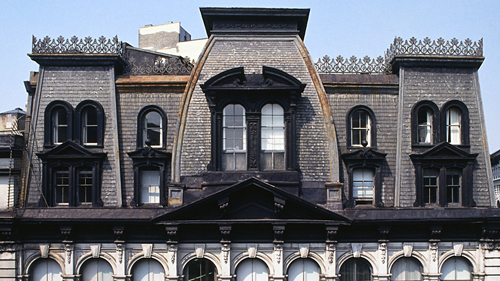
Rooftops on Broadway
Sights
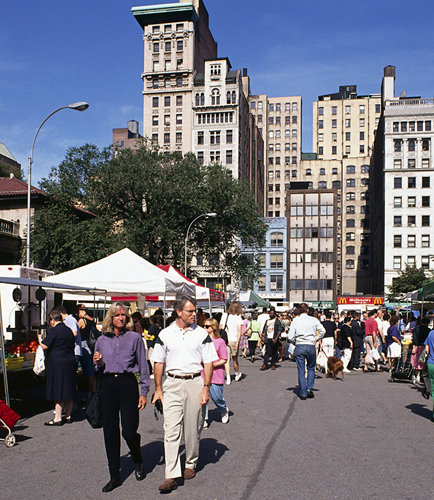
Union Square Greenmarket
Herbs
and berries, miniature vegetables, fresh flowers and homebaked
pastries, newly woven yarns, hams, honey – all of these and more can be
found at the bountiful Greenmarket that fills Union Square each Monday,
Wednesday, Friday, and Saturday. Over 200 regional farmers take part in
the market, each offering only goods that they have grown or made. Not
to be missed.At Broadway & 14th St
Open 8am–6pm Mon, Wed, Fri, Sat

A Manhattan market scene
ABC Carpet & Home
The
city’s most eclectic emporium, two landmark buildings that are part
flea market, part antiques fair, and part Middle Eastern bazaar.
Offerings include fancy French or rugged Mexican furniture, antiques,
fabrics and accessories, linens, bedding, flowers, and rugs. There are
two dining places: Dessert Studio and Pipa.881 & 888 Broadway at East 19th St
Madison Square
The
square opened in 1847 at the center of a residential area where
politician Theodore Roosevelt and writer Edith Wharton were born. The
original Madison Square Garden was here, at Madison Avenue and 26th
Street. Development brought distinguished sites such as the Flatiron and
Metropolitan Life buildings. Today the statue-filled park and the area
are being rediscovered.23rd to 26th Sts between Broadway & Madison Ave

Madison Square
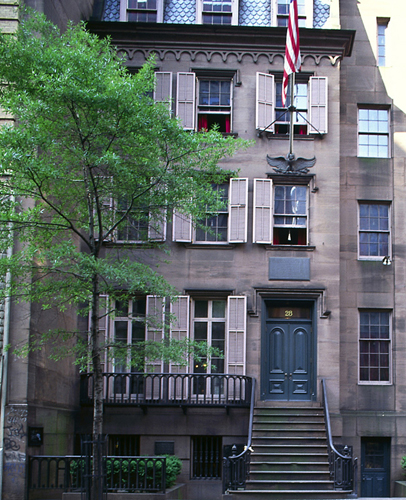
Theodore Roosevelt Birthplace
The
boyhood home where the colorful 26th President was born in 1858 has
been reconstructed. Exhibits trace his political career as well as his
explorations, displaying everything from toys to campaign buttons, and
emblems of the trademark “Rough Rider” hat Roosevelt wore in the
Spanish-American war. The house offers a rare glimpse of a privileged
19th-century New York lifestyle.28 East 20th St, between Broadway & Park Ave South
Open 9am–5pm Tue–Sat
Admission charge
Visits are by guided tour only

Theodore Roosevelt Birthplace
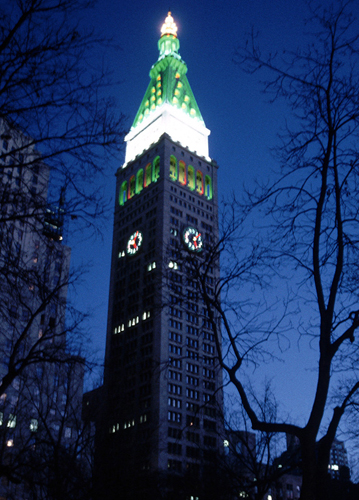
Metropolitan Life Tower
This
54-story tower, built along the east side of Madison Square in 1909,
was the world’s tallest building at that time, an appropriate corporate
symbol for the world’s largest insurance company. Designed by Napoleon
Le Brun and Sons, the tower follows the form of the campanile in the
Piazza San Marco in Venice. Although it was altered in the 1960s, when
the entire structure was renovated, the ornate four-faced clock and
crowning cupola remain, a familiar landmark on the New York skyline.1 Madison Ave, near 24th St
Open during office hours
Free

Metropolitan Life Tower
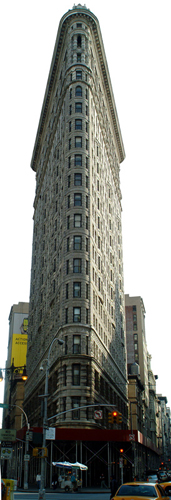
Flatiron Building
Though
dwarfed by countless taller structures today, this unusual building –
its shape conforming to a triangular plot of land – remains striking, a
symbol of the beginning of the skyscraper era. Its slim, rounded façade
is as proud as a ship’s prow sailing up the avenue. Completed in 1902,
it anchored the north end of the prestigious Ladies’ Mile shopping
district, located between Union and Madison squares. The designer,
famous Chicago architect Daniel Burnham, included detailed Italian
Renaissance decoration on the building from top to bottom, much of it in
terracotta.175 5th Ave at Broadway & 23rd St
Open office hours
Free

Flatiron Building
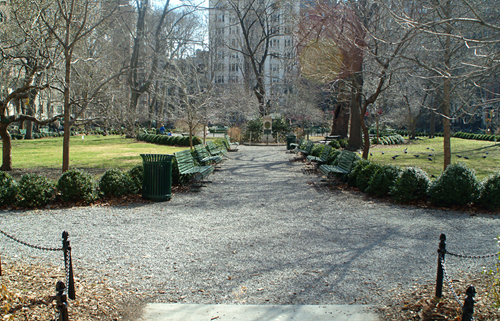
Gramercy Park
Samuel
Ruggles laid out this neighborhood around a private park in the 1830s.
It remains the city’s only private park and a desirable place to live.
Stanford White remodeled No. 16 in 1888 for Edwin Booth, who founded the
Players Club here. His statue stands in the park (see Edwin Booth as Hamlet).Lexington Ave, between 20th & 21st Sts
Closed to public

Gramercy Park

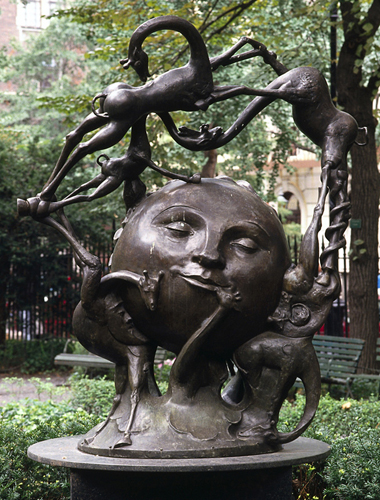
Fantasy Fountain, Greg Wyatt, Gramercy Park
National Arts Club
Originally the home of Samuel Tilden, a governor of New York and opponent of the notorious Boss Tweed.
The Gothic Revival brownstone was designed by Calvert Vaux, of Central
Park fame. The National Arts Club, whose members have included leading
American artists since the 1800s, bought the building in 1906. Each
member is asked to donate a work to the club. Its galleries are open to
the public.15 Gramercy Park South

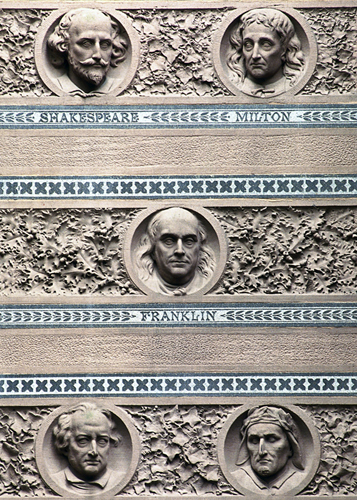
Writers’ faces, National Arts Club
69th Regiment Armory
This
Beaux Arts building was used as the drill hall and offices of a
military unit privately formed in 1848. In 1913, the controversial
exhibition of modern art known as the Armory Show was held here,
including works by Van Gogh, Duchamp, and Brancusi. The show was widely
panned in the press, but it brought modern art to New York on a large
scale and had a profound and lasting effect on American art.Lexington Ave, between 25th & 26th Sts
Closed to public
“Curry Hill”
Despite
changes around it, this three-block corridor just south of Murray Hill
remains filled with Indian shops selling saris and gifts, and is lined
with restaurants that are a boon for diners (particularly vegetarians)
in search of interesting food at reasonable prices. Kalustyan’s, 123
Lexington Avenue, is a treasure trove of fragrant spices and grains and
features some 31 different kinds of rice.Lexington Ave, between 26th & 29th Sts