Two of Paris’s best-known
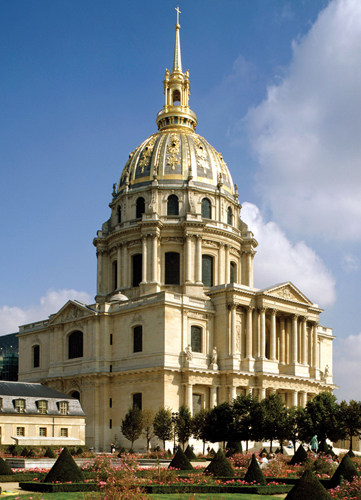
landmarks, the golden-domed Hôtel des Invalides and the Eiffel Tower,
are found in these quarters. Large parts of the area were created in the
19th century, when there was still room to construct wide avenues and
grassy esplanades. To the east of the Invalides are numerous stately
mansions now converted into embassies, and the French parliament. Jean
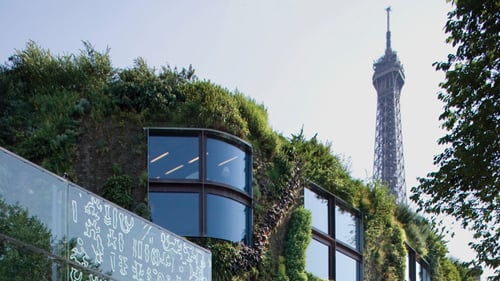
Nouvel’s Musée du Quai Branly is a striking feature beside the Seine.
Young NapoleonThe most famous alumnus of the Ecole Militaire |
Sights
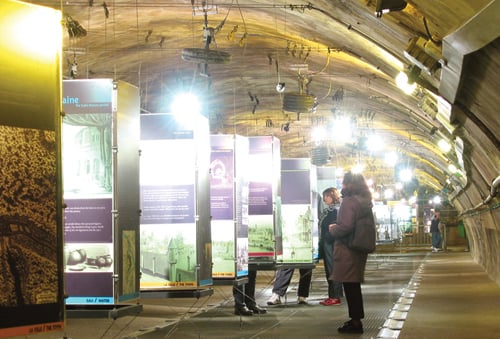
Les Egouts
In a city of glamour and grandeur, the sewers (egouts) of Paris are an incongruously popular attraction. They date from the Second Empire
(1851–70), when Baron Haussmann was transforming the city. The sewers,
which helped to sanitize and ventilate Paris, are considered one of his
finest achievements. Most of the work was done by an engineer named
Belgrand. The 2,100-km (1,300-mile) network covers the area from Les
Halles to La Villette – if laid end-to-end the sewers would stretch from
Paris to Istanbul. An hour-long tour includes a walk through some of
the tunnels, where you’ll see water pipes and various cables. The Paris
Sewers Museum, which is situated in the sewers beneath the Quai d’Orsay
on the Left Bank, tells the story of the city’s water and sewers, from
their beginnings to the present day. There is an audio-visual show and a
museum shop.Face au 93, quai d’Orsay, 75007
Open May–Sep: 11am–5pm Sat–Wed; Oct–Apr: 11am–4pm Sat–Wed
Closed two weeks mid-Jan
Admission charge

Musée de l’Armée
The
Army Museum contains one of the largest and most comprehensive
collections of arms, armour and displays on military history in the
world. There are weapons ranging from pre-historic times to the end of
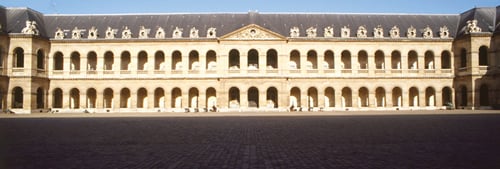
World War II, representing countries around the world. Housed in the
Hôtel des Invalides, the galleries occupy the old refectories in two
wings on either side of the courtyard. The museum ticket includes entry
to the Musée des Plans-Reliefs, the Historial Charles de Gaulle, the
Musée de L’Ordre de la Liberation and Napoleon’s Tomb (see Musée de l’Armée Exhibits).Hôtel des Invalides, 75007
Open 10am–6pm Wed–Mon, (until 9pm Tue & 5pm in winter)
Closed 1st Mon of month (except Jul–Sep), public hols
Admission charge

Musée de l’Armée
Musée Rodin
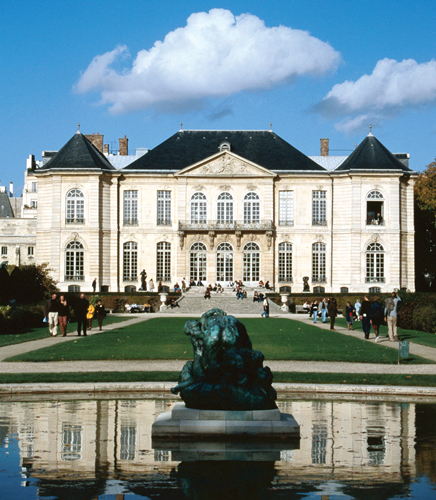
An
impressive collection of works by the sculptor and artist Auguste Rodin
(1840–1917) is housed in a splendid 18th-century mansion, the Hôtel Biron,
where he spent the last nine years of his life. The rooms display his
works roughly chronologically, including his sketches and watercolours.
Masterpieces such as The Kiss and Eve
are displayed in the airy rotundas. One room is devoted to works by his
talented model and muse, Camille Claudel, and Rodin’s personal
collection of paintings by Van Gogh, Monet and other masters hang on the
walls. The museum’s other highlight is the gardens, the third-largest
private gardens in Paris, where famous works such as Balzac and The Gates of Hell stand among the lime trees and rose bushes.79 rue de Varenne, 75007
Open 9:30am–5:45pm Tue–Sun (until 4:45pm in winter), gardens open one hour later
Admission charge

Musée Rodin
Musée du Quai Branly
The
aim of this museum is to showcase the arts of Africa, Asia, Oceania and
the Americas. The collection boasts nearly 300,000 artifacts, including
a fantastic array of African instruments, Gabonese masks, Aztec statues
and 17th-century painted animal hides from North America (once the
pride of the French royal family). Designed by Jean Nouvel, the building
is an exhibit in itself: glass is ingeniously used to allow the
surrounding greenery to act as a natural backdrop to the collection.37 quai Branly, 75007
Open 11am–7pm Tue–Sun (until 9pm Thu–Sat)
Admission charge
Rue Cler
The
cobblestone pedestrianized road that stretches south of rue de Grenelle
to avenue de La Motte-Picquet is the most exclusive street market in
Paris. Here greengrocers, fishmongers, butchers, and wine merchants sell
top-quality produce to the well-heeled residents of the area. Tear
yourself away from the mouth-watering cheeses and pastries, however, to
feast your eyes on the Art Nouveau buildings at Nos. 33 and 151.Ecole Militaire
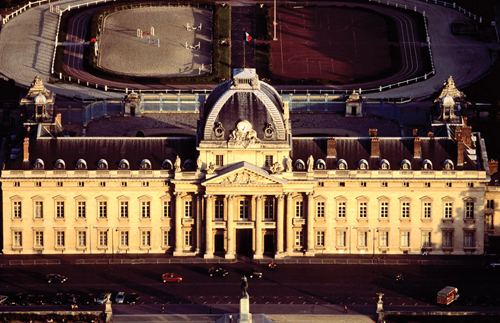
At
the urging of his mistress Madame Pompadour, Louis XV approved the
building of the Royal Military Academy in 1751. Although its purpose was
to educate the sons of impoverished officers, a grand edifice was
designed by Jacques-Ange Gabriel, architect of the place de la Concorde
and the Petit Trianon at Versailles, and completed in 1773. The central
pavilion with its quadrangular dome and Corinthian pillars is a
splendid example of the French Classical style.1 pl Joffre, 75007
Open to the public by special permission only (apply in writing)

UNESCO
The
headquarters of the United Nations Educational, Scientific and Cultural
Organization (UNESCO) were built in 1958 by an international team of
architects from France (Zehrfuss), Italy (Nervi) and the United States
(Breuer). Their Y-shaped building of concrete and glass may be
unremarkable, but inside the showcase of 20th-century art by renowned
international artists is well worth a visit. There is a huge mural by
Picasso, ceramics by Joan Miró, and a 2nd-century mosaic from El Djem in
Tunisia. Outside is a giant mobile by Alexander Calder and a peaceful
Japanese garden.7 pl de Fontenoy, 75007
01 45 68 10 00
By appointment only
Free
Assemblée Nationale
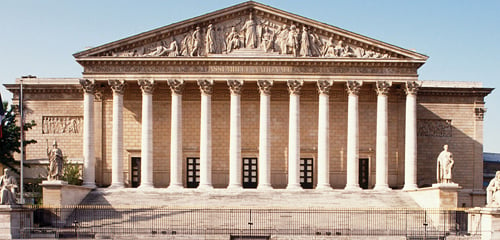
Built
for the daughter of Louis XIV in 1722, the Palais Bourbon has housed
the lower house of the French parliament since 1827. The Council of the
Five Hundred met here during the Revolution, and it was the headquarters
of the German Occupation during World War II. Napoleon added the
Classical riverfront façade in 1806 to complement La Madeleine across the river.33 Quai d’Orsay, 75007
Open for tours only (identity papers compulsory) 10am, 2pm, 3pm Sat, except public hols and when parliament is in session
Free