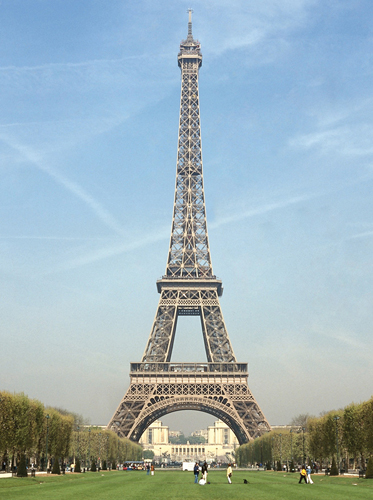
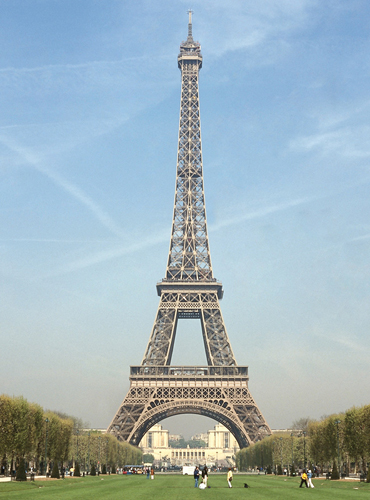
The most distinctive symbol of Paris, the Eiffel
Tower (Tour Eiffel) was much maligned by critics when it rose on the
city’s skyline in 1889 as part of the Universal Exhibition, but its
graceful symmetry soon made it the star attraction. At 312 m (1,023 ft)
high, it was the world’s tallest building until it was surpassed by New
York’s Empire State Building in 1931. Despite its delicate appearance,
it weighs 10,100 metric tons and engineer Gustave Eiffel’s construction
was so sound that it never sways more than 9 cm (3.5 in) in strong
winds.
Champ-de-Mars, 7e 01 44 11 23 23
www.tour-eiffel.com
Open: Lift
9:30am–11:45pm daily (last adm for top: 10:30pm) (mid-Jun–1 Sep:
9am–12:45am; last adm for top: 11pm); Stairs 9:30am –6:30pm daily
(mid-Jul–1 Sep: 9am–12:45am; last adm mid-night) Admission: €4.00 (stairs); €4.50–€11.50 (lift, depending on level) Disabled access first and second levels only
|
Born in Dijon, Gustave
Eiffel (1832–1923) was an engineer and builder who made his name
building bridges and viaducts. Eiffel was famous for the graceful
designs and master craftsmanship of his wrought-iron constructions. He
once remarked that his famous tower was “formed by the wind itself”. In
1890 he became immersed in the study of aerodynamics, and kept an office
in the tower until his death, using it for experiments. In 1889, when
the Eiffel Tower was erected, its creator was awarded the Légion
d’Honneur for the achievement. |
There are restaurants and snack bars on levels 1 and 2, plus food kiosks around the base. |
|
Beat the queues by booking your visit in advance either by phone or online. |
|
Top 10 Features
Viewing Gallery
At
276 m (906 ft), the view is stupendous from the third-level viewing
gallery, stretching for 80 km (50 miles) on a clear day. You can also
see Gustave Eiffel’s sitting room on this level.

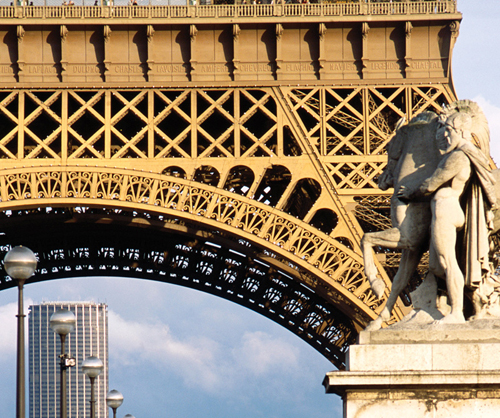
Ironwork
The
complex pattern of the girders, held together by 2.5 million rivets,
stabilizes the tower in high winds. The 18,000 metal parts can expand up
to 15 cm (6 in) on hot days.

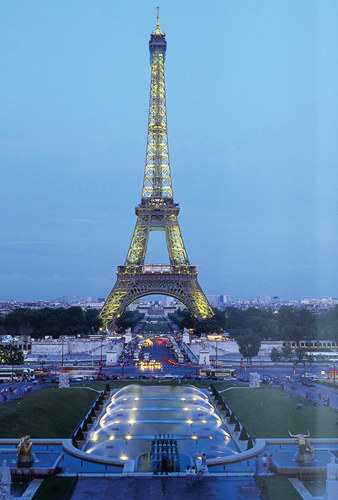
Lighting
A
292,000-watt lighting system makes the Eiffel Tower the most
spectacular night-time sight in Paris. Illuminated for 5 minutes every
hour, it sparkles like a giant Christmas tree.

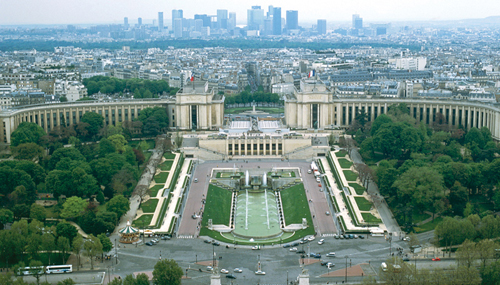
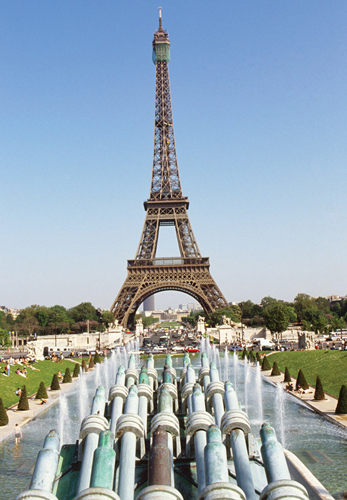
View from the Trocadéro
Day or night, the best approach for a first-time view of the tower is from the Trocadéro, which affords a monumental vista from the terrace across the Seine.

Eiffel Tower from the Trocadéro
Cineiffel
Located
on the first level, this small display tells the history of the tower
through an audiovisual show. It includes footage of famous visitors to
the tower, from Charlie Chaplin to Adolf Hitler.
First Level
You
can walk the 345 steps to the 57 m (187 ft) high first level, or jump
the lift queue by booking a table at the restaurant 58, Tour Eiffel on
level 1. Mail your postcards at the post office.

Second Level
At 115 m (377 ft) high, this is the location of the Jules Verne Restaurant, one of the finest in Paris for both food and views. It is reached by a private lift in the south pillar.

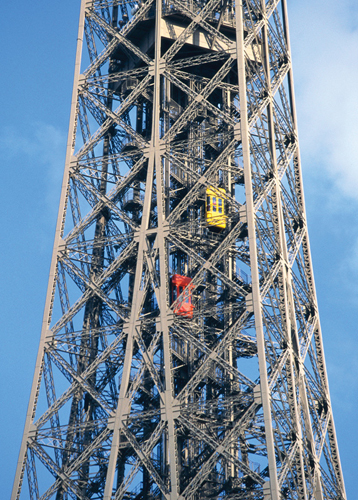
Hydraulic Lift Mechanism
The
1899 lift mechanism is still in operation and travels some 100,000 km
(62,000 miles) a year. The uniformed guard clinging to the outside is a
model.

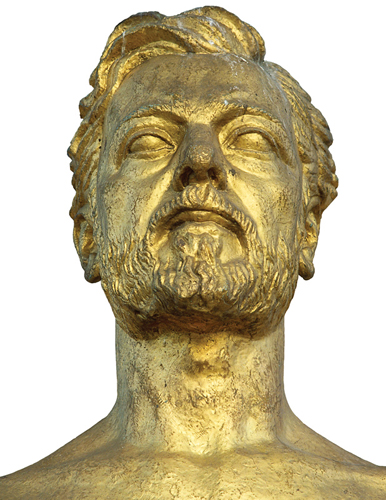
Bust of Gustave Eiffel
This
bust of the tower’s creator, by Antoine Bourdelle, was placed below his
remarkable achievement, by the north pillar, in 1929.

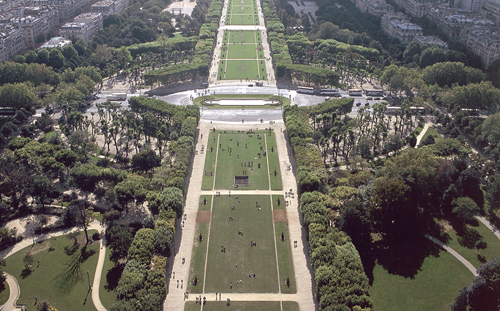
Champ-de-Mars
The long gardens of this former parade ground stretch from the base of the tower to the École Militaire (military school).