Les Misérables
The
1862 novel by Victor Hugo (1802–85) is an all-too-vivid portrayal of
the poor and the dispossessed in early 19th-century Paris. At its centre
is the tale of nobleman Jean Valjean, unfairly victimized by an unjust
system. The younger character of Marius is based around Hugo’s own
experiences as an impoverished student.

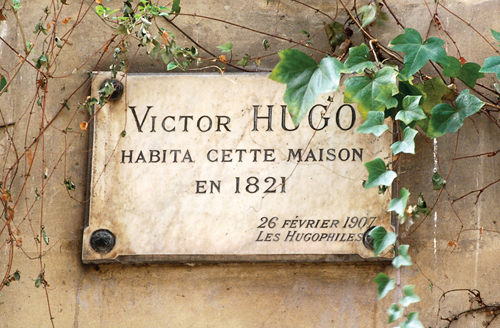
Plaque on Victor Hugo’s house
The Hunchback of Notre-Dame
Better
known by its English title, which inspired a film of the same name,
Victor Hugo’s Gothic novel was published in France in 1831 as Notre-Dame de Paris.
Set in the Middle Ages, it tells the strange and moving story of a
hunchback bell-ringer Quasimodo and his love for Esmeralda .Gustave
Flaubert (1821–80) studied law in Paris but illness disrupted his
chosen career and he devoted himself to literature. This work (L’education sentimentale in French), first published in 1870 in two volumes, stands alongside his greatest novel, Madame Bovary (1857), and marks the move from Romanticism to Realism in French literature.A la Recherche du Temps Perdu
The
master work of Marcel Proust (1871–1922) was written in 13 volumes, the
first novel appearing in 1913. Proust lived on boulevard Haussmann, and
his epic tale is the fictionalized story of his own life, and of Paris
during the belle époque. Proust is buried in Père Lachaise cemetery in eastern Paris.Nana
Perhaps
the greatest Parisian chronicler of them all, Emile Zola (1840–1902)
was born, lived and died in the city, although he spent part of his
youth in Aix-en-Provence in southern France. Nana
was published in 1880 and tells a shocking tale of sexual decadence,
through the eyes of the central character, a dancer and prostitute.L’Assommoir
Published in 1887, Zola’s L’Assommoir
(The Drunkard) shows a side of Paris that many at the time would have
preferred to ignore – the alcoholism of the working classes. It is one
of the author’s series of 20 linked books known as the Rougon-Macquart sequence, which depict life in every quarter of society, through the eyes of two branches of the same family.Thérèse Raquin
Here
Zola focuses on the secret passions that lurk behind a single Paris
shopfront, opening up to reveal a tale of obsessive lust that ultimately
leads to a brutal murder. It was published in 1867 and, only his second
novel, shows the author’s astonishing maturity and unflinching
examination of all aspects of 19th-century life.