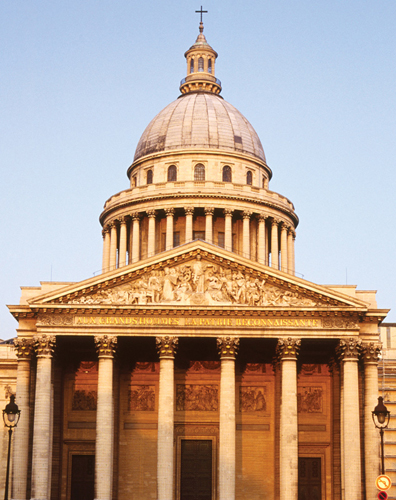
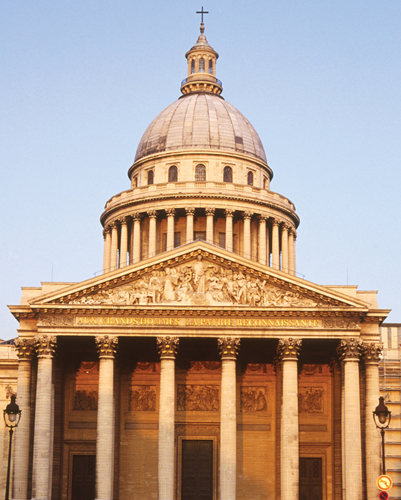
Today Paris’s beautiful Panthéon building is a
fitting final resting place for the nation’s great figures. However, it
was originally built as a church, on the instigation of Louis XV to
celebrate his recovery from a serious bout of gout in 1744. Dedicated to
Sainte Geneviève, the structure was finished in 1790 and was intended
to look like the Pantheon in Rome, hence the name; in fact it more
closely resembles St Paul’s Cathedral in London. During the Revolution
it was turned into a mausoleum, but Napoleon gave it back to the church
in 1806. It was later deconsecrated, handed back to the church once
more, before finally becoming a public building in 1885.
Place du Panthéon, 75005 01 44 32 18 00 Open Apr–Sep 10am– 6:30pm daily; Oct–Mar 10am–6pm daily. Closed 1 Jan, 1 May, 25 Dec. €7.50 (under 25s €4.80, under 18s free) Disabled access to main floor only
|
One of the most
influential citizens to be buried in the Panthéon is Louis Braille. Born
in France in 1809, Braille became blind at the age of three; at nine he
attended the National Institute for the Young Blind in Paris and proved
to be a gifted student. He continued at the Institute as a teacher and,
in 1829, had the idea of adapting a coding system in use by the army,
by turning words and letters into raised dots on card. Reading braille
transformed the lives of blind people forever. Its inventor died in
1852. |
Crêpes à Gogo ( , ) 12 rue Soufflot open 7am–11pm
is an ideal pit stop for a crêpe, coffee and an ice-cream. |
|
Ticket sales stop 45 minutes before closing time, so arrive on time. |
|
Top 10 Features
Dome
Inspired by Sir Christopher Wren’s design of St Paul’s Cathedral in London, as well as by the Dôme Church at Les Invalides, this iron-framed dome
is made up of three layers. At the top a narrow opening only lets in a
tiny amount of natural light, in keeping with the building’s sombre
purpose.


Dome Galleries
A
staircase leads to the galleries immediately below the dome, affording
spectacular 360-degree panoramic views of Paris. The pillars surrounding
the galleries are both decorative and functional, providing essential
support for the dome.
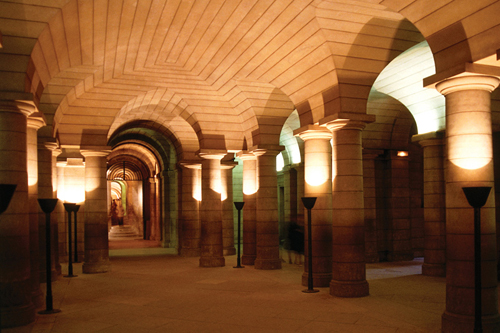
Crypt
The
crypt is eerily impressive in its scale compared to most tiny, dark
church crypts. Here lie the tombs and memorials to French citizens
deemed worthy of burial here, including the prolific French writer Emile
Zola .

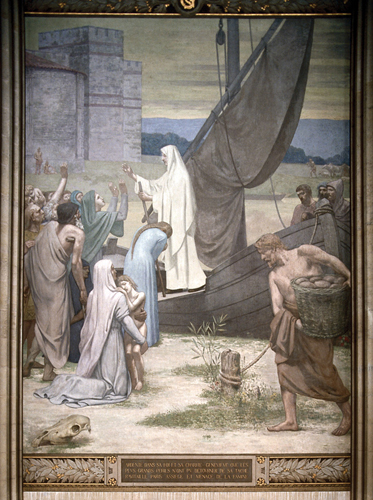
Frescoes of Sainte Geneviève
Delicate
murals by 19th-century artist Pierre Puvis de Chavannes, on the south
wall of the nave, tell the story of Sainte Geneviève, the patron saint
of Paris. In 451 she is believed to have saved the city from invasion by
the barbaric Attila the Hun and his hordes due to the power of her
prayers.

Foucault’s Pendulum
In
1851 French physicist Jean Foucault (1819–68) followed up an earlier
experiment to prove the earth’s rotation by hanging his famous pendulum
from the dome of the Panthéon. The plane of the pendulum’s swing rotated
11° clockwise each hour in relation to the floor, thereby proving
Foucault’s theory.
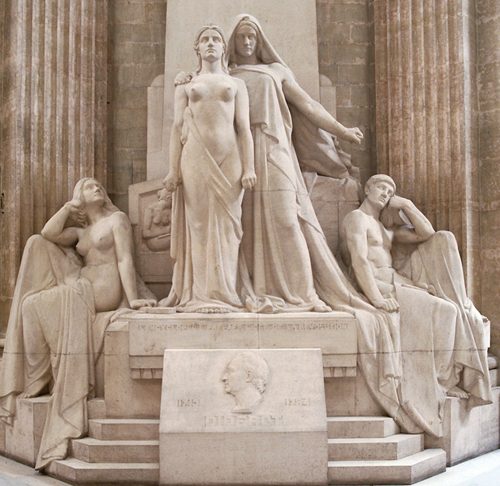
Monument to Diderot
French philosopher Denis Diderot (1713– 84) is honoured by this grand 1925 monument by Alphonse Terroir.

Façade
The Panthéon’s façade was inspired by Roman design. The 22 Corinthian columns support both the portico roof and bas-reliefs.

Panthéon façade
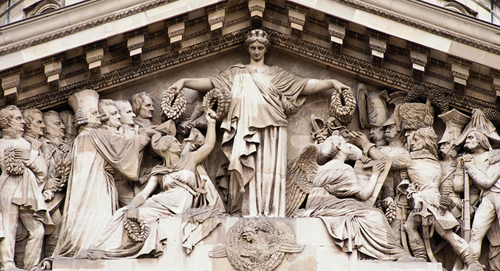
Pediment Relief
The bas-relief
above the entrance shows a female figure, representing France, handing
out laurels to the great men of the nation – the same way that Greeks
and Romans honoured their heroes.

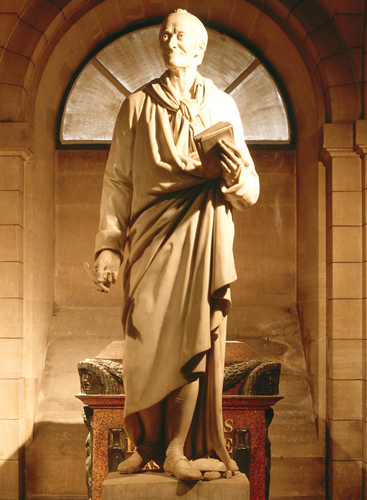
Tomb of Voltaire
A statue of the great writer, wit and philosopher Voltaire (1694– 1788) stands in front of his tomb.

Tomb of Victor Hugo
The body of the French author was carried to the Panthéon in a pauper’s hearse, at his own request.